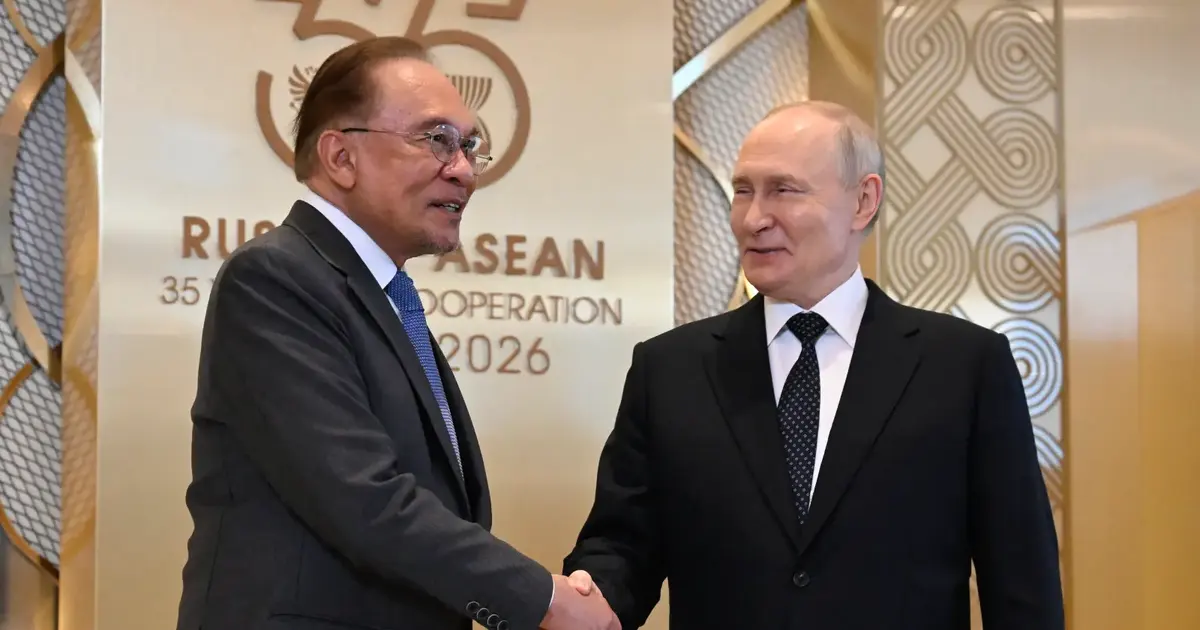
Prime Minister Anwar Ibrahim has announced a significant long-term energy commitment from Russian President Vladimir Putin, securing Malaysia's petroleum and gas supplies through the next two decades. The assurance represents a strategic anchor for the country's energy security at a time when global supply chains face mounting uncertainty and geopolitical tensions. Such multilateral arrangements underscore Malaysia's pragmatic approach to diversifying its energy partnerships beyond traditional regional sources, positioning the nation to navigate volatile international energy markets with greater stability.
The agreement with Russia addresses one of Malaysia's core economic vulnerabilities. As a country with substantial industrial and consumer energy demands, Malaysia has historically balanced imports with domestic production from its own oil and gas reserves. However, long-term supply agreements with major producers like Russia provide predictability for manufacturing sectors, power generation, and petrochemical industries that depend on affordable, reliable energy inputs. The 20-year horizon is particularly significant, as it allows Malaysian businesses to plan capital investments and operational strategies with confidence in their energy cost structures.
Russia's willingness to commit to extended supply relationships with Southeast Asian nations reflects Moscow's broader strategy to strengthen economic ties in the region amid international sanctions related to its actions in Ukraine. For Malaysia, this represents an opportunity to leverage geopolitical dynamics while advancing its national interests. The timing of such assurances also comes when Malaysia seeks to balance relationships with Western nations and other global powers, maintaining its traditionally non-aligned foreign policy stance.
Beyond energy security, Anwar Ibrahim's diplomatic engagement encompasses a wider economic vision for Malaysia. The Prime Minister has signalled intentions to expand Malaysian exports into three of Asia's largest and most economically dynamic markets: China, Japan, and South Korea. These three economies collectively represent enormous consumption capacity and represent crucial partners for Malaysian manufacturers seeking growth pathways. Chinese demand for Malaysian commodities, Japanese technological partnerships, and South Korean investment in Malaysian manufacturing and technology sectors all offer complementary opportunities for economic diversification.
Anwar's reference to his Turkmenistan visit indicates a broader Central Asian strategy that extends beyond Russia. Turkmenistan, a major hydrocarbon producer in its own right, represents another potential energy supplier and trading partner for Malaysia. The Central Asian republic has historically been more isolated from Southeast Asian commerce, making targeted diplomatic outreach an astute move to establish new commercial corridors. Such engagement could position Malaysia as a bridge between Central Asian resources and Asian-Pacific markets, creating value-added opportunities for Malaysian logistics, finance, and trading sectors.
The pursuit of expanded export markets reflects Malaysia's recognition that domestic demand alone cannot sustain economic growth rates necessary for rising living standards and employment creation. Manufacturing exports to China, Japan, and South Korea could encompass semiconductors and electronics, where Malaysia maintains competitive advantages, as well as palm oil and agricultural products where the nation has established production capacity. South Korean conglomerates, in particular, have shown interest in expanding operations across Southeast Asia, and improved bilateral relations could facilitate joint ventures and technology transfers beneficial to Malaysian industry.
Energy cost stability contributes directly to Malaysia's export competitiveness. Manufacturing sectors that consume significant electricity and fuel—such as petrochemicals, refining, and heavy industries—benefit substantially from predictable long-term energy pricing. When energy costs remain subject to volatile international markets, these sectors lose competitive advantage in pricing their final products. The Russian supply guarantee thus indirectly supports Malaysia's export ambitions by reducing one critical variable in production cost calculations.
Regional context matters considerably here. Other Southeast Asian nations including Vietnam, Thailand, and Indonesia also maintain energy partnerships with Russia and other global suppliers. Malaysia's move to secure long-term agreements positions it competitively within ASEAN and reinforces its status as an economically significant power in the region. The diversification of energy sources also insulates Malaysia from over-dependence on any single supplier, reducing vulnerability to supply disruptions or politically motivated restrictions.
The diplomatic framework announced by Anwar Ibrahim represents practical economics meeting strategic pragmatism. Malaysia's geographic position, existing industrial infrastructure, and human capital make it an attractive hub for value-added manufacturing and regional trade. Securing stable energy inputs removes a constraint on realising this potential. Simultaneously, Anwar's emphasis on Asian export markets demonstrates understanding that Malaysia's future prosperity depends on integration with high-growth economies rather than reliance on commodity exports alone.
Energy security agreements often operate beneath headlines but substantially influence long-term economic trajectories. For a nation like Malaysia with manufacturing ambitions and export-led growth aspirations, knowing that energy supplies will remain available and prices relatively predictable over two decades allows strategic planning that might otherwise seem impossible. The Putin assurance thus provides more than mere energy security—it offers Malaysian policymakers and business leaders the confidence to commit resources to expansion, technology adoption, and workforce development with greater certainty about fundamental input costs.