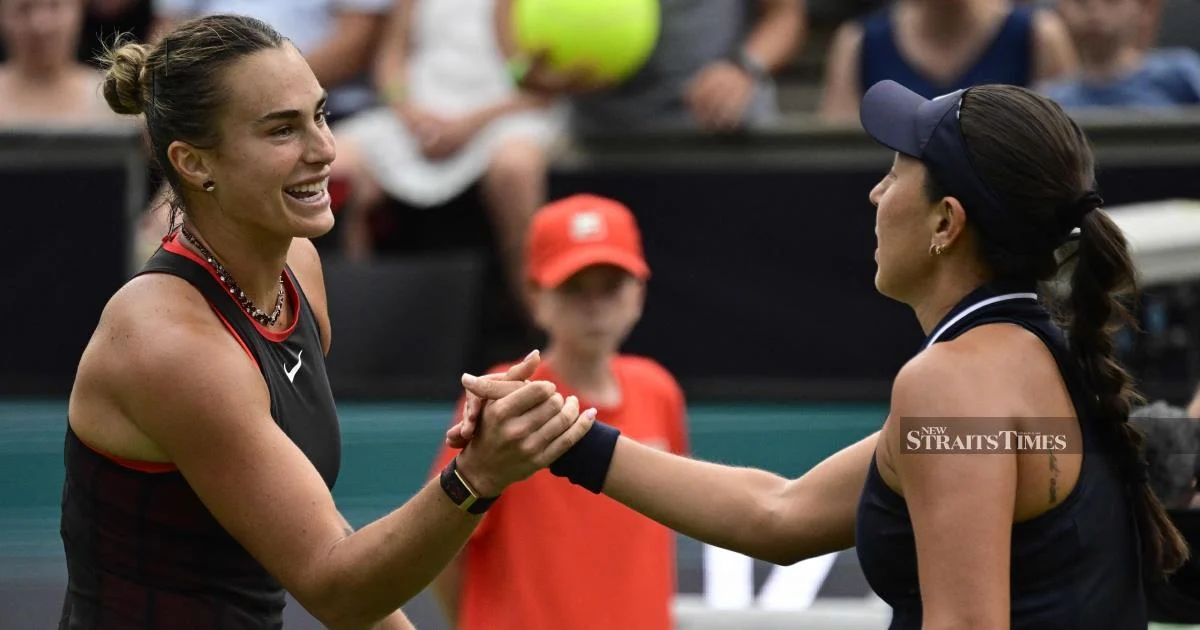
American tennis star Jessica Pegula has secured a spot in the Berlin WTA final after a commanding display against world number one Aryna Sabalenka, defeating the Belarusian player with a three-set scoreline of 6-2, 6-7 (4-7), 6-0. The victory marks Pegula's second appearance in the championship match of this prestigious grass-court tournament, demonstrating her growing prowess on surfaces that demand quick reflexes and aggressive shot-making.
The semi-final encounter on the grass courts of Berlin unfolded into a compelling contest, though the narrative shifted markedly as the match progressed. Sabalenka, who holds the top ranking in women's tennis, found herself outplayed in crucial phases, particularly in the opening and closing sets where Pegula's control proved decisive. The opening set saw Pegula establish her rhythm early, breaking serve and consolidating her lead to claim the first six games decisively, suggesting she had come prepared for a statement performance.
Sabalenka mounted a more determined challenge in the second set, where the match tightened considerably. The competitive nature of this frame was reflected in its conclusion, with both players fighting through a demanding tie-break that stretched to seven points. Though Sabalenka captured the tie-break 7-4, the mental toll of the extended second set appeared to drain resources from the world number one as the final set approached. This represents a common pattern in professional tennis, where psychological momentum frequently shifts after closely contested frames.
The third set proved absolutely one-sided, with Pegula implementing flawless tennis to complete her passage to the final. A scoreline of 6-0 in the final frame indicates complete control, with Pegula breaking Sabalenka's serve multiple times without losing her own delivery game. Such dominant performances in closing sets often signal a player's superior conditioning and mental fortitude in crucial moments—qualities that will serve Pegula well in her pursuit of the Berlin title.
Grass-court tennis in Europe during the summer swing represents a unique challenge distinct from the hard courts and clay surfaces that dominate much of the professional calendar. The Berlin tournament sits in a particularly strategic position within the women's tennis calendar, occurring as players prepare for the grass-court season's climax at Wimbledon. For Pegula, reaching the final here reinforces her growing credentials on this surface type, a development that could prove significant for her ambitions at the All England Club later in the season.
Pegula's path to the Berlin final also carries broader implications for the competitive balance in women's tennis. Her ability to overcome Sabalenka, the player widely regarded as the most dominant force in the women's game, suggests that the elite level remains dynamic and competitive. The Belarusian player's dominance in recent months has been formidable, making Pegula's victory a notable achievement that reinforces the quality of the American contingent in international tennis.
From a Southeast Asian perspective, the Berlin tournament maintains relevance as a benchmark for global competition standards. Malaysian and regional players continually study the tactics and strategies employed by top-ranked competitors to refine their own approaches. Pegula's victory demonstrates the importance of surface-specific preparation and mental resilience—lessons applicable across the professional tennis landscape.
Pegula's previous appearance in this Berlin final provides her with experiential advantage as she prepares for her championship match. Having navigated the tournament structure once before, she understands the particular demands of the competition and the mental requirements of competing for a title at this level. The American player has steadily built her ranking and reputation, and performances like this semi-final victory contribute meaningfully to her credentials as a consistent threat at major tournaments.
The implications of this result extend to the broader women's tennis rankings and qualification scenarios. As the season progresses toward its conclusion, victories over top-ranked players provide significant ranking points and credibility. For Pegula, this win represents confirmation of her status among the sport's elite competitors, a position she has worked consistently to establish over recent seasons.
Sabalenka's exit, while disappointing, reflects the inherent unpredictability of professional tennis even at its highest levels. The world number one remains a formidable competitor, and a single tournament result rarely diminishes the consistent excellence she has demonstrated across multiple surfaces and competitions throughout the season.