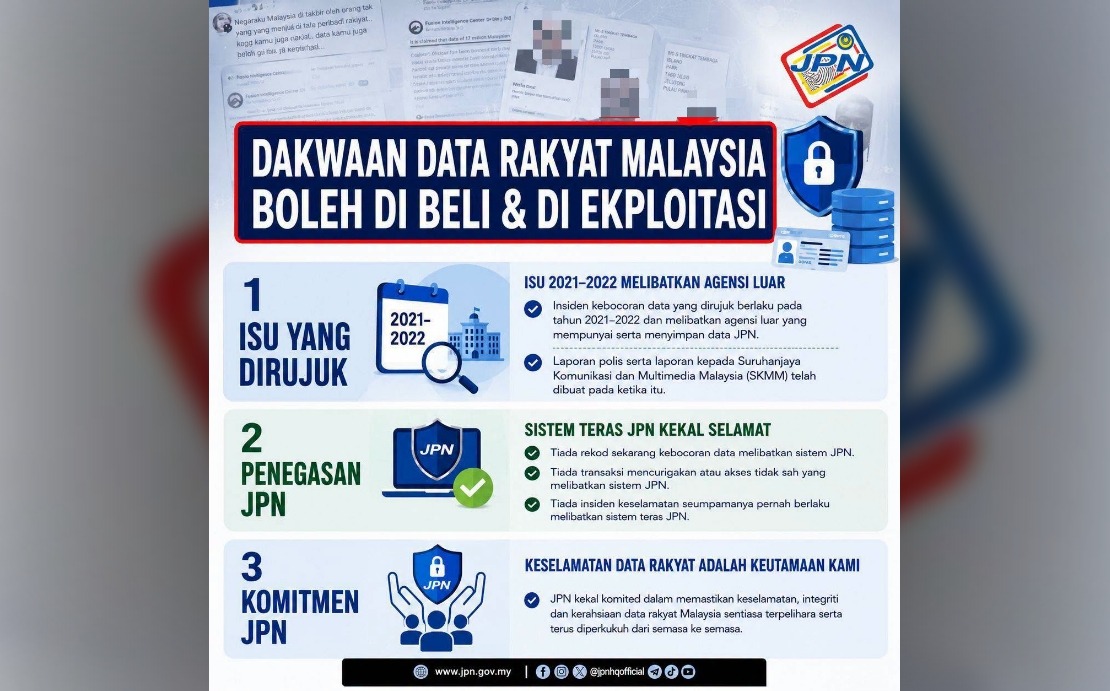
The National Security Council (MKN) has moved to dispel growing concerns about a data leak spreading across social media platforms, attributing the incident to historical cybersecurity breaches that occurred well before 2022. Through the National Cyber Security Agency (NACSA), the council stated that personal information now being shared online without permission originated from unlawful cyber intrusions targeting various computer systems years ago, and is being deliberately redistributed through unauthorised channels.
This distinction carries significant weight for Malaysian users concerned about the security of their current digital footprint. The council's clarification suggests that those circulating the leaked data obtained it through earlier system compromises rather than exploiting vulnerabilities in modern infrastructure. However, the timing of the redistribution raises questions about why historical breaches are resurfacing now and what has motivated the renewed dissemination of this material across social networks.
The legal implications of accessing or sharing such data cannot be overstated. NACSA emphasised that even though some hosting services may operate from outside Malaysia, individuals and entities involved in providing, distributing, or enabling access to unlawfully obtained information face criminal liability under Malaysian law. This underscores the government's determination to prosecute anyone benefiting from or perpetuating the spread of stolen data, regardless of where servers are physically located.
To contain the breach, NACSA has mobilised immediate response measures in coordination with MyNIC and the Personal Data Protection Department. These agencies have engaged overseas service providers to identify and remove affected websites and block public access to compromised information. The swift action reflects the seriousness with which authorities are treating the matter, even as they reassure the public that the breach does not represent a failure of current security frameworks.
Parallel to removal efforts, the Royal Malaysia Police is conducting digital forensic investigations to trace the individuals responsible for both the original intrusions and the recent redistribution campaign. These investigations aim to gather evidence sufficient for prosecution, sending a signal to potential cybercriminals that involvement in data theft and unauthorised distribution carries substantial legal risk. The coordination between civilian and law enforcement agencies demonstrates a comprehensive approach to addressing the broader ecosystem of cyber crimes.
MKN has also issued guidance discouraging Malaysians from engaging with services offering unlawfully obtained data. Beyond the legal jeopardy, such engagement fuels the market for stolen information and encourages future breaches. Public participation in circumventing data security, whether through curiosity or malice, directly enables the perpetuation of cybercrime and undermines national efforts to build a safer digital environment for all citizens.
The incident has become a catalyst for advancing Malaysia's legislative framework on cybersecurity. The forthcoming Cyber Crime Bill, scheduled for parliamentary tabling, introduces substantially strengthened provisions addressing contemporary threats. The bill specifically criminalises unauthorised access to computer systems and programmes without legitimate authority, closing gaps in current law. Additionally, it defines identity theft—the fraudulent use of another person's identity to commit crimes—as a distinct offence with dedicated penalties, a crucial addition given the nature of the leaked personal data.
Complementing legislative efforts is the Cyber Security Act 2024, which entered force in August 2024. This law mandates that operators of National Critical Information Infrastructure implement rigorous protection measures. Organisations now face mandatory compliance with approved codes of practice, must conduct systematic risk assessments, and are required to undergo regular security audits. These structural requirements aim to embed cybersecurity into the operational culture of entities handling sensitive national systems, making breaches inherently harder to achieve.
MKN has specifically addressed public concerns regarding MyDigital ID, clarifying a frequent misunderstanding. With over 16 million registrations, MyDigital ID does not function as a centralised personal data repository. Instead, it operates as an identity verification platform that authenticates users directly through the National Registration Department. This architecture means the system verifies identity without storing sensitive personal information in a vulnerable database, fundamentally limiting the potential damage from any breach of the MyDigital ID system itself.
The widespread integration of MyDigital ID across government and private sector services—including telecommunications, banking, and administrative applications—represents a strategic shift toward reducing identity theft through robust verification mechanisms. As adoption broadens, the platform's distributed verification model makes fraudulent identity use increasingly difficult for criminals, providing cumulative security benefits across the entire digital ecosystem rather than concentrating risk in any single system.
Beyond this specific incident, MKN has reaffirmed the government's commitment to ensuring that Malaysia's digital transformation benefits all citizens without compromising their security. The council has positioned NACSA as a ready responder to emerging cybersecurity threats, maintaining preparedness to detect and counter new attack vectors as they emerge. This forward-looking posture acknowledges that cybercriminals continuously evolve their methods and that static defences inevitably become obsolete.
For Malaysian businesses and individuals, the incident underscores an uncomfortable reality: historical breaches can resurface years later as attackers strategically time the release of stolen data for maximum impact or financial gain. This reality demands that Malaysians maintain vigilance regarding their digital footprint, update passwords regularly, monitor accounts for suspicious activity, and remain sceptical of unsolicited requests for personal information—practices that prove valuable even as government and private sector security infrastructure strengthens.