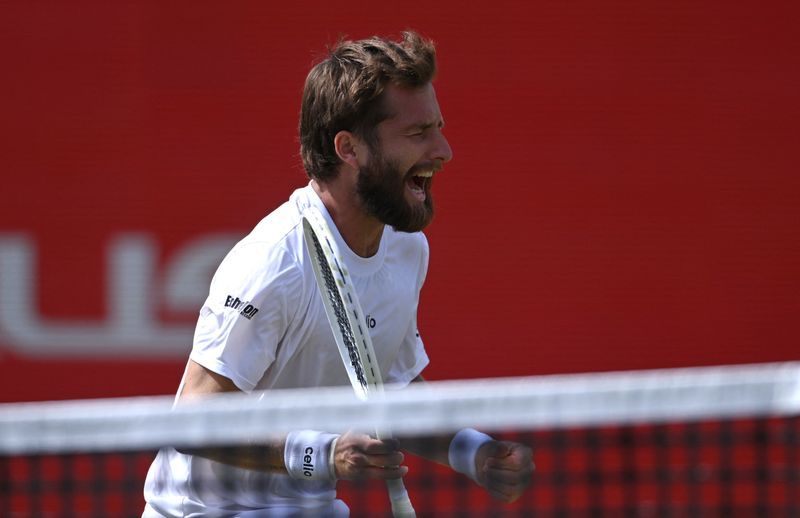
French tennis player Corentin Moutet's brief run at Queen's Club has ended not on the court but in the disciplinary office, with the ATP stripping him of nearly his entire tournament earnings following a public expletive-laden exchange with a BBC interviewer immediately after his opening-round victory. The 27-year-old world number 36 was issued a $40,000 fine for unsportsmanlike conduct following the incident, which occurred after his win over fellow Frenchman Giovanni Mpetshi Perricard at the prestigious London grass-court event in June.
Moutet's total earnings from the tournament amounted to $43,000 for reaching the second round, meaning the fine represents a catastrophic financial penalty that effectively wipes out his compensation for competing at one of tennis's marquee events. The ATP's decision underscores the sport's increasingly stringent approach to player conduct, particularly regarding language used in public forums where broadcasts reach millions of viewers worldwide. Though Moutet has filed an appeal against the ruling, the initial sanction sends a stark message about the professional standards expected at elite-level competitions.
The controversy erupted during the on-court interview that traditionally follows matches at Queen's Club. When asked about a particular moment in his victory, Moutet responded with an expletive, reportedly used to describe being aced on match point by a 142 miles-per-hour second serve. The interviewer immediately cautioned him against repeating the language, a request that went unheeded as Moutet uttered the same swear word three additional times before the BBC terminated the interview early and issued apologies to the watching crowd and television audience.
What might have ended as a momentary lapse in professionalism escalated when Moutet subsequently took to Instagram to characterize his behaviour as merely joking. This explanation failed to mollify tennis authorities, who viewed the repeated language and apparent flippancy about the incident as sufficiently serious to warrant substantial fines and prize money forfeiture. The decision reflects governing bodies' determination to maintain broadcast standards and protect the sport's image, particularly given that Queen's Club attracts significant international viewership and corporate sponsorship.
Moutet's disciplinary troubles extend well beyond this single incident, painting a picture of a talented but temperamentally inconsistent competitor. In 2022, he was defaulted from the Adelaide International for directing profanities at the umpire during a match against Serbia's Laslo Djere, an extreme sanction that removed him from the tournament entirely. That same year, the French Tennis Federation itself suspended his funding and support due to ongoing behavioural concerns, a dramatic intervention by his national federation that suggested institutional frustration with his conduct.
These repeated infractions raise questions about whether Moutet possesses the emotional discipline required to compete at the highest levels of professional tennis over an extended career. While raw talent has carried him to a respectable world ranking, the pattern of incidents suggests vulnerability to frustration and poor impulse control during high-pressure moments. For Malaysian and Southeast Asian tennis audiences, Moutet's struggles offer a cautionary tale about how quickly talent can be squandered without corresponding maturity and professionalism.
The Queen's Club episode also occurred during a tournament where Moutet failed to advance beyond the second round, losing to Spain's Alejandro Davidovich Fokina after his opening victory. This early exit meant that his earnings potential was already limited, making the fine's impact even more severe relative to what he actually earned from the event. For professional players operating on modest prize money at certain stages of their careers, such financial penalties carry genuine consequences for their ability to fund coaching staff, travel, and training facilities.
The incident highlights broader tensions within professional tennis regarding player conduct and broadcast standards. Tournament organizers, television networks, and sponsors increasingly expect athletes to maintain composure even in frustrating circumstances, recognizing that their behaviour reflects not only on themselves but on the sport as a whole. The ATP's enforcement of these expectations through substantial fines demonstrates institutional commitment to upholding professional standards, though critics occasionally argue that some penalties may be disproportionate to the infractions.
Moutet's appeal of the fine represents his opportunity to contest the ATP's interpretation of events and potentially argue for a reduced penalty. The outcome of that appeal may provide further clarity on the governing body's threshold for unsportsmanlike conduct fines and whether circumstances such as immediate remorse or first-time offences factor into penalty calculations. Regardless of the appeal outcome, the incident serves as a prominent reminder that even brief moments of poor judgment can carry significant financial and reputational consequences in modern professional sports.