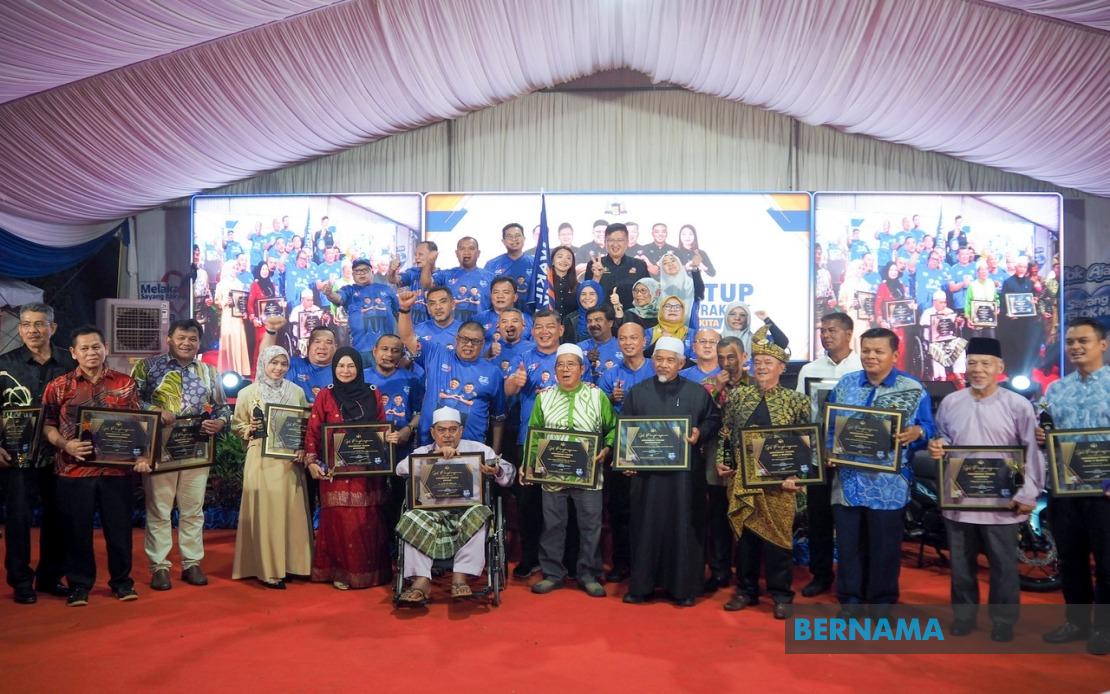
Melaka's state leadership has reframed how success should be evaluated for the Wakil Rakyat Untuk Rakyat (WRUR) Programme, signalling a shift in approach that prioritises tangible improvements in citizens' lives over the volume of initiatives deployed. Speaking at the closing ceremony of the programme for Kota Melaka parliamentary constituency in Telok Mas, Chief Minister Datuk Seri Ab Rauf Yusoh stressed that measuring achievement through the sheer number of programmes implemented misses the fundamental objective of addressing genuine community needs.
The WRUR initiative represents a bottom-up governance strategy aimed at capturing and resolving complaints at the constituency level, with the underlying principle that no resident should be overlooked based on their background or geographical location. This approach echoes broader regional trends in Southeast Asia where state governments are attempting to bridge the gap between administrative systems and citizen satisfaction through direct engagement mechanisms. By positioning the programme as a listening and problem-solving exercise rather than a showcase of government activity, Ab Rauf is effectively challenging the traditional metrics by which government effectiveness is measured.
The quantifiable results from WRUR's implementation across 19 state constituencies provide a concrete foundation for this argument. Since launch, the programme has collected approximately 4,027 complaints from members of the public, with 2,633 of these—representing more than 65 per cent—successfully resolved to date. These figures suggest that the complaint resolution pipeline is functioning at a reasonably efficient rate, though the outstanding backlog of roughly 1,400 cases indicates the scale of issues that communities face and the ongoing work required beyond programme timelines.
Kota Melaka marks the third parliamentary constituency within Melaka state to implement WRUR, following Alor Gajah and Hang Tuah Jaya. During its four-week operational period, the initiative generated activity across five state constituencies, with more than 500 programmes executed and over 200,000 residents reportedly benefiting. Within Kota Melaka specifically, 470 complaints were lodged during the implementation phase, with 31 fully resolved by the programme's conclusion and the remainder systematically prioritised for ongoing attention. The state leadership has committed to ensuring that all grievances remain under active review even after formal programme closure, tasking relevant agencies with continued monitoring and follow-through until residents perceive tangible outcomes.
This commitment to post-programme accountability reflects recognition within Melaka's government that citizen satisfaction depends on sustained action rather than ceremonial programme launches. The risk inherent in such community-driven initiatives is that they become one-off exercises that generate momentum temporarily before dissipating. By institutionalising oversight mechanisms and assigning agencies explicit responsibility for unresolved cases, the state is attempting to embed complaint resolution into regular administrative practice rather than treating it as a discrete campaign.
The Telok Mas state assemblyman, Datuk Abdul Razak Abdul Rahman, complemented the WRUR overview by detailing infrastructure and welfare achievements within his constituency over the preceding five years. A portfolio of 328 local development projects valued at nearly RM68 million has been distributed across 12 areas, encompassing road upgrades, river and drainage improvements, housing repairs and construction, and facility enhancements ranging from community halls to schools. This breadth of investment indicates sustained financial commitment to infrastructure development, though the per-project average cost appears modest, raising questions about scale and transformative potential in certain areas.
Welfare assistance programmes have extended to 6,098 Telok Mas residents since 2022, distributing food, welfare and health support exceeding RM1.2 million in value alongside 213 medical beds distributed to vulnerable households. The Jualan Rahmah and Jualan Murah initiatives, implemented across 70 series since 2022, have addressed cost-of-living pressures through subsidised goods programmes, while a Free Petrol Programme has provided fuel assistance to approximately 15,000 residents at a cost of RM177,000. In education, 1,694 secondary students preparing for their Sijil Pelajaran Malaysia examinations received support, and 255 high-achieving Form Five students and higher education institution attendees received educational incentives totalling RM244,200.
These programmes collectively suggest a multi-layered approach to constituent welfare, targeting immediate hardship through food and fuel assistance while simultaneously investing in human capital development through educational support. The allocation of resources across emergency relief and longer-term skill development indicates recognition that poverty and inequality operate along multiple dimensions requiring coordinated intervention. For Malaysian policymakers observing from other states, this model presents a potentially replicable framework, though its effectiveness ultimately depends on consistent funding availability and administrative capacity to execute programmes with quality and integrity.
Looking forward, the state has approved several tourism-focused development projects that may generate longer-term economic benefits. An allocation of RM2.4 million from the Ministry of Tourism, Arts and Culture will upgrade tourism facilities in Sungai Punggor and Alai, with completion projected for 2027. Additionally, RM300,000 has been designated for transforming Dataran Telok Mas into a centralised tourism and local products centre. The identification of Bukit Larang as a key geosite within the Melaka Geopark framework, with assessment for national recognition scheduled for October, suggests Melaka is positioning heritage and geological tourism as an economic development lever in a region increasingly reliant on such sectors.
These initiatives carry significance for Malaysia's broader tourism competitiveness within Southeast Asia, particularly as states compete to differentiate their offerings and attract both domestic and international visitors. The integration of geotourism, heritage preservation, and local enterprise development reflects evolving approaches to sustainable tourism that balance economic opportunity with cultural and environmental stewardship. For Melaka, a state with established historical tourism assets, leveraging geological heritage alongside existing attractions could broaden appeal and extend visitor engagement beyond conventional heritage zones.
The emphasis placed by Melaka's leadership on measuring WRUR success through impact rather than programme proliferation carries broader implications for governance philosophy in Malaysia. It suggests a recognition that citizen trust is built through demonstrated problem-solving capacity rather than the announcement of new initiatives. This mindset shift, if sustained across government machinery, could gradually reorient public administration towards accountability and efficacy. However, translating this principle into consistent practice across multiple agencies with varied institutional cultures and capacity levels remains a significant implementation challenge that Melaka will need to navigate carefully in coming months.