The Paris Vivatech festival has become a global stage for breakthrough technologies, with innovations on display this year spanning medicine, aviation, artificial intelligence, and sports science that could eventually reshape industries across Southeast Asia and beyond. Among the most compelling developments emerging from the three-floor exhibition space are solutions addressing longstanding challenges in orthopaedic surgery, urban logistics, digital fraud prevention, and athletic performance monitoring, each representing years of research investment and commercialisation strategies that reflect shifting priorities in global innovation funding.
Berlin-based Blueprint Biomed is tackling one of the most persistent problems in bone surgery: the complications arising from traditional autologous grafts, where surgeons harvest bone from patients' own bodies to support healing in damaged areas. Chief executive Aaron Herrera explained that these grafts, whilst widely used across millions of procedures annually, frequently fail and can necessitate additional surgery or trigger serious complications. Blueprint's alternative approach employs a three-dimensional printed scaffold constructed from polycaprolactone, a biodegradable polyester, combined with collagen structures that can be manufactured in virtually any geometric shape required by a patient's specific injury pattern. The brilliance of this design lies in its impermanence: both materials gradually dissolve, with collagen eliminated within three months and the polyester framework remaining functional for up to two years before the body absorbs it entirely, leaving only newly formed bone behind. The company is pursuing US$2.5 million in funding as it progresses toward human clinical trials, with Herrera projecting that patient implantations could begin as early as 2028, a timeline that could significantly reduce surgical burdens in Malaysian hospitals grappling with orthopaedic waiting lists.
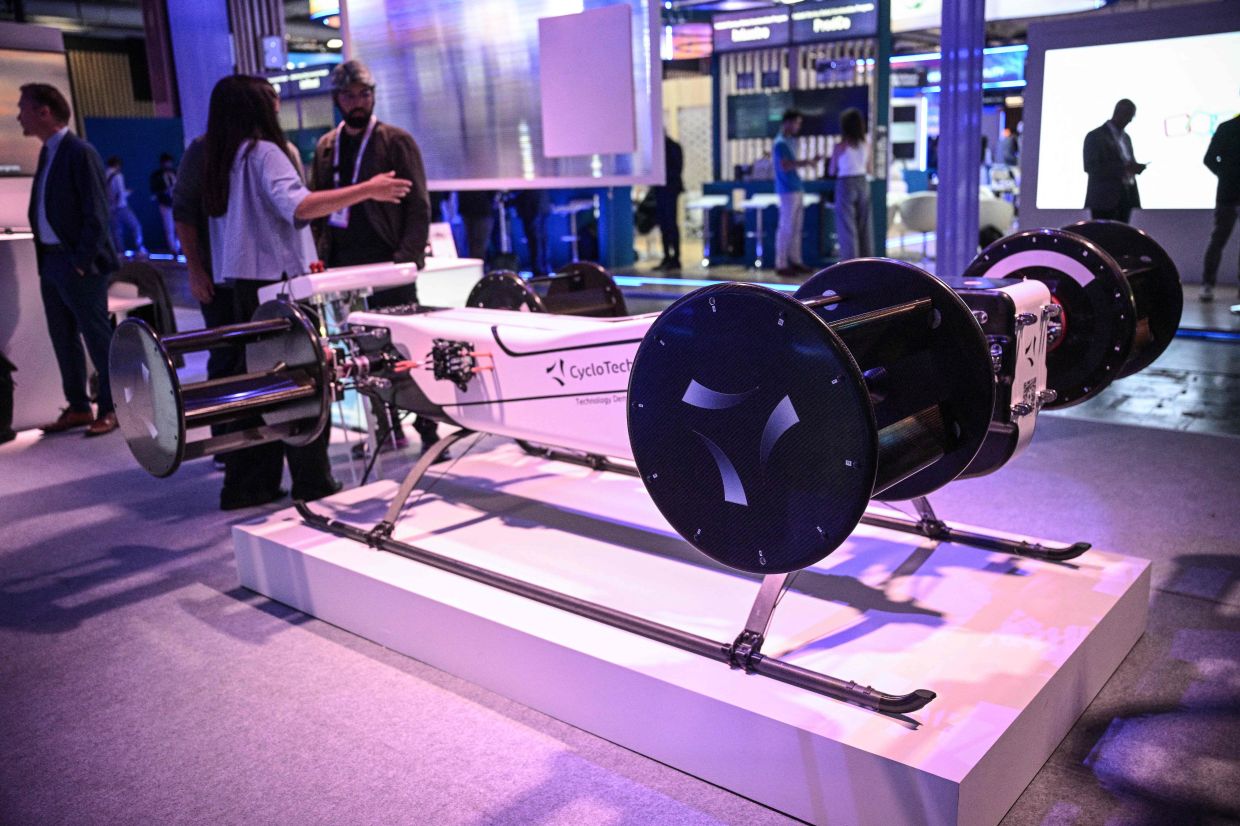
Austrian startup CycloTech is reimagining aerial vehicle design by developing an entirely novel motor architecture that could liberate drone and aviation manufacturers from conventional propulsion constraints. Rather than traditional rotors, CycloTech's motor takes the form of an open cylinder whose sides comprise multiple wing-shaped blades that operate through an ingenious mechanism allowing unprecedented manoeuvrability. Marketing chief Andrea Marchsteiner described capabilities that blur traditional aircraft categories: the system can maintain helicopter-like hovering, transition to forward flight matching conventional aircraft, execute mid-air braking, and even fly backwards—all with extraordinary precision landing capacity. These characteristics hold particular relevance for Southeast Asian applications, where dense urban environments and challenging topography present ongoing logistical obstacles. Potential uses range from last-mile delivery in congested city centres to emergency medical transport through complex terrain, alongside undisclosed military applications. The company, which employs 65 people and has already secured €40 million in previous funding rounds, is actively recruiting additional capital and seeking corporate partnerships willing to integrate CycloTech's motors into their existing flying platforms, suggesting that widespread deployment across the region could occur within several years.
French firm Whispeak emerged as a voice recognition company well before artificial intelligence became a dominant force in technology development, initially positioning itself as an identity verification solution for banking and sensitive services. However, the emergence of generative AI tools capable of producing convincing synthetic voices has fundamentally reshaped the company's mission. Chief executive Florent Van Calster articulated the urgency of this challenge: modern deepfake technology can replicate anyone's voice with less than ten seconds of audio samples, often using freely available tools, creating unprecedented fraud risks across telephony networks. Whispeak has spent three years developing sophisticated detection algorithms that can identify fraudulent audio with extraordinary accuracy, a breakthrough that has earned first-place recognition in multiple international competitions. The company is currently collaborating with major French telecom operator Bouygues to implement deepfake screening across their networks, issuing automated warnings to users when suspicious calls are detected. Van Calster acknowledged that detection error rates now average below one percent, though he recognised the perpetual nature of security advancement, describing a constant escalating competition between fraudsters and detection specialists that will likely persist indefinitely as both sides improve their respective technologies.
Hong Kong-based PointFit addresses a fundamental limitation in athletic monitoring by proposing that traditional blood and heart rate analysis provides incomplete physiological insight for performance optimisation. Chief executive Kenny Oktavius, who began developing the underlying technology in 2019 whilst still a student, designed an adhesive patch containing microscopic sensors capable of analysing biomarkers—including glucose and cortisol levels—directly through perspiration collected on the skin. Rather than presenting raw data, PointFit's artificial intelligence system generates a personalised "sweat index" that contextualises results against an individual's demographic characteristics and environmental conditions including ambient temperature, producing genuinely comparative performance metrics. Oktavius illustrated the practical significance of this approach by referencing professional marathon runners who continue experiencing sudden collapses despite wearing expensive, sophisticated monitoring equipment, suggesting that conventional heart rate monitoring fundamentally misses critical physiological information that becomes apparent only through biomarker analysis similar to hospital diagnostic protocols. The company has established working relationships with Red Bull's Athlete Performance Centre and Puma's Nitro Labs innovation division, validating the technology's effectiveness for elite-level athletic applications. However, Oktavius emphasised that broader commercial retail expansion represents the genuine market opportunity, with potential retail distribution through major sporting goods retailers like Decathlon and established eyewear firms like EssilorLuxottica capable of reaching millions of consumers seeking performance optimisation. Such expansion could democratise sophisticated athletic monitoring across Southeast Asia, where fitness consciousness and sports participation have expanded dramatically over recent years, potentially creating new market segments for wearable health technology.