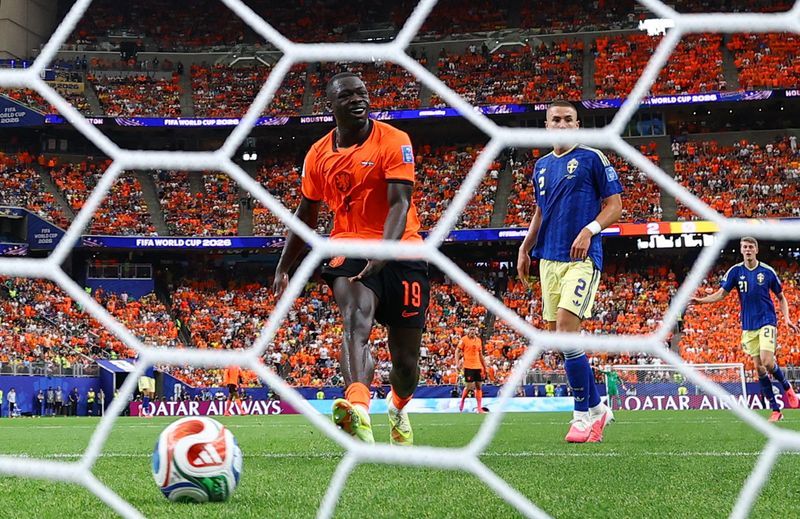
Ronald Koeman's substitution decisions drew considerable flak after the Netherlands' opening 2-2 draw with Japan in Dallas, but the Dutch coach silenced his critics emphatically on Saturday with a masterclass in tactical adjustment that produced a resounding 5-1 victory over Sweden in their second group assignment. The manager's choice to deploy Brian Brobbey as his primary attacking threat proved transformative, offering concrete evidence that the restructuring of Netherlands' attacking personnel, a concern that has loomed over the Dutch camp for some time, may finally have found a viable solution.
Brobbey's contribution extended far beyond the statistical record, though his two goals in the opening seventeen minutes certainly commanded attention. The 24-year-old showcased the type of predatory finishing and intelligent movement that had been questioned during his earlier exclusion from the squad, demonstrating a marked elevation in his overall tactical awareness compared to his previous appearances in the orange shirt. His performance suggested that his season competing in English football at Sunderland has fundamentally reshaped his approach to the striker's role, introducing dimensions to his game that were previously underdeveloped.
The path to this vindication has been far from straightforward. Brobbey had occupied a peripheral position within the national team's plans, finding himself overlooked during qualification rounds for the 2026 World Cup and absent from squad selections for an extended period stretching back more than a year. His recall in March represented a calculated gamble by the coaching staff, a decision that critics questioned given the established alternatives available to Koeman. The double against Sweden has retrospectively validated that gamble in the most emphatic manner possible, transforming a player once considered surplus to requirements into a central figure in the team's attacking ambitions.
The forward himself articulated the nature of his evolution during conversations with media representatives at the Dutch training facility earlier in the tournament. Brobbey emphasized that his development transcends the physical battles that have traditionally defined his playing style, extending instead into the subtle elements of positioning, awareness, and spatial intelligence that separate functional strikers from clinical finishers. His ability to recognize and exploit gaps in defensive formations, coupled with improved timing in his runs behind opposition lines, reflects a genuinely transformed understanding of his role within the team's tactical framework. These improvements suggest that his investment in competitive club football at a higher standard has yielded tangible dividends in his development.
The broader context regarding Netherlands' attacking resources adds considerable significance to Brobbey's emergence as a viable candidate for the lead striker position. Memphis Depay, the national team's all-time leading goalscorer, has been managing the consequences of a substantial injury lay-off that has undermined his rhythmic sharpness and explosive capacity in front of goal. The search for an heir apparent to Depay has represented an ongoing priority for the Dutch football federation, reflecting the legitimate concern that the nation's historical reliance on a single attacking figurehead could create vulnerability if that individual becomes unavailable or diminished through injury or age. Brobbey's performance provides encouraging evidence that this succession planning need not result in a significant diminution of attacking potency.
The supporting cast surrounding Brobbey has also demonstrated remarkable cohesion, with the service provision from wide areas proving particularly incisive. Cody Gakpo's penetrative running down the left flank created multiple opportunities for central movements, while the overlapping contributions of fullback Denzel Dumfries on the right side effectively compressed Swedish defensive structures and generated favorable matchups in attacking zones. The introduction of Crysencio Summerville into the attacking contingent further enriches the range of offensive options available to Koeman, ensuring that Brobbey benefits from a supporting ensemble capable of consistent chance creation. This depth of attacking resource means that the strike force need not carry an unrealistic burden of responsibility.
The Netherlands' position atop their group following the convincing Swedish victory reflects the comprehensive nature of their attacking display, with the five-goal haul demonstrating an attacking coherence that had been questioned during the Japanese encounter. Brobbey's clinical finishing provided the impetus for this improvement, offering the type of definitive attacking statement that had been conspicuously absent from the earlier match. His capacity to convert chances with predatory efficiency establishes him as qualitatively different from several alternatives under consideration, combining reliability in the final phase with the intelligent positioning that modern forward play demands.
For Malaysian and Southeast Asian observers of international football, Brobbey's resurgence carries particular resonance given the region's ongoing engagement with English club football and the demonstrated pathway for talented players to achieve continental recognition through performance in major European leagues. His season at Sunderland exemplifies how sustained competitive exposure at an elevated standard can fundamentally reshape player development trajectories, a lesson particularly relevant to aspiring footballers throughout Southeast Asia seeking to maximize their potential through selective European opportunities. The narrative suggests that strategic club placement targeting developmental improvement can genuinely translate into enhanced international performance and expanded opportunities at the highest levels of international competition.
Koeman's managerial rehabilitation following the Japanese disappointment hinges substantially upon Brobbey's continued ability to deliver in high-pressure international fixtures. The manager's faith in the forward selection appears vindicated by the immediate returns, yet the true test of this attacking reconfiguration will emerge through the tournament's progression, particularly in more demanding defensive scenarios and against stronger opposition. The Swedish performance, while impressive in its scope, was facilitated by significant space and opportunities that stronger defensive teams may be less willing to concede. Brobbey must therefore demonstrate that his clinical finishing and improved positional intelligence can flourish even when opposition defensive structures prove substantially more organized and compact.
%22%2F%3E%3C%2Fpattern%3E%3C%2Fdefs%3E%3Crect%20width%3D%22100%25%22%20height%3D%22100%25%22%20fill%3D%22url(%23ph2m8m0g)%22%2F%3E%3Crect%20width%3D%22100%25%22%20height%3D%22100%25%22%20fill%3D%22url(%23ph2m8m0p)%22%2F%3E%3Ctext%20x%3D%2250%25%22%20y%3D%2250%25%22%20text-anchor%3D%22middle%22%20dominant-baseline%3D%22central%22%20fill%3D%22rgba(255%2C255%2C255%2C0.95)%22%20font-family%3D%22Georgia%2C%20'Times%20New%20Roman'%2C%20serif%22%20font-weight%3D%22700%22%20font-size%3D%22320%22%20letter-spacing%3D%22-0.02em%22%3EIJN%3C%2Ftext%3E%3C%2Fsvg%3E)
%22%2F%3E%3C%2Fpattern%3E%3C%2Fdefs%3E%3Crect%20width%3D%22100%25%22%20height%3D%22100%25%22%20fill%3D%22url(%23ph9nuzg)%22%2F%3E%3Crect%20width%3D%22100%25%22%20height%3D%22100%25%22%20fill%3D%22url(%23ph9nuzp)%22%2F%3E%3Ctext%20x%3D%2250%25%22%20y%3D%2250%25%22%20text-anchor%3D%22middle%22%20dominant-baseline%3D%22central%22%20fill%3D%22rgba(255%2C255%2C255%2C0.95)%22%20font-family%3D%22Georgia%2C%20'Times%20New%20Roman'%2C%20serif%22%20font-weight%3D%22700%22%20font-size%3D%22226%22%20letter-spacing%3D%22-0.02em%22%3EMarcos%3C%2Ftext%3E%3C%2Fsvg%3E)
%22%2F%3E%3C%2Fpattern%3E%3C%2Fdefs%3E%3Crect%20width%3D%22100%25%22%20height%3D%22100%25%22%20fill%3D%22url(%23ph4a1v8g)%22%2F%3E%3Crect%20width%3D%22100%25%22%20height%3D%22100%25%22%20fill%3D%22url(%23ph4a1v8p)%22%2F%3E%3Ctext%20x%3D%2250%25%22%20y%3D%2250%25%22%20text-anchor%3D%22middle%22%20dominant-baseline%3D%22central%22%20fill%3D%22rgba(255%2C255%2C255%2C0.95)%22%20font-family%3D%22Georgia%2C%20'Times%20New%20Roman'%2C%20serif%22%20font-weight%3D%22700%22%20font-size%3D%22272%22%20letter-spacing%3D%22-0.02em%22%3EPerak%3C%2Ftext%3E%3C%2Fsvg%3E)