Hong Kong police have made seven arrests in connection with a brazen daylight robbery at the city's international airport, where a travelling businessman was attacked and relieved of six gold bars worth HK$7 million. The arrests, made within twelve hours of the June 18 incident being reported, represent a swift police response to one of the territory's more audacious recent airport crimes.
The suspects comprise four men and three women ranging from age 20 to 39. Police records indicate that at least some of those detained have connections to organised crime syndicates, though investigations continue into the roles played by individual members of the group. Authorities have characterised the arrests as targeting those suspected of conspiracy to commit robbery and abetting in the criminal enterprise, suggesting a carefully coordinated operation rather than an opportunistic attack.
The incident unfolded when the victim, carrying the gold consignment in his backpack, arrived at Hong Kong International Airport early Thursday morning after travelling from Bali, Indonesia. The gold was intended for delivery to a businessman based on the Chinese mainland. As the man made his way toward the airport car park 3 to retrieve his vehicle, three assailants wearing masks intercepted him and launched a violent assault. Armed with knives, the attackers stabbed the victim in his left hand and foot before fleeing with the backpack aboard a seven-seater vehicle.
The victim was taken to Princess Margaret Hospital where he remains in stable condition, according to police statements. His injuries, while serious enough to require hospitalisation, do not appear to pose long-term threat. The relatively restrained nature of his injuries—given the viciousness of the initial attack—may suggest the attackers' primary objective was theft rather than inflicting maximum harm, though this remains speculative.
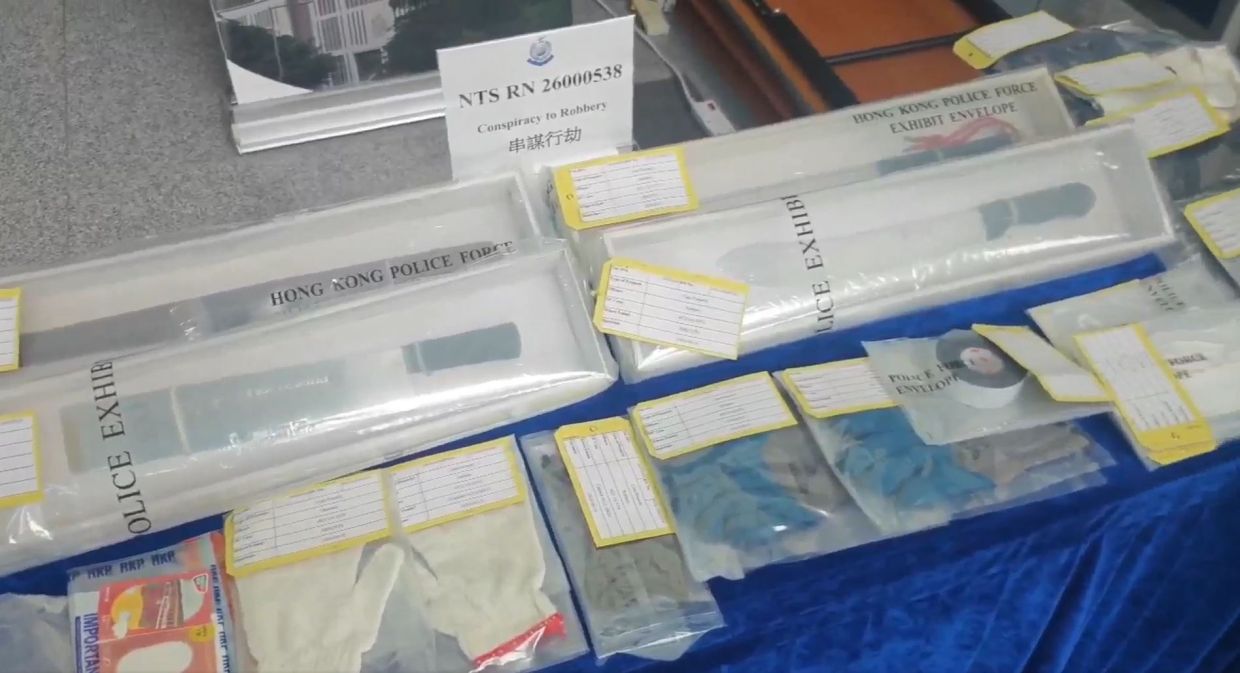
Investigators recovered crucial evidence within hours of the robbery. The seven-seater vehicle used as the getaway car was located in Tsuen Wan, along with the knives employed in the assault. The rapid recovery of physical evidence points to the coordinated police operation that led to the swift arrests, suggesting that either police had solid leads or that the perpetrators made careless decisions in disposing of their tools and vehicle.
Police have indicated that this was far from a random street crime. The deliberate nature of the attack, combined with the assailants' apparent knowledge of the victim's flight arrival time and his specific parking location, has led investigators to suspect involvement of an insider to the scheme. This suggests the robbery may have been planned weeks or months in advance, with someone within airport operations or the victim's network providing crucial logistical details to the criminal ring.
The involvement of suspects with triad connections raises questions about whether organised crime syndicates are increasingly targeting high-value cargo movements through Hong Kong's airport. The use of a seven-seater vehicle for a relatively small group of attackers also hints at more extensive involvement than the three initial assailants, with others potentially serving as lookouts, drivers, or coordinators.
Authorities have indicated that additional suspects remain at large, with intelligence suggesting several have crossed into mainland China. Police have formally requested assistance from Chinese law enforcement authorities to track down those who fled across the border. This cross-border dimension adds complexity to the investigation, as pursuing fugitives in mainland jurisdiction requires formal cooperation channels that can be time-consuming to activate.
The incident highlights vulnerability in airport security, particularly in the car park areas where passengers transfer from terminal buildings to vehicles. The attack occurred in daylight hours in what is ostensibly a controlled airport environment, raising questions about whether surveillance systems and security patrols were adequately deployed in the parking facility. For travellers and businesses using Hong Kong's gateway, the robbery underscores the risks involved in transporting high-value items through the airport, particularly when connections to organised crime are involved.
For Malaysian readers, the case carries several implications. Hong Kong remains a key hub for legitimate business transactions involving precious metals and commodities, and incidents like this can affect confidence in airport security across the region. The robbery also demonstrates how organised crime networks operate with sophisticated coordination across the Greater China region, using insider information and cross-border mobility to execute large-scale crimes. For Malaysian businesses with operations in Hong Kong or transit through its airport, the incident serves as a reminder to implement stringent security protocols for valuable cargo movements.
The investigation remains active, with police continuing to pursue the fled suspects and expand the circle of those questioned. Authorities have not ruled out additional arrests as the investigation proceeds and more details emerge about the planning and execution of the heist. The case represents a significant challenge to Hong Kong's reputation for efficient airport security and orderly operations, and its resolution will be closely watched by the international business community operating in the region.