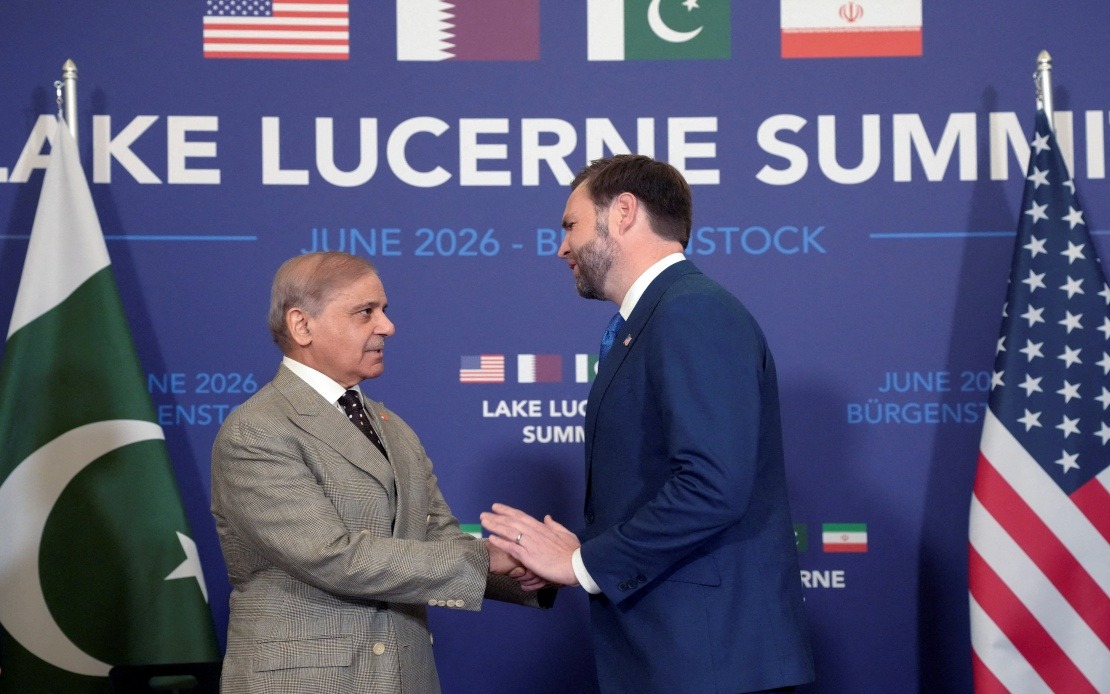
Vice President JD Vance, along with special envoys Steve Witkoff and Jared Kushner, met with Pakistan's Prime Minister Shehbaz Sharif and Pakistan Army Chief Field Marshal Asim Munir at the Burgenstock resort in Switzerland on Sunday. The encounter, confirmed by the White House press pool, represents a notable diplomatic moment as the region grapples with ongoing tensions between major powers and their strategic partners. The timing of this engagement underscores Pakistan's pivotal role in broader regional negotiations, particularly as the United States pursues a settlement with Iran following months of escalating military confrontation.
The Burgenstock gathering served as a backdrop for technical-level discussions involving not only American and Iranian delegations but also key mediator nations Pakistan and Qatar. These talks, conducted away from public view, mark a critical phase in efforts to de-escalate the conflict that erupted on February 28. The involvement of Pakistan as a mediating power reflects Islamabad's longstanding position as a crucial diplomatic intermediary in South and West Asian affairs, a role that carries particular weight given the country's historical ties to both Washington and Tehran.
Underscoring the diplomatic momentum, the United States and Iran have already signed a memorandum in the early hours of June 18 that outlines a framework for terminating the military conflict. This preliminary agreement establishes concrete timelines for several key provisions, including the withdrawal of the American naval blockade that has significantly constrained Iran's maritime operations. Simultaneously, the accord commits Iran to restoring normal shipping activities through the Strait of Hormuz, a waterway of immense strategic importance to global energy markets and Southeast Asian trade routes. For Malaysian readers and the broader region, any disruption or normalisation of traffic through this chokepoint carries direct implications for supply chains and economic stability.
A particularly significant component of the emerging agreement addresses Iran's nuclear programme, an issue that has remained contentious for nearly two decades. Rather than attempting comprehensive resolution in the immediate term, negotiators have opted for a bifurcated approach: the preliminary memorandum establishes Iran's commitment to refrain from acquiring nuclear weapons, while detailed technical discussions on the nuclear question will proceed through a separate negotiating track. This sequencing strategy allows both parties to demonstrate progress on military de-escalation while preserving space for more complex discussions on proliferation concerns.
The parties have stipulated a 60-day window for completing negotiations on Iran's nuclear programme. This compressed timeline reflects the urgency both Washington and Tehran feel regarding stabilisation, yet also signals that fundamental disagreements persist on technical and verification matters. The compressed schedule could either accelerate breakthrough or amplify pressure if fundamental incompatibilities emerge. For stakeholders across Asia, the outcome will determine whether sanctions against Iran are lifted, which would have ripple effects on energy prices, shipping insurance costs, and regional investment patterns.
From Tehran's perspective, the ultimate prize remains the comprehensive lifting of anti-Iran sanctions that have hobbled its economy for years. International restrictions have isolated Iranian financial institutions, constrained oil exports, and disrupted access to spare parts and technology across multiple sectors. The prospect of sanction relief would represent a transformative shift for Iran's economy and its regional influence. However, such relief requires sustained American commitment and likely parliamentary approval, introducing variables that complicate the negotiation process.
Pakistan's presence at these discussions carries particular significance for the country's own strategic interests and regional standing. Islamabad has long sought to position itself as an indispensable bridge-builder between conflicting parties, and its mediating role in US-Iran negotiations bolsters this narrative. Moreover, stability in Iran directly affects Pakistan's western border regions and energy security. The country's economy depends substantially on energy imports and regional trade flows, making any US-Iran resolution consequential for Pakistani prosperity.
The involvement of Qatar alongside Pakistan reflects a broader multilateral approach to conflict resolution that moves beyond purely bilateral engagement. Both countries bring diplomatic credibility and regional networks that facilitate backchannel communications and creative problem-solving. Their presence suggests that international mediation, rather than unilateral pressure, now characterises approaches to managing great-power tensions in Asia and the Middle East.
For Malaysia and the Southeast Asian region, these diplomatic developments merit careful observation. Should the US-Iran agreement hold and sanctions ease, regional energy markets could experience volatility, shipping patterns may shift, and investment opportunities in Iran could materialise. Conversely, any breakdown in negotiations could reignite military escalation, threatening vital sea lanes through which Southeast Asian trade transits. The Strait of Hormuz remains critical for global energy supplies that feed into Asian economies, making the success of these negotiations relevant to prosperity across the region.