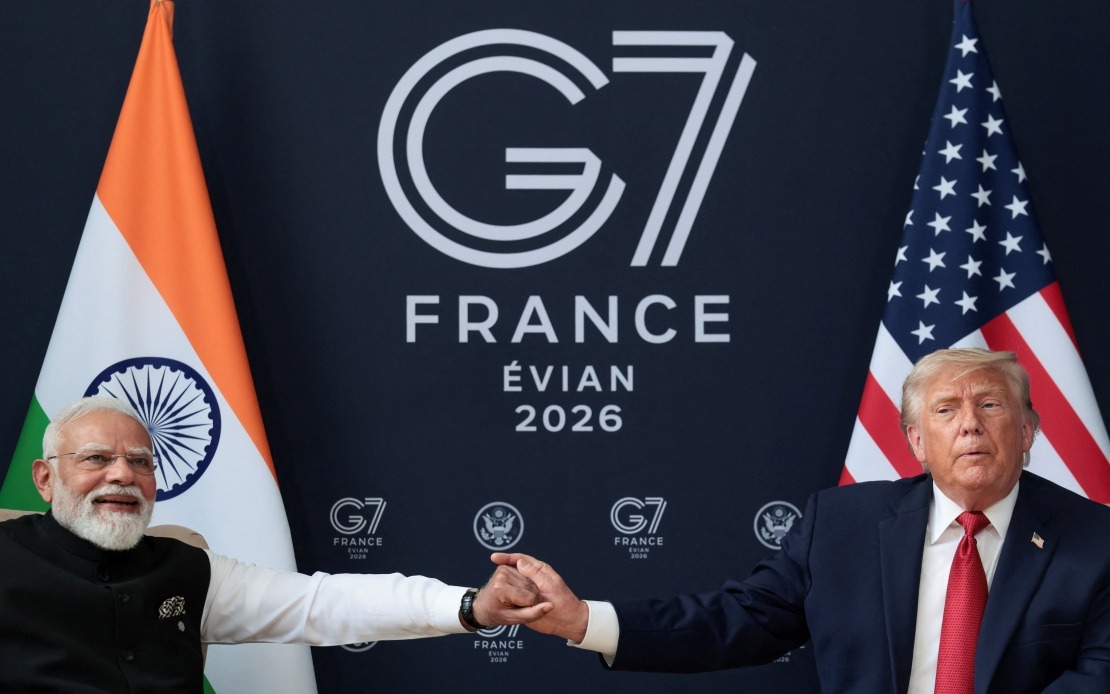
The Indian government has signalled considerable advancement in its protracted efforts to secure a comprehensive trade arrangement with the United States, marking a potential breakthrough in negotiations that have stretched across multiple administrations. The announcement emerged from high-level discussions between Indian Prime Minister Narendra Modi and US President Donald Trump during their bilateral meeting on the sidelines of the Group of Seven summit held in Evian, France, on Wednesday. Both leaders conveyed optimism about the trajectory of talks, with New Delhi's External Affairs Ministry issuing a formal statement underlining the "significant progress" achieved in ongoing negotiations towards an interim bilateral trade agreement.
The joint statement from the Indian government indicated that Modi and Trump had specifically acknowledged the advancement and instructed their respective negotiating teams to accelerate efforts towards finalising an arrangement that would balance the interests of both trading partners while delivering commercially meaningful outcomes. The tempo of engagement is expected to increase markedly in the coming weeks, with US Trade Representative Jamieson Greer scheduled to travel to India for follow-up discussions, signalling that the momentum generated at the G7 gathering will be maintained through sustained diplomatic momentum at the working level. This high-level attention underscores the significance both nations place on concluding negotiations in a timely manner.
Trump's characterisation of Modi as a formidable negotiating counterpart provides insight into the nature of discussions that have been occurring behind closed doors. When questioned about the state of trade talks, the US president described Modi using colourful language that reflected his respect for the Indian leader's negotiating prowess, noting that Modi represents "one of the toughest" negotiators he has encountered. Trump's comments, while light in tone, suggest that both sides have been pursuing their respective interests with considerable vigour, and that any agreement reached will represent genuine compromise rather than capitulation by either party.
The context surrounding these negotiations reflects the volatile trade environment that has characterised recent years. Under the Trump administration, the US imposed substantial tariffs on Indian goods, initially levying a 25 percent duty on various products and an additional 25 percent penalty specifically targeting Indian purchases of Russian oil. These punitive measures created friction in the relationship and provided the impetus for pursuing a more formalised trade framework. The imposition of such tariffs prompted both nations to engage more seriously in bilateral negotiations, recognising that a structured agreement would better serve their long-term economic interests.
An interim trade agreement was successfully concluded between Washington and New Delhi in February of this year, under which the US reduced its tariff rates to 18 percent on Indian goods. This interim arrangement represented a partial resolution of trade tensions and created space for continued negotiations toward a more comprehensive accord. The February agreement essentially froze the escalation in trade hostilities while both sides pursued a permanent solution, establishing a framework within which more detailed negotiations could proceed. The achievement of this intermediate step demonstrates the commitment both governments have shown to resolving trade disputes through negotiation rather than protectionist escalation.
For regional observers in Southeast Asia, these developments carry significant implications beyond the bilateral US-India relationship. India's growing economic clout and its strategic importance to the United States have elevated bilateral trade negotiations to a matter of considerable geopolitical consequence. As India continues to position itself as a counterweight to China within the Indo-Pacific region, securing stable and expanded trade access to the American market becomes increasingly important to New Delhi's strategic calculations. The successful conclusion of a comprehensive trade deal would signal the consolidation of deeper economic ties between two major democracies and could influence the broader architecture of trade relationships across Asia.
The negotiation process itself reflects the complexities involved in reaching trade agreements in the contemporary environment. Both nations bring competing interests to the table, with India particularly concerned about protecting its domestic industries and services sectors while simultaneously seeking greater access to American markets. The United States, meanwhile, has its own domestic constituencies demanding protection for specific sectors and has shown willingness to employ tariffs as a negotiating tool. The fact that officials from both sides have now been instructed to accelerate efforts suggests that political leadership on both sides has determined that the benefits of reaching an agreement outweigh the costs of continued trade friction.
The timeline for concluding negotiations remains fluid, though the instructions issued by Modi and Trump to their respective teams indicate a desire to move swiftly toward finalisation. With Greer's imminent visit to India, the substantive work of reconciling remaining differences will intensify. The negotiating teams will likely focus on outstanding tariff schedules, rules of origin for manufactured goods, and provisions governing trade in services, areas that typically prove contentious in bilateral trade negotiations. The February interim agreement has already demonstrated that both sides can find common ground, providing a foundation upon which more comprehensive arrangements can be built.
Industry observers and policy analysts across the region will be monitoring these developments closely, as the eventual shape of a US-India trade agreement could influence broader regional trade dynamics. An agreement that preserves India's industrial development space while expanding market access could serve as a model for other bilateral arrangements, or conversely, could establish precedents that constrain future negotiating flexibility. The strategic importance of India to US interests in the Indo-Pacific means that trade negotiations will remain intertwined with broader geopolitical considerations, ensuring that commercial discussions carry implications well beyond the realm of pure economics.