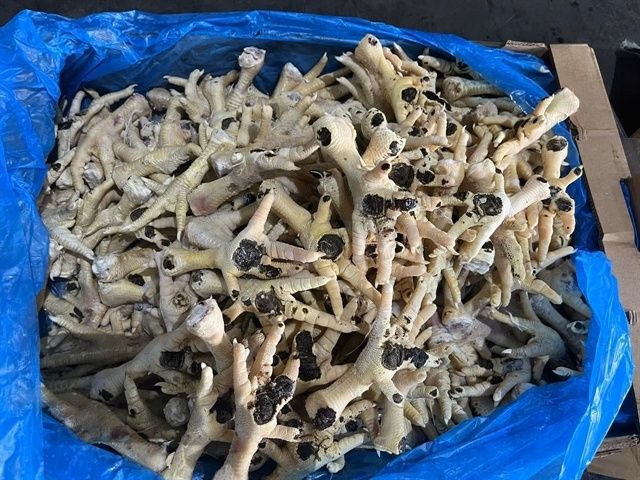
Hanoi authorities announced charges against two businesswomen on Friday after uncovering an extensive smuggling operation involving frozen chicken feet valued at more than US$13 million. The investigation revealed that Nguyen Thi To Loan, 47, who operated ABF Food Import-Export JSC in Ninh Binh Province, and Trang Tuyet Ngoc, 45, who held a senior position at An Binh Group, orchestrated the illegal importation and domestic distribution of poultry products that should never have entered Vietnam's consumer market.
The fraudulent scheme centred on a deliberate misuse of Vietnam's import regulations designed to protect public health. Between 2023 and 2026, the two suspects imported 339 containers of frozen chicken feet originating from countries experiencing active poultry disease outbreaks. Vietnamese law explicitly restricts such imports to licensed processing facilities that must re-export the finished products; domestic sales are categorically prohibited due to disease transmission risks. Yet investigators found that Loan systematically directed Ngoc to violate this core requirement by distributing the chicken feet throughout Vietnam's domestic food-service sector rather than honouring the legal re-export mandate.
The scale of the operation underscores how vulnerable supply chains can become when regulatory frameworks are deliberately circumvented. Over 10,000 metric tonnes of frozen chicken feet were traced to restaurants, hotels, and catering businesses across multiple provinces including Hanoi, Cao Bang, Ninh Binh, and Quang Ninh. The imported goods carried a total declared value exceeding VNĐ347 billion, yet the suspects paid zero import duties, suggesting additional customs violations layered atop the primary smuggling offences. Both women have reportedly confessed to all charges levelled against police investigators.
Police raids on cold-storage warehouses connected to the operation revealed the staggering quantity of illicit inventory still in circulation. At the An Viet 2 freezer facility in Hanoi's Quang Minh Industrial Zone, authorities discovered over 1,000 metric tonnes of frozen chicken feet, including approximately 260 metric tonnes that had already expired. Investigators documented visible signs of degradation including mould and persistent foul odours, yet evidence suggested these spoiled products were being prepared for further distribution to unsuspecting food-service operators and ultimately consumers.
A subsequent raid at THL cold-storage warehouse in northern Lang Son Province uncovered an additional 1,030 metric tonnes, demonstrating the geographic spread and warehousing infrastructure supporting the conspiracy. The discovery of such substantial volumes of expired, contaminated poultry products staged for market distribution raises serious questions about potential health consequences already suffered by Vietnamese consumers who unknowingly purchased and consumed these items over the three-year operation window.
From a regulatory perspective, this case exposes significant enforcement gaps within Vietnam's biosecurity framework despite the country's critical vulnerability to poultry-related disease transmission. As a densely populated Southeast Asian nation with extensive agricultural and food-service sectors, Vietnam faces genuine risks from avian influenza and other zoonotic pathogens. The deliberate circumvention of import restrictions designed to manage these dangers represents not merely commercial fraud but a calculated endangerment of public health infrastructure.
The conspiracy also highlights how corruption may have facilitated the operation at customs entry points. The systematic falsification of import documentation over 339 separate container shipments, combined with complete evasion of duty payments, suggests complicity or negligence among officials responsible for verifying that imported poultry products actually meet legal re-export requirements. Hanoi police have formally charged both Loan and Ngoc under Article 188 of Vietnam's 2015 Penal Code, which addresses smuggling offences.
For regional food-safety regulators and traders operating in Southeast Asia, this case serves as a cautionary reminder of how importers can weaponise legitimate trade categories to channel restricted products into consumer channels. The use of legitimate cold-chain infrastructure and established food-service distribution networks made the operation difficult to detect until investigators pieced together customs paperwork inconsistencies with actual market supply patterns.
Authorities emphasise that their investigation remains active, with ongoing efforts to identify additional individuals and organisations complicit in the smuggling network. The inquiry will likely expand beyond the two primary suspects to determine whether warehouse operators, logistics providers, food-service purchasers, or customs officials bore knowledge of or facilitation responsibilities for the scheme. Each layer of the distribution chain represents a potential avenue for expanding criminal liability.
The case reinforces the importance of supply-chain traceability systems that can flag inconsistencies between declared import purposes and actual product destinations. For Malaysian food importers and regulators, the parallel lesson extends to vigilance over one's own borders; cross-border trafficking of banned agricultural commodities remains a persistent regional challenge requiring coordinated enforcement across national boundaries and shared intelligence databases.

%22%2F%3E%3C%2Fpattern%3E%3C%2Fdefs%3E%3Crect%20width%3D%22100%25%22%20height%3D%22100%25%22%20fill%3D%22url(%23ph523ndg)%22%2F%3E%3Crect%20width%3D%22100%25%22%20height%3D%22100%25%22%20fill%3D%22url(%23ph523ndp)%22%2F%3E%3Ctext%20x%3D%2250%25%22%20y%3D%2250%25%22%20text-anchor%3D%22middle%22%20dominant-baseline%3D%22central%22%20fill%3D%22rgba(255%2C255%2C255%2C0.95)%22%20font-family%3D%22Georgia%2C%20'Times%20New%20Roman'%2C%20serif%22%20font-weight%3D%22700%22%20font-size%3D%22272%22%20letter-spacing%3D%22-0.02em%22%3EAnwar%3C%2Ftext%3E%3C%2Fsvg%3E)