Malaysia's leadership has underscored the symbolic importance of honouring exemplary Muslim figures, with Deputy Prime Minister Datuk Seri Dr Ahmad Zahid Hamidi pointing to this year's Tokoh Maal Hijrah awards as a catalyst for broader community inspiration. The recognition bestowed upon the laureates carries implications that extend beyond individual achievement, serving instead as a benchmark for how Muslims across the nation should conduct themselves in pursuit of knowledge, societal contribution and spiritual development.
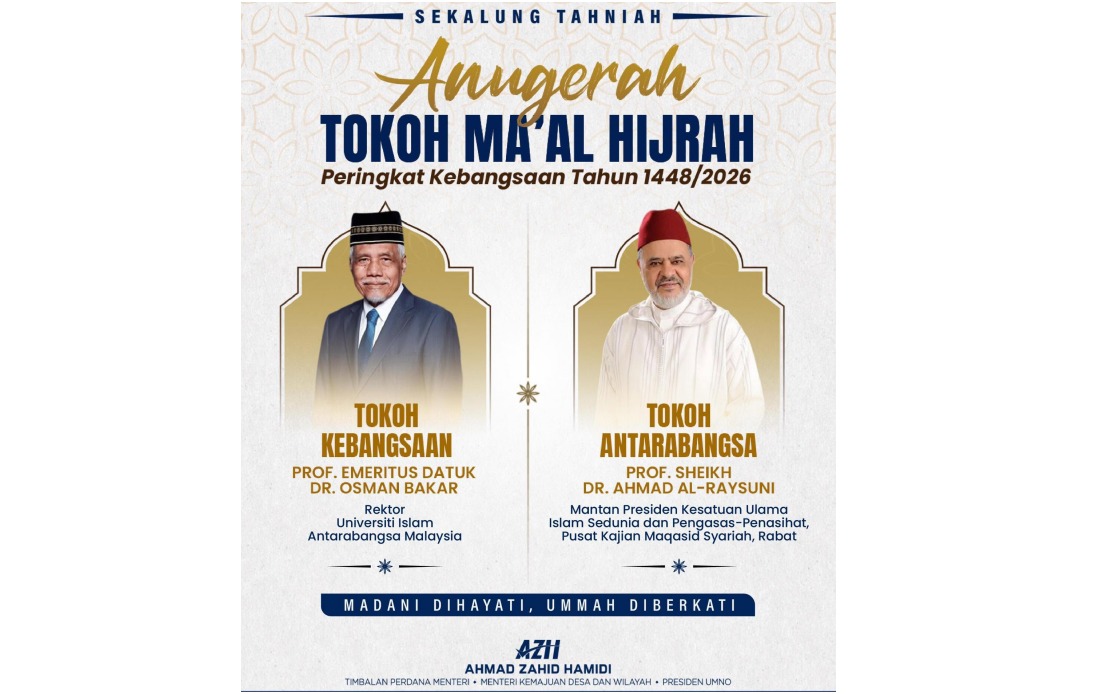
Prof Emeritus Datuk Dr Osman Bakar claimed the National Tokoh Maal Hijrah Award for 2026, whilst the International variant was conferred upon Prof Sheikh Dr Ahmad Al-Raysuni, an accomplished Islamic jurisprudence scholar from Morocco. The selection of these two figures reflects a deliberate effort to acknowledge intellectual and spiritual leadership spanning both domestic and international contexts, reinforcing Malaysia's positioning as a centre for Islamic thought and scholarship.
In his statement, Ahmad Zahid characterised the awards as recognition of substantive contributions made towards strengthening the Muslim ummah. He particularly highlighted how the recipients have elevated the standing of knowledge within Muslim circles whilst disseminating Islamic values grounded in pragmatism—values centred on mercy, practical wisdom and tangible societal benefit rather than abstract theological discussion. This framing suggests an official emphasis on Islam as a framework for progressive development and social welfare rather than merely spiritual observance.
The Deputy Prime Minister's exhortation for continued pursuit of knowledge carries particular resonance in the Malaysian context, where competition for educational excellence and intellectual capital remains intense across religious and secular domains. By explicitly linking the awards to scholarly achievement, Ahmad Zahid positioned intellectual advancement as a religious obligation rather than secular pursuit, potentially reshaping how Muslim students and professionals view their career trajectories and knowledge-seeking endeavours.
A parallel perspective emerged from Deputy Prime Minister Datuk Seri Fadillah Yusof, who broadened the appeal of the awards to encompass all Malaysians rather than Muslims exclusively. Fadillah's framing suggested that principles of service, sacrifice and community contribution transcend religious boundaries, whilst simultaneously reinforcing these values as central to the Islamic historical tradition. His invocation of the hijrah—the Prophet Muhammad's migration from Mecca to Medina—as a foundational principle of resilience and determined change offered a recontextualised reading suitable for contemporary nation-building discourse.
The hijrah concept, central to Islamic calendrical and spiritual life, conventionally marks the beginning of the Islamic lunar calendar and represents a turning point in Islamic history. Yet Fadillah's interpretation positioned it as a motivational exemplar applicable to modern development challenges, suggesting that the historical event embodies timeless principles of sacrifice, collective solidarity and unwavering commitment to constructive transformation. This rhetorical move bridges traditional Islamic understanding with contemporary governance philosophy, making historical religious narratives directly relevant to present-day policy objectives.
Fadillah's specific emphasis on strengthening unity, deepening faith and multiplying virtuous deeds reflected an implicit acknowledgement of social cohesion challenges within plural Malaysia. By framing these three elements as interconnected imperatives for national prosperity, he articulated a vision wherein religious fervour, communal harmony and individual righteousness operate synergistically to advance collective wellbeing. The formulation carries subtle implications for how interfaith relations and national development ought to be conceived.
The presentation ceremony itself, held at Masjid Putra in Putrajaya and presided over by Sultan Nazrin Shah of Perak, invested the occasion with ceremonial gravitas befitting national honours. The provision of cash prizes, trophies and certificates of appreciation transformed abstract recognition into tangible reward, signalling serious governmental investment in honouring intellectual and spiritual excellence. The location choice—the nation's principal mosque situated in the federal administrative capital—positioned the event within formal state structures rather than confining it to civil religious institutions.
The international dimension of the awards merits particular consideration for Malaysian and Southeast Asian observers. The recognition of Prof Sheikh Dr Ahmad Al-Raysuni, a Moroccan scholar, signals Malaysia's engagement with Islamic intellectual currents beyond the region and its aspiration toward leading Islamic thought globally. For a nation that has positioned itself as a moderate Islamic voice on the world stage, honouring accomplished foreign Islamic scholars reinforces claims to intellectual openness and cross-border scholarly collaboration.
Within Southeast Asia's broader context, Malaysia's deliberate celebration of Islamic excellence through such awards reflects broader regional dynamics. As Muslim-majority nations throughout the region navigate modernisation whilst preserving religious identity, the explicit valorisation of scholarship and community service offers a model demonstrating compatibility between Islamic commitment and developmental progress. The awards implicitly position knowledge-seeking and social contribution as authentically Islamic pursuits rather than secular alternatives to religious life.
The messaging from both Deputy Prime Ministers carries particular salience given Malaysia's increasingly polarised discourse surrounding Islam's role in public life. By emphasising practical benefit, mercy and societal welfare as central Islamic values, both officials implicitly pushed back against more restrictive or purely ritualistic interpretations, suggesting that true Islamic excellence manifests through tangible contributions to human flourishing rather than doctrinal purity alone.
Looking forward, the Tokoh Maal Hijrah awards appear positioned as an annual occasion for restating official priorities regarding Islamic leadership and community engagement. The recognition of select individuals inevitably establishes standards others will measure themselves against, potentially influencing how aspiring Islamic scholars, professionals and community leaders orient their work. Whether these aspirational calls translate into concrete institutional support for knowledge-seeking and community service remains to be observed.
The awards framework also invites consideration of how Malaysia's Islamic establishment intends to navigate contemporary challenges including sectarian tensions, religious extremism and competing claims to authentic Islamic authority. By privileging figures representing scholarly sophistication, cross-cultural engagement and development-oriented thinking, the government signalled preferences regarding what contemporary Islamic leadership ought to embody. Whether such symbolic gestures sufficiently address substantive theological and communal divisions within Malaysia's Muslim population presents a longer-term question for national cohesion.