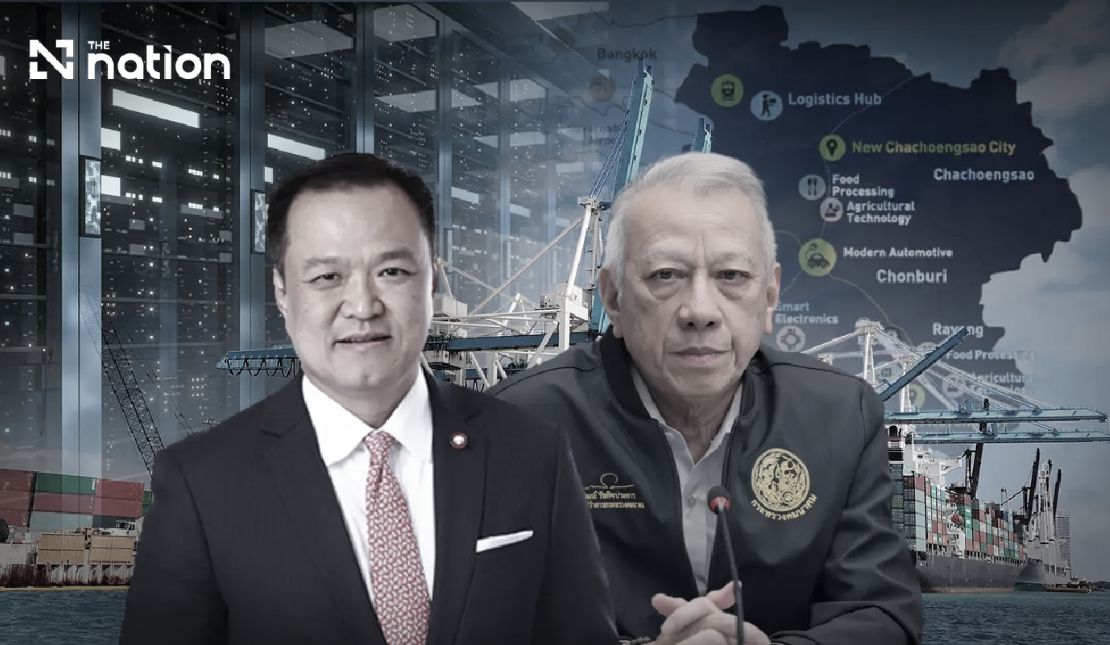
Thailand's Prime Minister Anutin Charnvirakul has moved to reassert personal control over the Eastern Economic Corridor, a flagship development zone that has struggled to realise its full potential over recent years. The shift in governance structure, formalised through Cabinet orders signed on June 15 and effective immediately, represents a significant repositioning of how Bangkok intends to market the EEC to international investors. By assuming direct supervision, Anutin is essentially placing himself at the forefront of Thailand's investment diplomacy, positioning the Prime Minister's office as the central point of contact for foreign capital seeking entry into Southeast Asia's economy.
The transfer of authority from Deputy Prime Minister and Transport Minister Phiphat Ratchakitprakarn signals an acknowledgment within Thailand's highest echelons that the EEC requires fresh strategic direction. Government sources have characterised the transition as collaborative rather than contentious, emphasising that Phiphat himself identified friction between the EEC Office and the Board of Investment as a primary impediment to progress. This characterisation, while diplomatically framed, underscores deeper operational challenges that have hampered the corridor's development trajectory. The narrative presented by the Government House source attempts to neutralise any perception of political turbulence, yet the fact that such a high-profile portfolio reassignment requires explicit damage control suggests underlying tensions within Thailand's governing coalition.
Central to Anutin's repositioning strategy is a deliberate distancing from the EEC's traditional identity as a heavy industrial hub. Rather than competing with established manufacturing powerhouses across Asia, the government now intends to leverage the eastern region's comparative advantages in agricultural and agribusiness sectors. This pivot towards positioning the EEC as a global food security hub reflects recognition of shifting international investment priorities. Countries worldwide are increasingly concerned with securing reliable supply chains for protein, fresh produce, and processed agricultural goods, particularly following disruptions witnessed over the past several years. Thailand's eastern provinces, with their established strengths in livestock production, aquaculture, fruit cultivation, and horticulture, represent a credible platform for attracting investors seeking to build resilient food supply networks aligned with environmental and sustainability standards.
The government's simultaneous push to establish the corridor as a major data centre destination addresses an entirely different investment class yet shares a common strategic logic. Data centre development requires substantial infrastructure investment—reliable electricity supply, water resources, connectivity, and security—precisely the kind of large-scale projects where government coordination becomes essential. The Energy Ministry's preparation of a new electricity user category specifically designed for data centre operators, with tariffs calibrated to reflect actual consumption costs, demonstrates the comprehensive nature of this strategic recalibration. Such sectoral specialisation also sidesteps the resource constraints that have historically limited the EEC's heavy industrial expansion. By targeting food security and digital infrastructure rather than energy-intensive manufacturing, Bangkok seeks to position the corridor as investment-worthy despite limitations in electricity and water provision that plague traditional industrial development.
This reframing carries particular significance for Southeast Asia's broader economic trajectory. Malaysia, Indonesia, and Vietnam have all invested heavily in competing industrial zones and special economic areas, creating intense competition for multinational manufacturing investment. By pivoting towards food security and data infrastructure, Thailand attempts to differentiate its offer in an increasingly crowded marketplace. These sectors also align with global megatrends—the rising importance of sustainable agriculture, cybersecurity, cloud computing, and digital transformation—creating potentially more durable demand streams than traditional manufacturing.
The reshuffle's timing and context merit careful examination for what they reveal about Thai governance dynamics. Officials have conspicuously denied that Anutin's decision reflects conflict with either Phiphat personally or their shared Bhumjaithai Party. Yet the decision to remove a Deputy Prime Minister and Transport Minister from oversight of a major development corridor, regardless of ostensible collaboration, necessarily carries political weight. The explicit denial regarding the unresolved high-speed rail project linking three major Bangkok airports—a contentious file that Phiphat previously managed—suggests this dispute remains a live issue within Thai government circles. Phiphat's previous resistance to amending the payment model for the private-sector contract, favouring the original completion-before-payment arrangement over a progress-based payment structure, apparently did not align with broader government inclinations. By reasserting control over the EEC portfolio, Anutin may be signalling his capacity to reset the terms of engagement with the private sector partner, Asia Era One, which remains linked to CP Group, one of Thailand's most influential business conglomerates.
Anutin's questioning of Phiphat's proposal to develop a Disneyland project within the EEC corridor adds another dimension to this governance recalibration. The Prime Minister's skepticism—pointedly asking when the project would materialise and whether financial returns would justify investment—reflects a shift towards project-based scrutiny rather than grand strategic vision divorced from rigorous economic analysis. This more parsimonious approach to development planning may appeal to Thailand's fiscal guardians while also signalling international investors that Anutin intends to ensure EEC investments meet concrete viability standards rather than serving as vehicles for political patronage or speculative real estate deals.
For Malaysian policymakers and business interests, Thailand's strategic repositioning carries implications worth monitoring. The EEC's enhanced focus on food security and data centres could intensify competition in sectors where Malaysia also maintains aspirations—both nations possess agricultural capabilities and both vie for regional data centre investment. Conversely, Thailand's explicit recognition that traditional heavy industry faces insurmountable constraints due to resource limitations might signal broader Southeast Asian economic realities that other nations must also confront. The region's rapid industrialisation has already strained electricity and water resources across multiple jurisdictions, suggesting that future investment strategies region-wide may need similar recalibration.
Underlying Anutin's consolidation of EEC authority is a broader assertion of prime ministerial prerogative over Thailand's economic development architecture. By positioning himself as the central figure in marketing Thailand's investment opportunities, Anutin effectively elevates his own profile as Thailand's premier dealmaker and economic strategist. This personalisation of economic governance, while potentially effective in bilateral negotiations with major foreign investors, carries attendant risks. Should significant EEC projects falter or fail to materialise, responsibility will necessarily accrue to the Prime Minister himself rather than diffusing across departmental structures. The stakes attached to this portfolio reassignment therefore extend beyond mere bureaucratic restructuring to encompass Anutin's broader political standing within Thailand's governing coalition and national public opinion.
The structural changes introduced suggest Thailand's government has concluded that the EEC requires not merely new investment attraction strategies but a fundamentally different approach to stakeholder coordination. The emphasis on resolving friction between the EEC Office and the Board of Investment, if genuinely addressed through Anutin's direct involvement, could potentially unlock project approvals that institutional rivalries previously blocked. Food security and data centre sectors share a characteristic that traditional heavy manufacturing lacks: they depend heavily on coordinated government action across multiple agencies simultaneously. Electricity supply, trade policy, immigration arrangements for specialist workers, data security frameworks, and international food standard compliance all require executive coordination beyond what any single ministry can provide. Placing the EEC portfolio directly under prime ministerial authority theoretically enables such cross-cutting coordination more readily than delegating authority to a single deputy.
The international dimension of this repositioning warrants attention from regional observers. Thailand's explicit reframing of the EEC as a pilot project presented with a refreshed narrative suggests the government intends to conduct sustained promotional activities globally, targeting investor communities in Europe, North America, and Asia-Pacific simultaneously. This investment diplomacy effort, personally championed by the Prime Minister, signals that Bangkok considers EEC revival sufficiently important to warrant high-level political commitment. Whether such commitment translates into concrete project commitments and actual capital inflows remains to be seen, yet the very fact of Anutin's personal involvement may itself prove attractive to risk-averse international investors seeking assurance that their projects enjoy the highest levels of Thai government support and priority.
Looking forward, the success of Anutin's EEC repositioning will ultimately depend on execution. Food security and data centre investments represent legitimate opportunities, but converting strategic vision into actual projects requires sustained effort across multiple domains—regulatory reform, infrastructure development, workforce training, and international marketing. Thailand's track record in executing ambitious special economic zone strategies offers mixed lessons. The EEC itself, launched in 2017 with considerable fanfare, has substantially underperformed relative to initial projections, suggesting that strategic repositioning alone, however well-conceived, proves insufficient without complementary operational improvements. Anutin's assumption of direct control establishes conditions whereby Thai leadership can pursue more aggressive development strategies, but converting such authority into tangible economic outcomes remains the genuine test ahead.