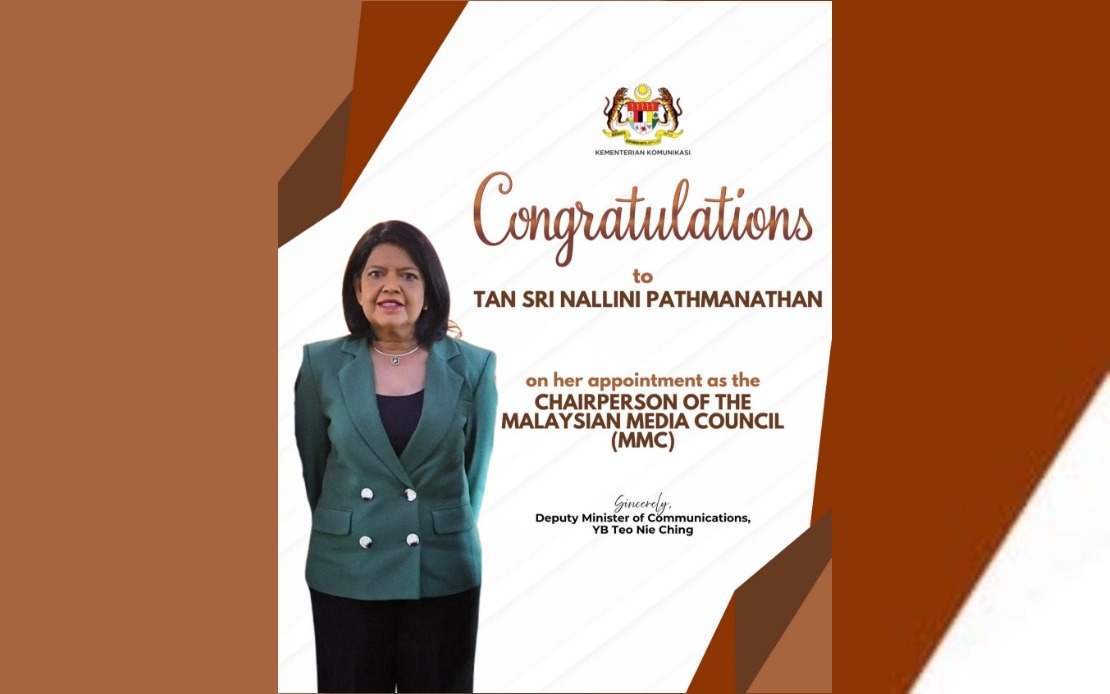
Former Federal Court judge Tan Sri Nallini Pathmanathan has been appointed chairperson of the Malaysian Media Council following her unanimous endorsement by MMC Board members at a meeting on May 26. The appointment marks a significant milestone for Malaysia's media landscape, as the council represents the culmination of five decades of sustained advocacy and policy dialogue aimed at establishing an independent, self-regulatory mechanism for the country's news industry. Deputy Communications Minister Teo Nie Ching has publicly welcomed the appointment, positioning it as a guarantee that the fledgling regulatory body will operate with the judicial wisdom and constitutional rigour necessary to safeguard both journalistic integrity and press freedom.
Teo's endorsement rested principally on Nallini's track record as a Federal Court judge, where she demonstrated consistent concern for the protection of constitutional rights and fundamental freedoms. In particular, Teo highlighted a dissenting judgment Nallini authored in a citizenship case involving the inheritance of Malaysian nationality by a child born to a Malaysian father and a foreign mother. In what was a narrowly divided 4-3 decision, Nallini had advocated for a purposive and compassionate reading of constitutional citizenship provisions, signalling her willingness to interpret law in ways that protected vulnerable populations and advanced human dignity. This judicial philosophy, Teo suggested, would inform Nallini's approach to regulating media in a manner that prioritised both freedom and responsibility.
Equally significant to Teo was Nallini's dissenting opinion in a landmark case concerning an online news portal's liability for user-generated comments. The judgment reflected a nuanced understanding of how modern digital communication operates and rejected a broad interpretation of publisher liability that might have chilled the speech of platforms hosting public discourse. By ruling that a news portal should not be held responsible for statements made by its subscribers, Nallini demonstrated sophisticated thinking about the distinction between editorial responsibility and the hosting of third-party speech—a distinction that underpins much contemporary debate about media regulation worldwide. Teo interpreted this ruling as evidence that Nallini would lead the Malaysian Media Council with sensitivity to the practical realities of journalism and publishing in the digital age.
The appointment arrives at a pivotal juncture for Malaysian media governance. The Malaysian Media Council Act 2025, which provides the statutory foundation for the MMC, represents a deliberate choice to move away from heavy-handed state regulation toward self-regulation by the industry itself. This philosophical shift reflects international best practice, where press councils and similar bodies are designed to uphold journalistic standards, address public complaints, and maintain professional ethics without governmental interference. The timing of the council's establishment—after fifty years of unsuccessful attempts—suggests that political consensus around the necessity of such a body has finally crystallised among policymakers, media organisations, and civil society advocates.
Teo's public statement emphasised the structural rationale underlying this self-regulatory approach. Journalists occupy a distinctive constitutional position as custodians of the public interest and as institutions essential to democratic governance. Any attempt by state authorities to directly control or regulate media carries inherent risks of being perceived as authoritarian censorship, Teo argued, thereby undermining the legitimacy of governance itself. Self-regulation, by contrast, allows the media industry to police its own conduct, investigate complaints, and enforce ethical standards while remaining insulated from accusation of governmental manipulation. This framework presupposes, however, that the regulatory body must be genuinely independent, transparent, and led by individuals whose credentials command public confidence—conditions that Nallini's judicial background ostensibly satisfies.
The emphasis Teo placed on Nallini's judicial temperament and her demonstrated commitment to constitutional protections signals the government's recognition that the MMC's credibility depends fundamentally on leadership with proven judicial independence and principled reasoning. A regulatory body led by someone perceived as sympathetic to governmental interests or inadequately protective of press freedom would likely face resistance from journalists and civil society, potentially undermining its effectiveness. By contrast, an MMC chaired by a respected former judge known for dissenting from judicial consensus on behalf of constitutional principles conveys a message that the council will operate as an authentic guardian of professional standards rather than as a tool of state power.
For Malaysia's media industry specifically, Nallini's appointment carries broader implications for how the MMC will address recurring tensions between press freedom and other social interests. Malaysian courts have periodically grappled with questions about the scope of permissible press criticism, the boundaries of journalistic privilege, and the proper balance between freedom of expression and protection of personal reputation or national security. Nallini's record suggests she will bring a sophisticated, rights-respecting approach to these questions—one that recognises journalism's democratic function while acknowledging legitimate constraints. This intellectual framework will be critical as the MMC develops its code of ethics, procedures for adjudicating complaints, and sanctions for violations.
Regionally, Malaysia's establishment of the MMC and the appointment of Nallini reflect broader patterns in Southeast Asia whereby countries seek to develop media governance structures that avoid the extremes of either unfettered commercialism or state domination. Neighbouring countries including Singapore, Thailand, and Indonesia have experimented with various approaches to media regulation, with mixed results. Malaysia's investment in an industry-led self-regulatory model, anchored by an institutionally independent chairperson, represents an attempt to chart a third path—one that protects journalistic freedom while ensuring accountability to ethical standards and public interest.
The success of this experiment will depend substantially on how the MMC develops its institutional culture, investigates complaints, and engages with both journalists and the broader public during its formative years. Nallini's role will be crucial in establishing norms of procedural fairness, transparency in decision-making, and principled reasoning that extend beyond the courtroom into the council's operations. Her ability to earn credibility with a sceptical journalistic community—which has historically viewed regulatory initiatives with suspicion—will be tested immediately as the council begins operations. Early cases and decisions will signal whether the MMC functions as a genuine self-regulatory body or becomes, over time, an instrument of indirect censorship.
Teo's public backing of Nallini also underscores the government's stake in the MMC's legitimacy. A media council that enjoys industry and public confidence serves the broader democratic project by establishing accountability structures that reduce pressure for heavier-handed state intervention. Conversely, an MMC that fails to earn credibility or that appears to operate capriciously could provoke demands for governmental takeover or statutory regulation. By appointing a judge of Nallini's standing and philosophical inclination, the government is, in effect, betting that principled self-regulation can succeed where state-imposed regulation might provoke resistance and undermine press freedom. Whether this gamble proves correct will become apparent as the council encounters its first substantive cases and controversial decisions.