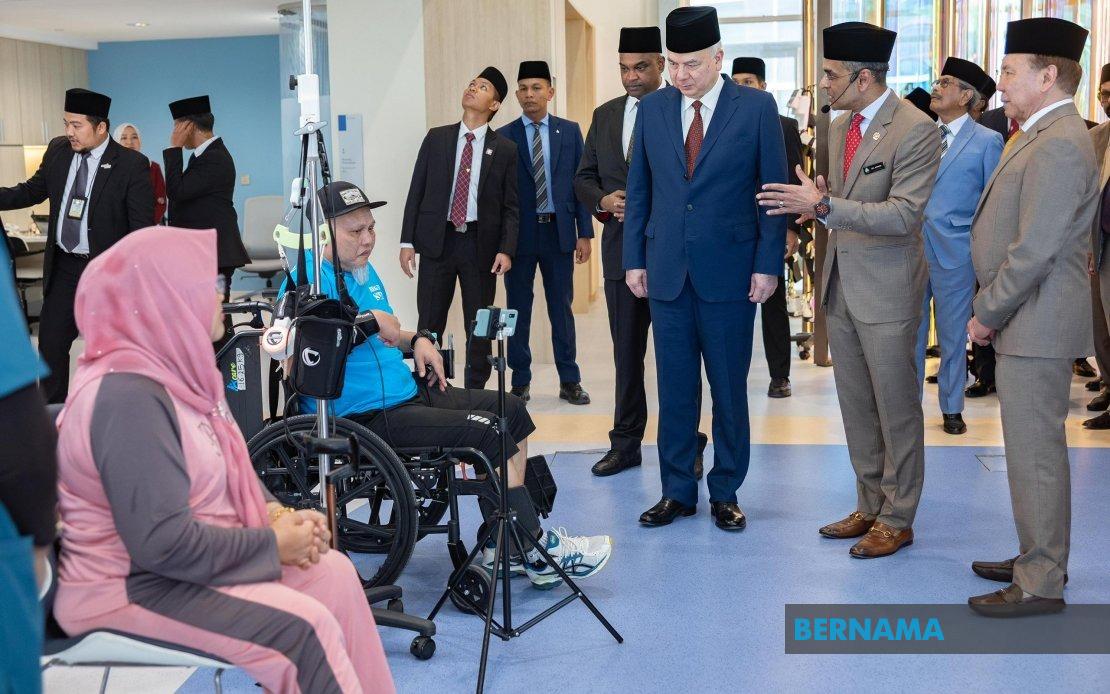
The Sultan of Perak, Sultan Nazrin Shah, has officially opened the Social Security Organisation's (PERKESO) state-of-the-art Neuro-Robotics and Cybernetics Rehabilitation Centre in Meru Raya, signalling a significant advancement in Malaysia's approach to worker rehabilitation and social healthcare. The facility, whose design draws inspiration from the intricate patterns of traditional gold-thread embossing, has been formally designated as the Pusat Rehabilitasi Perkeso Sultan Nazrin Shah in recognition of the royal patronage and commitment to advancing the nation's welfare infrastructure.
At the opening ceremony, attended by Perak's royal retinue including Raja Muda Perak Raja Jaafar Raja Muda Musa and Raja Di Hilir Perak Raja Iskandar Dzulkarnain Sultan Idris Shah, along with senior government officials including Menteri Besar Datuk Saarani Mohamad and Minister of Human Resources Datuk Seri R. Ramanan, the Sultan articulated a transformative vision for rehabilitation services that extends far beyond clinical infrastructure. He emphasised that the true value of such a facility rests not merely in technological sophistication but in the calibre and dedication of the medical professionals, therapists and support staff who deliver care within its walls.
The centre represents a convergence of multiple specialisations—neuromedicine, assistive technology, physiotherapy, occupational and vocational therapy alongside psychological and social support—creating an integrated ecosystem designed to address the multifaceted needs of individuals recovering from neurological injuries and work-related disabilities. This comprehensive approach reflects a departure from fragmented service delivery models, instead positioning rehabilitation as a holistic journey towards restored independence and reintegrated livelihoods.
Crucially, Sultan Nazrin framed the facility as emblematic of a fundamental philosophical shift in how the nation conceptualises disability and recovery. Rather than viewing adversity as a terminal condition, the centre embodies a commitment to creating pathways whereby individuals can rebuild their lives with both dignity and practical independence. This messaging carries particular significance in a Malaysian context where stigma surrounding disability and mental health remains a barrier to rehabilitation uptake and social reintegration.
The centre's potential impact extends across multiple patient populations. For stroke survivors, it offers structured interventions to restore motor function and cognitive capability. Workers recovering from neurological injuries gain access to technology-assisted strength and coordination rebuilding. Individuals with traumatic brain injuries can access specialised support to restore memory, language, and self-regulatory functions. Beyond the patients themselves, the facility serves as a beacon of possibility for families navigating the psychological and financial upheaval that accompanies serious workplace injury or sudden disability.
The Sultan referenced the centre's genesis during the tenure of Ipoh Barat Member of Parliament M. Kulasegaran as Minister of Human Resources between 2018 and 2020, acknowledging the policy commitment required to transform such an ambitious vision into concrete infrastructure. This lineage underscores how rehabilitation centres function as long-term policy commitments that transcend individual administrations, requiring sustained investment and cross-party support to realise their full potential.
A particularly noteworthy aspect of PERKESO's strategy involves partnerships with private sector entities to facilitate post-rehabilitation employment. The existing collaboration with 7-Eleven to provide workplace training with genuine employment prospects demonstrates a recognition that rehabilitation efficacy ultimately depends on successful labour market reintegration. For individuals who have invested months or years in therapy and recovery, the ability to secure meaningful employment represents the final and perhaps most consequential stage of rehabilitation, yet it remains often overlooked in facility-focused discourse.
Sultan Nazrin issued a direct appeal to the private sector to expand such partnerships through corporate social responsibility initiatives and vocational training programmes. This call addresses a significant implementation gap in Malaysian rehabilitation policy: the availability of transitional employment opportunities remains insufficient relative to the number of individuals completing rehabilitation programmes. Without coordinated employer engagement, even the most technologically advanced facilities risk producing graduates lacking concrete pathways to economic self-sufficiency.
The Sultan reframed national progress as extending beyond physical infrastructure and macroeconomic indicators to encompass the resilience of social safety nets and the preservation of human dignity in times of crisis. This philosophical positioning carries implications for how Malaysian policymakers evaluate public investment priorities, suggesting that expenditure on rehabilitation and social support represents not welfare expenses but rather expressions of core national values and social cohesion.
The call to eliminate prejudicial attitudes towards persons with disabilities represents an essential complement to infrastructure investment. Even state-of-the-art facilities cannot fully overcome employment discrimination or social exclusion rooted in persistent misconceptions about disability and capability. The Sultan's emphasis on collective social responsibility signals that meaningful rehabilitation outcomes require attitudinal shifts throughout society, not merely clinical interventions.
For Malaysian workers and their families facing the prospect of long-term disability, the centre's opening signals an institutional commitment to recovery-oriented rehabilitation grounded in contemporary neuroscience and assistive technology. The facility's existence potentially influences both recovery trajectories and psychological resilience during rehabilitation, as individuals gain access to evidence-based interventions delivered in a compassionate institutional setting.
The Neuro-Robotics and Cybernetics Rehabilitation Centre ultimately represents a stake in the claim that severe illness or injury need not determine one's entire life trajectory. By combining technological innovation with compassionate care and genuine employment pathways, the facility proposes a comprehensive answer to how modern welfare systems can support the most vulnerable members of the workforce while simultaneously advancing national productivity and social stability.