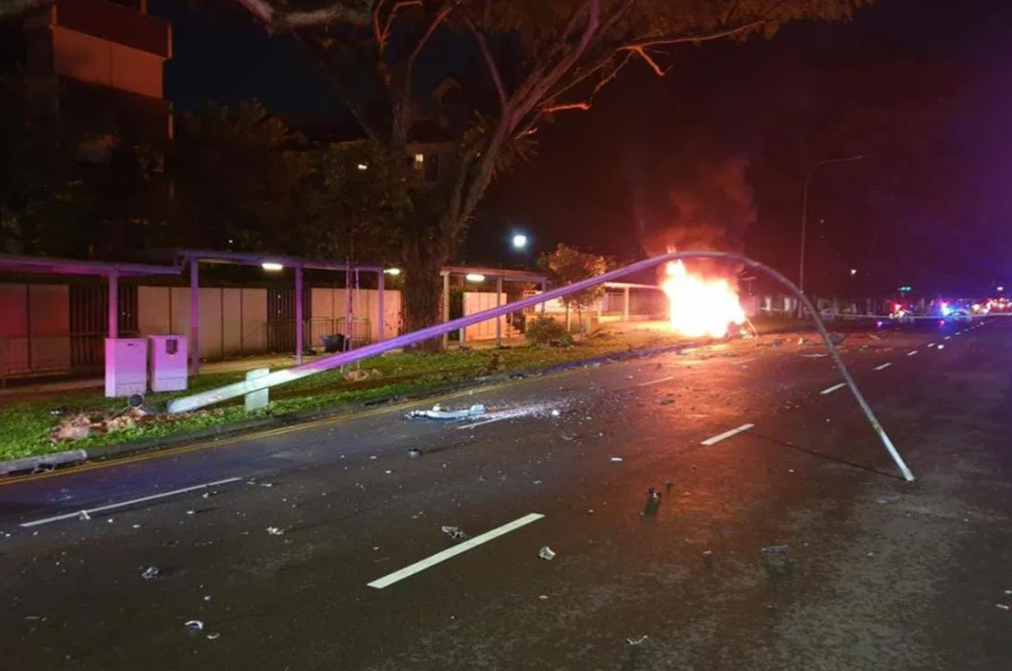
A 29-year-old man in Singapore is facing serious criminal charges following a chaotic early-morning incident in March 2024 that involved high-speed driving against traffic, a collision with a school bus, and a burning vehicle. Aaron Tan Yao Cong appeared in court on Thursday last week, where prosecutors laid five charges against him relating to the dangerous sequence of events that unfolded along the busy roads connecting Bukit Timah and Sixth Avenue.
The incident began just before dawn on March 6, 2024, when Tan's vehicle approached Cavenagh Road at a point where traffic was permitted only to proceed straight ahead. Rather than complying with the directional signage, Tan steered left and began driving directly into the path of oncoming vehicles. Within minutes, police records show he had abandoned that initial collision site and accelerated rapidly along Bukit Timah Road, where he was subsequently clocked traveling at approximately 114 kilometres per hour. During this phase of the incident, he continuously changed lanes while weaving through early-morning traffic between Coronation Road and Anamalai Avenue.
The most serious collision occurred when Tan reached the junction of Sixth Avenue at around 6.16 in the morning. Court documents indicate that he failed to stop for a red traffic signal and struck a private bus that was legally executing a U-turn at the intersection. The force of the impact caused Tan's vehicle to continue forward until it struck a lamp post, which ruptured the fuel system and ignited a fire. Four individuals—Tan and three passengers in his vehicle—managed to exit the burning car before flames spread further. The bus driver and two child passengers, both under 11 years of age, also required emergency medical treatment following the collision.
Alcohol appears to have been a significant factor in the dangerous driving. When officers arrested Tan at the scene, he declined to submit to a breathalyser test, a refusal that itself constitutes a criminal offense under Singapore law. Despite his initial refusal, subsequent medical testing revealed his blood alcohol concentration to be 148 milligrams per 100 millilitres—substantially exceeding the legal limit of 80 milligrams per 100 millilitres. This finding is particularly concerning given Tan's prior criminal history: he was previously convicted in 2019 of both drink driving and driving without due care and attention, meaning he was a repeat offender at the time of this March incident.
The formal charges against Tan span multiple traffic and road safety violations, each carrying distinct penalties under Singapore's stringent transport laws. The drink driving charge is the most serious, as it qualifies as a repeat offense under the law. If convicted, Tan faces imprisonment of up to two years alongside a fine reaching $20,000. The dangerous driving causing hurt charge, which specifically addresses the injuries inflicted on the children and the bus driver, carries potential sentences of up to two years imprisonment or fines up to $10,000, with repeat offenders facing enhanced penalties including fines up to $20,000.
Additional charges relate to more technical but equally important violations. Leaving his vehicle in a position that endangered other road users carries a maximum three-month jail sentence or $1,000 fine. His refusal to provide a breath specimen when lawfully required to do so can result in six months' imprisonment, a fine of up to $5,000, or both, with repeat offenders potentially facing one year in jail and $10,000 in fines. The charge of driving against the flow of traffic, the initial violation that triggered the entire sequence, brings penalties of up to three months imprisonment or $1,000 in fines, extending to six months and $2,000 for repeat offenders.
Tan has not yet indicated how he intends to respond to the charges, and his next court appearance is scheduled for July 16. This delay provides time for prosecutors to prepare their evidence and for the defense to prepare any counterarguments. The case has drawn attention within Singapore's legal and road safety communities, as it exemplifies the cascading consequences that can result when a driver under the influence makes poor decisions at critical moments. The injuries sustained by the two young passengers have made this more than simply a traffic violation case—it touches on public safety concerns affecting vulnerable road users.
For Malaysian readers, this case serves as a sobering reminder of the dangers posed by impaired driving and the importance of enforcement mechanisms. While Malaysia's drink-driving laws have become progressively tougher in recent years, particularly following high-profile incidents, the severity of Singapore's penalties—and their application to repeat offenders—illustrates how regional authorities view such violations. The fact that Tan had already been convicted in 2019 and continued to drive while intoxicated suggests that individual rehabilitation and legal deterrence alone may not prevent determined offenders from reoffending.
The case also highlights the unpredictable nature of serious traffic accidents. What began as a wrong-turn violation escalated into a dangerous high-speed pursuit through busy urban roads, resulting in a collision affecting innocent parties including children. Road safety experts often note that such incidents frequently involve multiple compounding factors—in this case, wrong routing decisions, excessive speed, impaired judgment, and red-light violation all converging within minutes. The survival of all involved parties, though five required medical attention, was partly fortunate and partly a result of modern vehicle safety features and emergency response protocols.
From a legal perspective, Singapore's approach to prosecuting such cases demonstrates how authorities can pursue multiple charges simultaneously when dangerous conduct affects public safety. Rather than consolidating offenses, prosecutors lay out distinct charges that allow courts to calibrate sentencing according to the specific harms caused by each element of the driver's misconduct. This approach ensures that the gravity of each decision made during the incident—refusing a breathalyser test, exceeding speed limits, running traffic lights—is formally acknowledged in the legal proceedings.
The outcome of this case, expected sometime after July 16, will set important precedent regarding how repeat offenders who cause injuries through impaired driving are treated in Singapore's court system. Given the presence of child victims and the driver's prior convictions, sentencing could be substantial. This case will likely be referenced in future discussions about road safety policy in Singapore and potentially across Southeast Asia, where drink-driving remains a persistent public health and safety concern despite increasingly tough legal frameworks.

%22%2F%3E%3C%2Fpattern%3E%3C%2Fdefs%3E%3Crect%20width%3D%22100%25%22%20height%3D%22100%25%22%20fill%3D%22url(%23ph523ndg)%22%2F%3E%3Crect%20width%3D%22100%25%22%20height%3D%22100%25%22%20fill%3D%22url(%23ph523ndp)%22%2F%3E%3Ctext%20x%3D%2250%25%22%20y%3D%2250%25%22%20text-anchor%3D%22middle%22%20dominant-baseline%3D%22central%22%20fill%3D%22rgba(255%2C255%2C255%2C0.95)%22%20font-family%3D%22Georgia%2C%20'Times%20New%20Roman'%2C%20serif%22%20font-weight%3D%22700%22%20font-size%3D%22272%22%20letter-spacing%3D%22-0.02em%22%3EAnwar%3C%2Ftext%3E%3C%2Fsvg%3E)