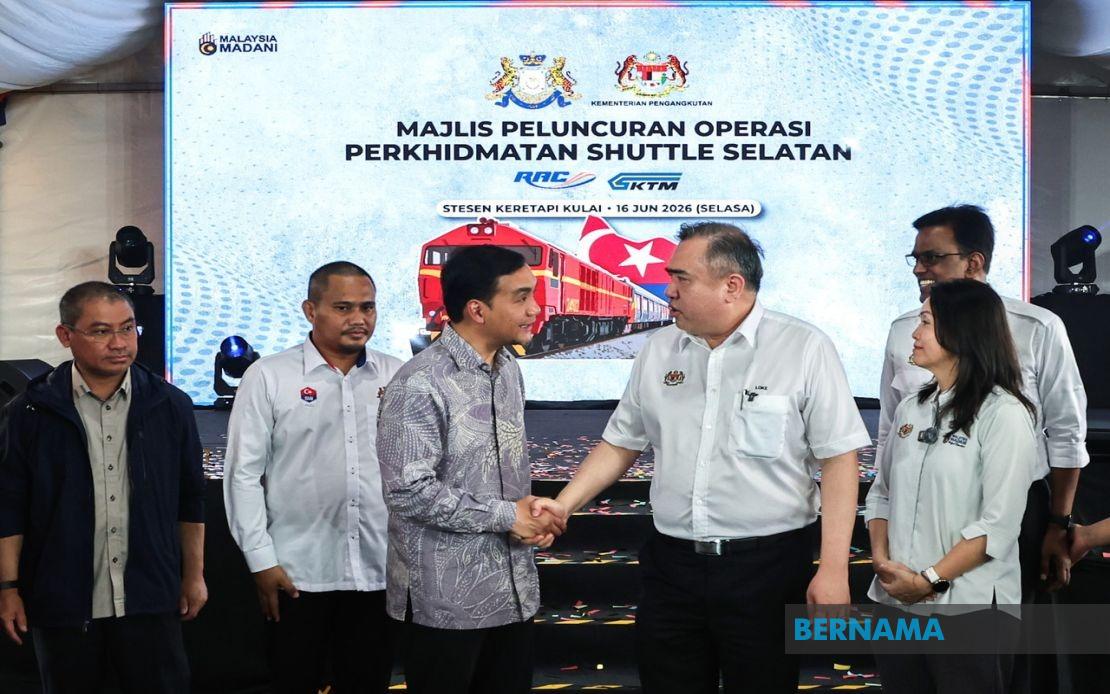
The Shuttle Selatan rail service commenced operations today, marking a significant addition to Johor's public transport infrastructure and positioning itself as a critical link between Kulai, JB Sentral, and Pasir Gudang. Transport Minister Anthony Loke, speaking at the official launch at Kulai KTM station, outlined the ambitious scope of the initiative, which is projected to serve more than two million residents across the three connected municipalities. The service represents a coordinated effort to address mobility challenges in one of Malaysia's most economically dynamic regions, where industrial activity and population growth have consistently outpaced traditional transport capacity.
Initially, operations will focus on two primary corridors: the Kulai-JB Sentral route running in both directions, and the Kempas Baru-Pasir Gudang service. Journey times demonstrate the efficiency gains passengers can expect, with the Kulai-JB Sentral leg scheduled to take approximately 40 minutes, whilst the eastern route between Kempas Baru and Pasir Gudang requires between 40 and 45 minutes. These timeframes underscore the service's positioning as a faster alternative to road-based transport, particularly significant given Johor's notorious traffic congestion and the economic cost of commuter delays in industrial zones.
The government has signalled its commitment to expanding the network substantially beyond its current configuration. Future plans include extending service from Paloh through to Kulai via Kluang, Renggam, and Layang-Layang stations, broadening geographic reach and connectivity to outlying areas. Additionally, three new stations are under development at Taman Daya, Bandar Baru Sri Alam, and Pasir Putih, ensuring that residential communities gain equitable access to rail-based mobility options. This phased expansion strategy reflects a deliberate approach to building infrastructure capacity whilst allowing operational systems to mature.
Recognising that rail connectivity alone cannot solve first-and-last-mile transport challenges, the Ministry has implemented a comprehensive suite of supporting measures designed to maximise usage and accessibility. Feeder bus services now connect passengers from residential areas to shuttle stations, while coordination with Bas.My routes optimises the integration of multiple transport modes. A dedicated shuttle service operates at the Kempas Baru interchange, and park-and-ride facilities at AEON Bandar Dato' Onn provide motorists with convenient transition points to public transport. These layered interventions address a persistent weakness in Malaysian public transport ecosystems, where passengers often face frustration connecting between different modal systems.
To accelerate public adoption, the government has introduced the Commuter MADANI Shuttle Selatan Card, a subsidised travel pass offering unlimited rides during specified periods. Some 3,000 cards have been distributed without charge to Johor residents, whilst the RM50 card provides exceptional value proposition for regular commuters. The Railway Assets Corporation (RAC) has committed over RM150,000 in incentives to stimulate modal shift from private vehicles to public transport, demonstrating financial commitment commensurate with the policy ambition. This direct subsidy mechanism addresses price sensitivity that typically constrains public transport adoption in Malaysia, where motorists often perceive private vehicle operation as economically competitive with fare-based services.
Johor's rapid economic expansion creates both opportunity and urgency for enhanced transport infrastructure. As one of Malaysia's fastest-growing states, Johor's industrial, logistics, port, education, and trade sectors have expanded dramatically, generating substantial commuter flows that conventional transport networks struggle to accommodate efficiently. The Shuttle Selatan service directly responds to this sectoral growth, deliberately enhancing connectivity between residential catchment areas, urban commercial centres, and the industrial zones clustered throughout the state. By improving workers' mobility, the service indirectly supports business productivity and competitiveness in these key economic sectors.
The launch brings together three institutional actors whose collaboration has been essential to the initiative's realisation. The Ministry of Transport provided policy direction and coordination, Keretapi Tanah Melayu Berhad (KTMB) contributes operational expertise and existing rail infrastructure, whilst the Railway Assets Corporation (RAC) manages assets and financing. This tripartite arrangement reflects broader trends in Malaysian infrastructure development, where public sector agencies increasingly share responsibility for service delivery, though coordination challenges frequently complicate execution. The Shuttle Selatan's successful commencement suggests these institutional relationships have functioned effectively, at least through the launch phase.
From a regional perspective, Johor's transport challenges mirror broader Southeast Asian urbanisation patterns. Rapid metropolitan expansion, coupled with substantial commuter populations, creates demand for mass transit that outstrips traditional road capacity. The Shuttle Selatan illustrates one approach to addressing these pressures through rail-based solutions integrated with feeder networks and modal coordination. Similar services are emerging across the region, in cities such as Bangkok, Jakarta, and Ho Chi Minh City, suggesting that shuttle-style operations represent a pragmatic middle ground between high-capacity metros and conventional bus systems.
The service's success will ultimately depend on consistent operational execution, maintenance of service reliability, and sustained patronage uptake. Early indicators suggest demand forecasts may prove conservative, given Johor's population density and commuter concentration patterns. However, Malaysian public transport services have historically struggled with maintaining operational standards and passenger confidence, particularly in newer initiatives. Regular performance monitoring, transparent communication regarding service changes, and responsive customer service will prove essential to converting the initial enthusiasm into durable ridership habits.
Longer-term implications extend beyond immediate transport functionality. Enhanced connectivity between Johor's urban and industrial nodes could catalyse economic clustering and specialisation, potentially strengthening the state's competitive positioning within Malaysia's regional economy. Improved worker mobility reduces time spent in transit, increasing productive hours available for employment and education. Environmental benefits accrue through reduced vehicular emissions, though Johor's continuing motorisation makes quantifying these gains difficult. The service also establishes a template for similar initiatives elsewhere, particularly in other rapid-growth regions of Malaysia facing comparable transport pressures.