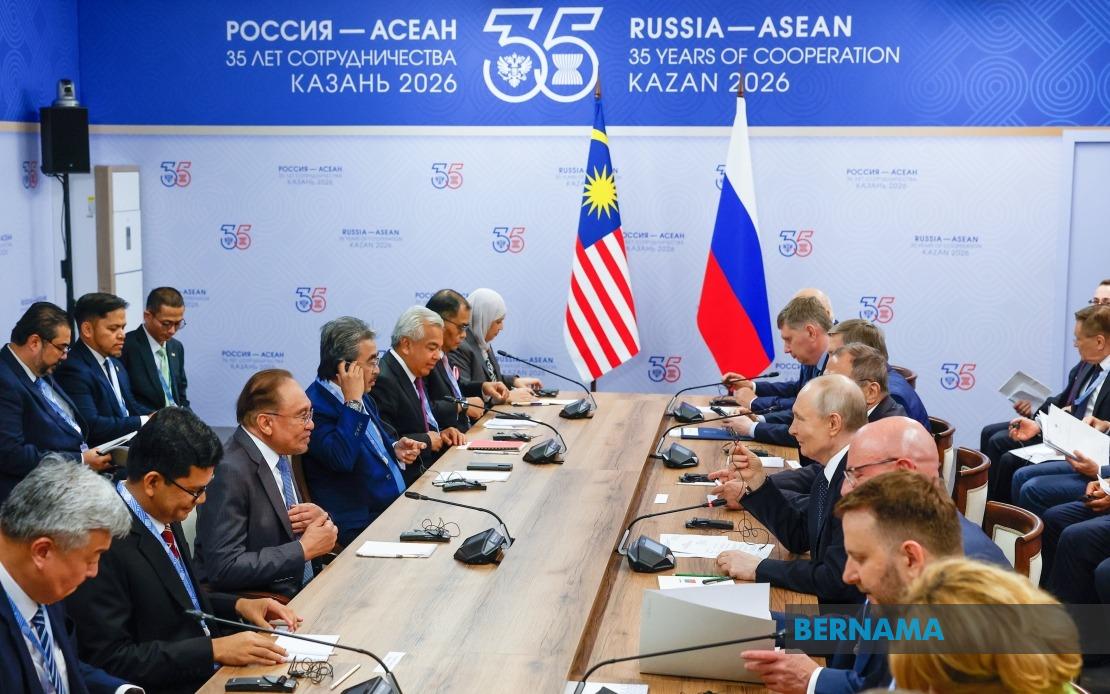
Russian President Vladimir Putin conveyed optimism about deepening Moscow's relationship with Malaysia during talks with Prime Minister Datuk Seri Anwar Ibrahim at the ASEAN-Russia Commemorative Summit in Kazan on June 18. The two leaders discussed prospects for enhanced bilateral engagement at a pivotal moment, with the countries poised to commemorate six decades of formal diplomatic ties in 2025. Putin emphasised that the foundation for expanded cooperation has been firmly established through years of substantive interaction and mutual commitment to shared objectives across multiple sectors.
The significance of the upcoming 60th anniversary milestone reflects the maturity and resilience of the Russia-Malaysia relationship. Putin characterised the approaching anniversary as an opportunity to build on what he described as "substantive positive experience" accumulated through sustained engagement between both nations' governments, legislatures, and various institutions. This framing underscores how bilateral ties have transcended traditional political cycles and weathered geopolitical shifts, remaining anchored in pragmatic cooperation despite broader global tensions and regional complexities.
Institutional mechanisms have proven crucial in maintaining momentum in the relationship. Moscow maintains regular diplomatic contact with Kuala Lumpur through multiple channels, including intergovernmental dialogue at ministerial and agency levels as well as parliamentary exchanges. An intergovernmental commission dedicated to economic, scientific, technical, and cultural cooperation serves as the primary vehicle for translating political goodwill into concrete collaborative projects. This structured approach demonstrates how both capitals have systematised their engagement rather than relying solely on episodic high-level visits, creating continuity regardless of personnel changes or shifting political priorities.
Trade dynamics reveal the practical viability of deeper economic integration. Bilateral commerce expanded by 12.9 per cent during 2025, signalling robust market activity and growing business confidence between the two economies. While the absolute figures were not disclosed, the double-digit growth rate exceeds many bilateral trade relationships and suggests that commercial actors on both sides perceive genuine opportunity for profitable engagement. For Malaysia, expanding Russian trade ties offers diversification benefits and access to energy resources and materials, while Russia gains exposure to Southeast Asian markets and Malaysian expertise in sectors such as palm oil production and regional distribution.
Education, science, and technology cooperation form important pillars of the strategic partnership. Putin specifically highlighted Moscow's commitment to collaborative programmes in these domains, recognising that knowledge exchange and human capital development create lasting bonds between societies. Such cooperation extends beyond immediate commercial returns, fostering people-to-people connections and institutional partnerships that build long-term mutual understanding. Joint research initiatives, student exchange programmes, and technology transfer arrangements help embed Russian-Malaysian relations into the fabric of civil society and academic institutions, reducing vulnerability to political fluctuations.
Cultural and humanitarian ties complement the economic and scientific dimensions. Tourism represents another avenue for expanding interactions, allowing citizens from both nations to experience each other's cultures directly. These softer aspects of bilateral relations often generate domestic constituencies supportive of friendly government-to-government ties, creating political resilience for the partnership. When ordinary Malaysians visit Russian cultural sites or when Russians experience Malaysian hospitality and heritage, they develop personal investments in maintaining good relations between their countries.
Malaysia's leadership role within ASEAN carries particular weight in Putin's strategic calculations. The Russian leader emphasised appreciation for Kuala Lumpur's support in strengthening Moscow's partnership with the 10-member regional bloc, noting that the inaugural Russia-ASEAN summit was held in Malaysia in 2005. This historical marker demonstrates Malaysia's long-standing commitment to facilitating Russian engagement with Southeast Asia. When Malaysia chaired ASEAN in 2024, Russia viewed this as an opportunity to reinforce institutional relationships with the organisation, and Putin's acknowledgment of Malaysian stewardship suggests Moscow values having a sympathetic voice within ASEAN's deliberations.
The Russia-ASEAN strategic partnership itself carries significance for regional stability and Malaysia's geopolitical positioning. By maintaining cordial relations with Moscow while also honouring its commitments to Western-aligned partners and managing relations with other major powers, Malaysia exemplifies the "hedging" approach common among Southeast Asian nations. Putin's recognition of Malaysia's balancing act implies Russian understanding that Kuala Lumpur operates within constraints and must manage multiple relationships simultaneously. This sophistication in Moscow's diplomacy contrasts with more confrontational approaches and may explain why Malaysia has successfully maintained productive ties with Russia despite international sanctions and geopolitical polarisation.
Putin's personal touches during the meeting, including conveying greetings to His Majesty Sultan Ibrahim, King of Malaysia, reflect diplomatic protocol while signalling respect for Malaysian institutions and leadership. The emphasis on mutual respect and consideration of interests—principles Putin articulated as foundational to the relationship—suggests an approach based on recognising Malaysia's sovereignty and agency rather than demanding alignment. For a country like Malaysia, which faces pressure from various quarters to take sides in global disputes, this rhetoric of non-coercive partnership holds particular appeal.
The timing of this engagement matters within broader geopolitical context. As Russia faces international isolation over its actions in Ukraine and seeks to strengthen ties with non-Western partners, deepening the Malaysia relationship serves Moscow's interests in maintaining economic and diplomatic space. Simultaneously, Malaysia's willingness to engage substantively with Russia—rather than maintaining purely perfunctory contacts—indicates that Kuala Lumpur views the relationship as valuable for its own strategic interests. This mutuality of interest, rather than coercion or ideological alignment, appears to characterise the partnership.
Looking ahead to 2025's 60th anniversary celebrations, both nations appear positioned to announce expanded cooperation frameworks or commemorative initiatives. The mention of "serious coordination towards further expansion" suggests concrete projects may be in development. These could span infrastructure investment, energy cooperation, agricultural trade, or defence ties, though none were publicly detailed during the Kazan meeting. The anniversary provides a natural occasion for institutionalising new arrangements and setting ambitious targets for the relationship's next phase.
For Malaysia specifically, strengthening Russia ties offers several strategic benefits. Economically, it diversifies trading partners and reduces over-reliance on Western or Chinese markets. Diplomatically, it enhances Malaysia's ability to navigate great power competition while maintaining its cherished non-aligned posture. Within ASEAN, Malaysia's successful management of the Russia relationship demonstrates the bloc's collective commitment to engaging all major powers constructively, rather than adopting Cold War-style alignments. As global tensions persist, Malaysia's model of principled pragmatism in its Russia ties offers a template for Southeast Asian nations seeking to preserve their agency in a polarised world.