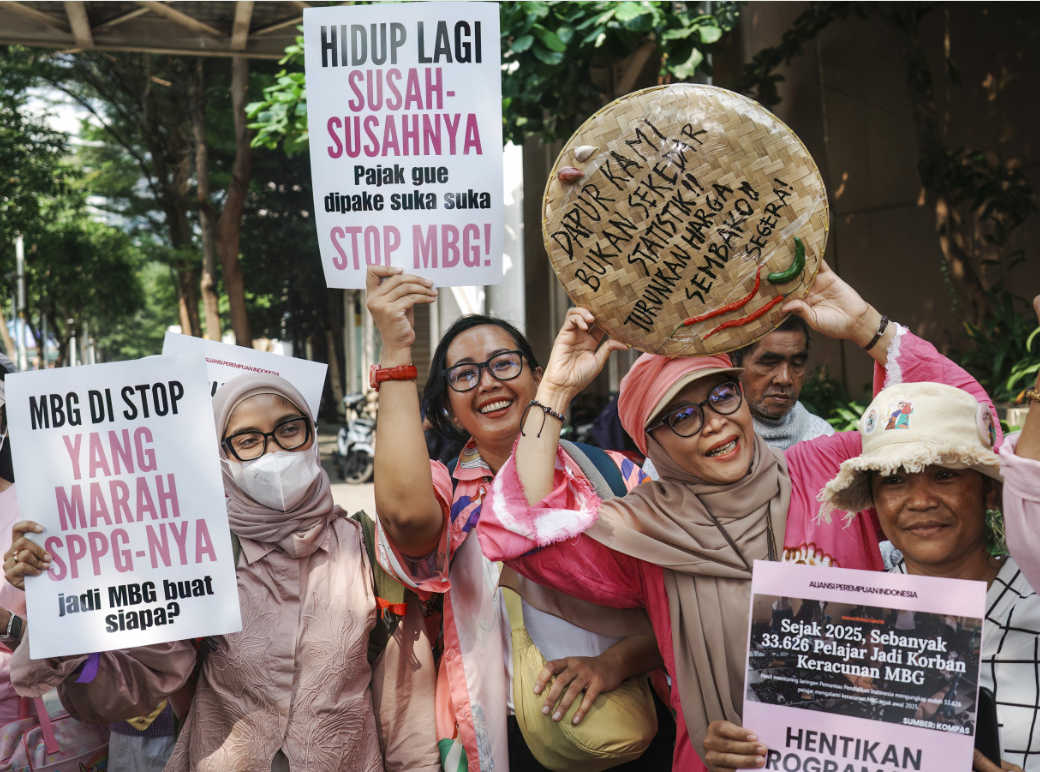
The foundation of President Prabowo Subianto's signature effort to combat child malnutrition and stunting is cracking under mounting scrutiny, as recipients of the free nutritious meal programme openly declare they would prefer forfeiting assistance over accepting substandard food. The willingness to reject government support represents a striking indictment of a scheme that cost Rp 268 trillion in the 2026 budget—a figure that itself underwent trimming after public backlash over its substantial expense and implications for education spending. What was envisioned as a transformative public health intervention has instead become emblematic of implementation challenges that reach far beyond individual kitchen operations, touching on questions of governmental accountability and resource allocation across Southeast Asia's largest economy.
The controversy crystallised with a jarring photograph shared on social media by Nesti Nagari, a mother from Kediri in East Java, depicting what appeared to be an unidentifiable white paste purportedly comprising her eight-month-old baby's nutritious meal. The image, garnering over 11,000 likes within a day, became the symbolic rallying point for broader dissatisfaction simmering among programme participants. Nagari's frank assessment—that no responsible parent would knowingly feed such substance to an infant—resonated precisely because it articulated what many beneficiaries had observed quietly but were reluctant to publicise. She subsequently disclosed that she had redirected the meal to her poultry rather than serve it to her child, and expressed openness to programme suspension or termination entirely if it meant resources could flow toward education and healthcare infrastructure instead. Her perspective carries particular weight because she represents the demographic the scheme targets: a household with demonstrated capacity to prioritise child nutrition but positioned below comfort thresholds that would negate assistance.
Parallel concerns emerged from Diah Farika, a nursing mother in Semarang, Central Java, whose experience since May enrolment revealed a troubling pattern of deteriorating meal standards. Rather than isolated incidents, Farika documented systematic problems: undersized portions, nutritionally unbalanced menus, and unripened fruit inclusions that suggested either procurement shortcuts or logistical mismanagement. When she raised objections through official channels, the nutrition fulfilment service unit responsible for meal preparation—known by its Indonesian acronym SPPG—dismissed her concerns with what she characterised as dismissive responses. This institutional indifference proved the decisive factor in her decision to decline meals, more consequential than the quality defects themselves. Farika's willingness to support temporary programme suspension for comprehensive kitchen inspections by the National Nutrition Agency reflects beneficiaries' capacity for nuanced evaluation: they distinguish between the programme's conceptual merit and operational failures, suggesting that solutions exist within the current institutional framework rather than necessitating wholesale abandonment.
The grievances articulated by individual mothers have mobilised organised advocacy. The Indonesian Women's Alliance staged a coordinated rally in Central Jakarta demanding governmental halt and thorough review of the programme's mechanics. These demonstrations, occurring alongside media coverage and social media discourse, have collectively elevated programme deficiencies from localised complaints to matters of political significance. The convergence of beneficiary rejection, activist mobilisation, and media attention creates a moment where continued programme expansion becomes politically untenable, explaining why the National Nutrition Agency subsequently halted expansion of the SPPG network despite its current scope encompassing approximately 27,000 kitchens across the archipelago.
The expansion freeze followed a corruption scandal ensnaring former BGN leadership, which damaged institutional credibility and complicated efforts to reassure stakeholders about operational integrity. The timing compounded difficulties for investors who had committed hundreds of billions of rupiah constructing SPPG facilities. These investors recently sought clarification from BGN leadership regarding programme continuity and their capital recovery prospects, reflecting legitimate commercial concerns that nonetheless complicate policy evaluation. Several kitchens temporarily shuttered in early June due to funding delays, though some subsequently resumed operations, further undermining public confidence in systematic administration.
MBG Watch, an independent oversight platform established by civil society organisations, has documented how accumulated problems erode institutional legitimacy beyond programme-specific concerns. The analytical framing deployed by Center of Economic and Law Studies researcher Isnawati Hidayah—questioning whether multibillion-dollar expenditures genuinely serve intended beneficiaries or primarily benefit intermediary contractors—articulates suspicions that circulate widely across Indonesian society. A CELIOS study estimated that approximately 34 percent of current beneficiaries, equating to roughly 61 million children and pregnant women, technically fall outside the most disadvantaged cohorts, instead encompassing economically stable households with adequate existing nutrition access. This inclusion pattern suggests either targeting mechanisms that prioritise scale over precision or insufficient means-testing procedures, both explanations implying programme redesign requirements.
Responding to accumulated pressure, the National Nutrition Agency has initiated corrective measures acknowledging previous trajectory errors. As of Thursday, the agency had removed 76 schools across Java from beneficiary rolls, affecting more than 39,000 recipients. BGN deputy head and spokesperson Agustina Arumsari characterised this recalibration as refocusing assistance toward populations demonstrating genuine dependence on governmental nutritional support. Simultaneously, the agency implemented austerity measures including eliminating incentive payments to kitchens during non-operational periods and subjecting underperforming facilities to evaluation. These adjustments suggest recognition that programme continuation requires demonstrated operational competence rather than mere expansion.
The Indonesian experience offers instructive lessons for regional policymakers contemplating large-scale nutritional assistance programmes. The disconnect between beneficiary needs assessment and implementation capacity—evident when mothers receive unidentifiable food substances—indicates that even well-resourced initiatives falter when operational frameworks prove inadequate. Malaysia and other Southeast Asian nations expanding social assistance schemes might examine whether their oversight mechanisms, kitchen standards, menu development protocols, and quality assurance procedures genuinely align with programme objectives before scaling expansion. The willingness of beneficiaries to forgo assistance rather than accept inferior provision suggests that public support for welfare initiatives depends fundamentally on delivered quality, not merely intentions or budget allocations.
Looking forward, the programme's trajectory remains uncertain. Continued beneficiary rejection, investor concerns regarding capital security, and activist pressure suggest that restoration of institutional credibility requires demonstrable operational improvements rather than rhetorical commitments. The National Nutrition Agency's narrowing of beneficiary scope and kitchen evaluations represent pragmatic acknowledgment that programme viability depends on delivery quality. For Indonesia's broader development agenda, the current episode poses uncomfortable questions about governmental capacity to execute complex social programmes at unprecedented scale. Whether the institution can recover public confidence through systematic improvement or whether structural deficiencies prove insurmountable remains to be determined, but the phenomenon of beneficiaries voluntarily rejecting assistance suggests that the current trajectory is unsustainable regardless of budgetary commitments.

%22%2F%3E%3C%2Fpattern%3E%3C%2Fdefs%3E%3Crect%20width%3D%22100%25%22%20height%3D%22100%25%22%20fill%3D%22url(%23ph523ndg)%22%2F%3E%3Crect%20width%3D%22100%25%22%20height%3D%22100%25%22%20fill%3D%22url(%23ph523ndp)%22%2F%3E%3Ctext%20x%3D%2250%25%22%20y%3D%2250%25%22%20text-anchor%3D%22middle%22%20dominant-baseline%3D%22central%22%20fill%3D%22rgba(255%2C255%2C255%2C0.95)%22%20font-family%3D%22Georgia%2C%20'Times%20New%20Roman'%2C%20serif%22%20font-weight%3D%22700%22%20font-size%3D%22272%22%20letter-spacing%3D%22-0.02em%22%3EAnwar%3C%2Ftext%3E%3C%2Fsvg%3E)