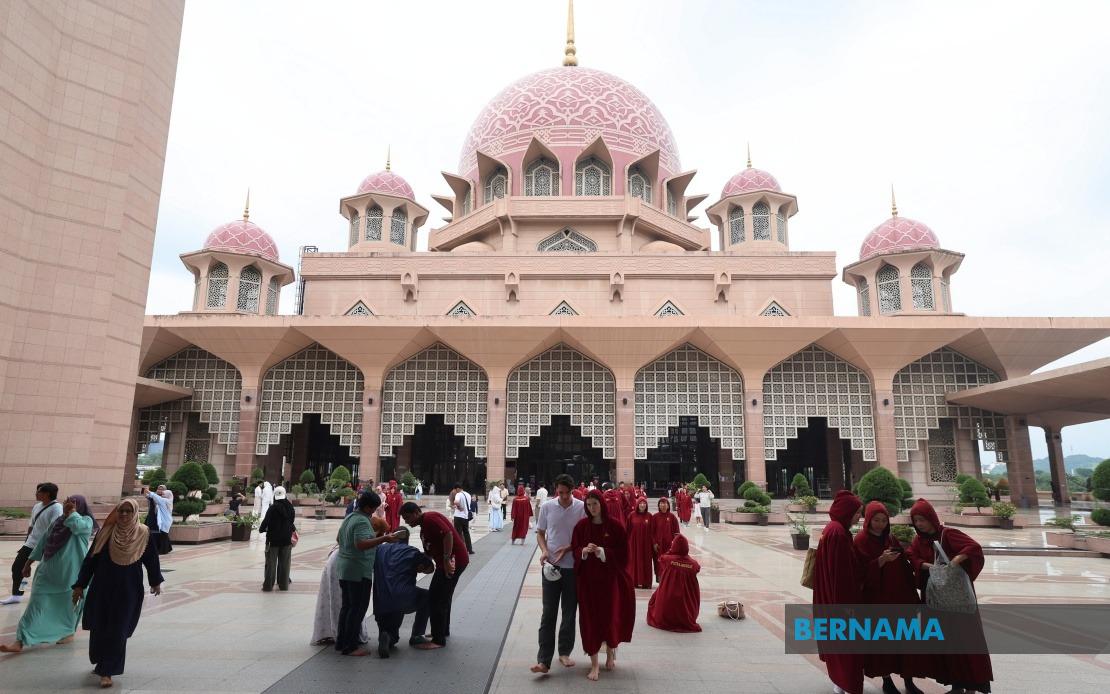
The Putra Mosque in Putrajaya will serve as the venue for Malaysia's National Maal Hijrah 1448H/2026M celebration, drawing an estimated 5,000 participants from within the country and abroad. The significant religious and national observance underscores Malaysia's commitment to commemorating the Prophet Muhammad's migration to Medina, a pivotal moment in Islamic history that established the foundation for Islamic civilisation's development.
Sultan of Perak Sultan Nazrin Shah will officiate the proceedings, lending the occasion the gravitas befitting a national event of religious importance. Accompanying the Sultan will be a distinguished assembly of government figures, including Deputy Prime Ministers Datuk Seri Ahmad Zahid Hamidi and Datuk Seri Fadillah Yusof, various Cabinet ministers, foreign diplomatic representatives, heads of government departments and other senior officials. This high-level attendance reflects the multifaceted significance of Maal Hijrah celebrations across Malaysia's political and religious establishments.
The centrepiece of the day's programme will be the Sultan's royal address to the gathered audience, conveying messages aligned with the event's spiritual and national objectives. Following this keynote address, the presentation of the National and International Tokoh Maal Hijrah Awards will take place, honouring individuals whose contributions to Islam and society have been deemed exemplary.
The Tokoh Maal Hijrah Awards carry considerable prestige within Malaysia's Islamic community and beyond. Recipients are selected based on stringent criteria encompassing profound knowledge within their respective professional or academic domains, demonstrated moral character of the highest standard, and substantive contributions to advancing Islamic understanding and practice at both domestic and international spheres. These awards thus recognise not merely religious scholarship but also practical and meaningful engagement with Islamic values across diverse fields of human endeavour.
The Department of Islamic Development Malaysia (JAKIM) has framed this year's observance around a deliberate thematic choice designed to inspire deeper reflection among the Muslim population. By encouraging believers to reconnect with the spirit underlying the Prophet's Hijrah, the celebration aims to position this historical event as an ongoing source of spiritual renewal and motivation. The theme effectively reframes Hijrah not as a distant historical occurrence but as a living principle capable of inspiring contemporary Muslims to pursue positive transformation in their personal and collective lives.
A notable innovation within this year's programme is the Tausiyyah @ Maal Hijrah initiative, which was conducted at the mosque during the preceding day. This programme emphasised tadabbur, the Islamic practice of profound contemplation and reflection upon Quranic verses. Rather than approaching the Quran as a text for recitation alone, the programme structured its activities to deepen participants' comprehension of the textual messages, the wisdom embedded within those messages, and the practical guidance they offer. Distinguished qari—professional Quran reciters—performed selections, while facilitators guided attendees in extracting meaning and determining how those meanings could inform daily decision-making and ethical conduct.
The Department's approach reflects a growing recognition within Malaysia's Islamic institutions that contemporary Muslims require spaces and frameworks for deep theological and spiritual engagement. The Tausiyyah programme demonstrates an institutional commitment to moving beyond ceremonial observance toward substantive religious education and personal spiritual development. For Malaysian readers, this signals a shift in how major Islamic celebrations are being conceptualised—less as national holidays and more as opportunities for systematic spiritual renewal.
Extending the celebration's reach beyond the primary ceremony, the National and International Tokoh Maal Hijrah Lecture 1448H/2026 will convene the following day at the Putrajaya Islamic Complex Auditorium from 9 am. This lecture series will feature the award recipients themselves as speakers, creating an educational platform where their expertise, experiences and insights can benefit a broader audience. Such knowledge-sharing sessions serve to amplify the impact of individual achievement and make award recipients' contributions accessible to students, professionals, religious leaders and engaged citizens seeking to understand how Islamic principles can be translated into meaningful action across different sectors.
For Malaysia and the broader Southeast Asian context, this celebration carries particular significance. The country's multicultural and multi-religious composition means that national observances of Islamic occasions must balance inclusive governance with authentic religious expression. By hosting such major celebrations with full government participation and international attendance, Malaysia demonstrates its positioning as a Muslim-majority nation with sophisticated, globally-engaged Islamic institutions. The inclusion of international guests and the conferral of International Tokoh awards positions Malaysian Islamic scholarship and achievement within transnational networks of Islamic learning and practice.
The calibre of participants and the substantive programming also reflect Malaysia's efforts to present Islam as intellectually rigorous, spiritually dynamic and socially constructive. In a regional context where Islamic practice sometimes faces stereotyping or misunderstanding, celebrations such as Maal Hijrah—when executed with intellectual depth and high-level political commitment—serve to communicate a vision of Islam that is both traditional in its theological foundations and contemporary in its applications and expressions. This messaging carries implications not only for Muslim communities within Malaysia but also for inter-religious understanding and Malaysia's international reputation as a moderate Islamic-majority nation.
The comprehensive programme spanning multiple days and encompassing spiritual reflection, recognition of achievement and knowledge dissemination indicates that Malaysian institutions view Maal Hijrah as more than a commemorative date. Instead, it represents an occasion for institutional renewal, community building and the articulation of Islamic values through contemporary frameworks. As Malaysia navigates questions about religious identity, development and globalisation, celebrations like this one serve as annual touchpoints where the nation's political, religious and civil society leaders gather to reaffirm shared commitment to Islamic principles and their role in national life.