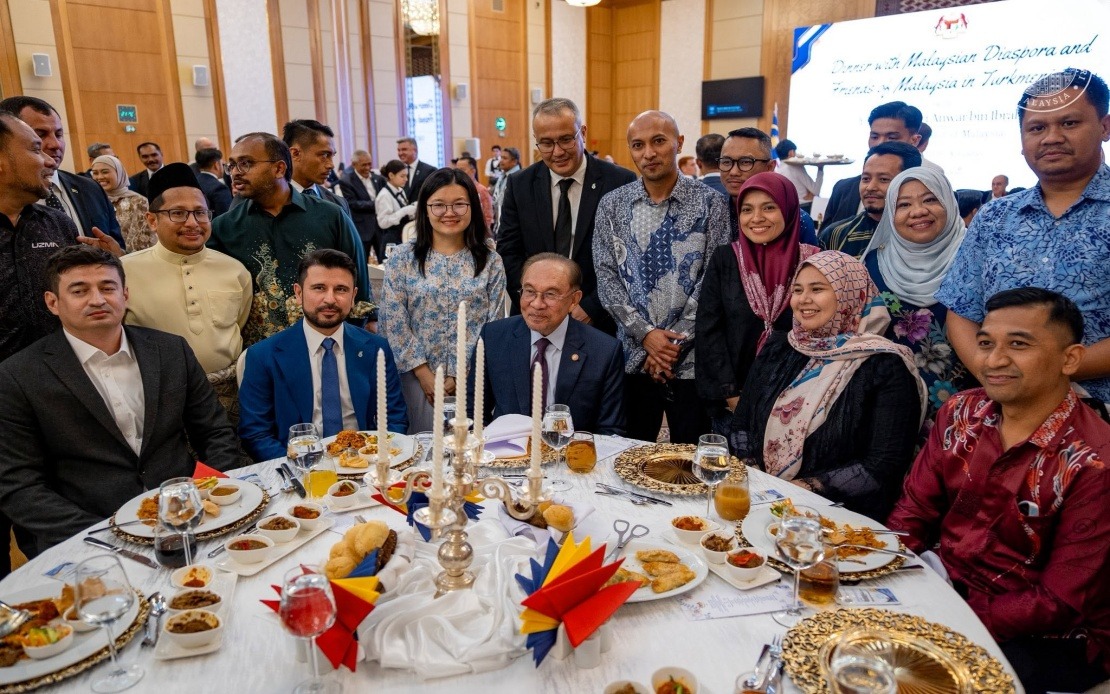
Prime Minister Datuk Seri Anwar Ibrahim has made a point of meeting with members of the Malaysian diaspora community during his current visit to Ashgabat, Turkmenistan, underscoring the MADANI Government's commitment to nurturing relationships with citizens living abroad. The engagement reflects a broader diplomatic strategy that recognizes Malaysians scattered across the globe as vital assets to the nation's soft power and international standing.
During his interactions with the diaspora group in Ashgabat, Anwar emphasized the importance of maintaining strong bonds with Malaysia despite geographical distance. He encouraged members of the community to stay informed about developments taking place in their home country and to remain emotionally and intellectually connected to Malaysian affairs. This outreach signals that the government views its overseas population not merely as expatriates, but as stakeholders with a vested interest in the nation's trajectory and prosperity.
Anwar characterized these Malaysians abroad as unofficial ambassadors for the country, suggesting that their professional accomplishments, civic contributions, and personal conduct in their adopted nations serve to enhance Malaysia's global reputation and standing. The Prime Minister's framing acknowledges that diaspora communities often function as cultural bridges and network-builders, helping to expand Malaysia's influence across multiple continents and sectors. By publicly recognizing this role, Anwar signals that the government values the diaspora's contributions to national prestige and international relations.
The timing of this engagement is significant given that Anwar is currently undertaking his first official visit to Turkmenistan, a strategic Central Asian nation. The visit extends beyond conventional economic parameters, according to the Prime Minister, to encompass deeper diplomatic objectives including the strengthening of bilateral friendship and the cultivation of mutual understanding. This multifaceted approach to international relations reflects Malaysia's effort to position itself as a bridge-builder within Asia and beyond, capable of engaging with diverse regions and cultures.
The visit itself was initiated following an invitation from Turkmenistan President Serdar Berdimuhamedov, who had travelled to Malaysia in December 2024 on an official state visit. Such reciprocal high-level visits represent a reciprocal commitment to strengthening ties and creating a foundation for expanded cooperation. For Malaysia, engaging with Central Asian nations like Turkmenistan opens pathways for trade partnerships, investment opportunities, and cultural exchanges that can diversify the country's international footprint and reduce dependency on traditional regional markets.
Anwar's engagement with Malaysians in Ashgabat reflects a growing recognition within Malaysian government circles that diaspora communities can serve as conduits for fostering deeper bilateral relationships between Malaysia and their host countries. When diaspora members are actively engaged and encouraged to feel connected to home, they become more likely to promote Malaysian interests, facilitate business introductions, and foster cultural understanding in their professional and social circles. This creates informal channels of influence that complement formal diplomatic structures.
The diaspora outreach also carries domestic political significance. By demonstrating government attention to Malaysians abroad and encouraging them to remain connected to national affairs, the MADANI administration signals that it views citizenship as a lasting bond rather than a geographical constraint. This approach can strengthen national cohesion by reminding citizens living overseas that Malaysia remains invested in their wellbeing and that they maintain a role in the nation's collective future, potentially encouraging diaspora members to eventually return home or maintain stronger ties with Malaysia.
For Southeast Asian context, Malaysia's diaspora-focused diplomacy aligns with broader regional trends of countries recognizing the strategic value of overseas communities. Nations across ASEAN have increasingly implemented diaspora engagement programs, recognizing that overseas communities contribute substantially to remittances, foreign direct investment, technology transfer, and soft power projection. Malaysia's approach under the MADANI Government appears to be moving in this direction, potentially creating more formal structures and initiatives to harness diaspora potential.
The emphasis on expanding cooperation between Malaysia and Turkmenistan extends the geographical reach of Malaysian diplomacy into Central Asia, a region historically less prioritized than Southeast Asia or South Asia. By pursuing engagement at multiple levels—government-to-government, business-to-business, and people-to-people through diaspora networks—Malaysia is attempting to create more robust and resilient bilateral relationships. This diversification of international partnerships is particularly relevant for a nation seeking to navigate an increasingly complex geopolitical landscape marked by great power competition and shifting regional alignments.
Anwar's public acknowledgment of the diaspora meeting, shared through social media, indicates that the government views such engagements as worthy of broader public awareness and discussion. This transparency helps demonstrate government responsiveness to overseas constituents and may encourage other diaspora communities to engage more actively with Malaysian diplomatic missions. The practice also creates positive narratives that can be deployed domestically to show the government's reach and influence on the global stage.

%22%2F%3E%3C%2Fpattern%3E%3C%2Fdefs%3E%3Crect%20width%3D%22100%25%22%20height%3D%22100%25%22%20fill%3D%22url(%23ph523ndg)%22%2F%3E%3Crect%20width%3D%22100%25%22%20height%3D%22100%25%22%20fill%3D%22url(%23ph523ndp)%22%2F%3E%3Ctext%20x%3D%2250%25%22%20y%3D%2250%25%22%20text-anchor%3D%22middle%22%20dominant-baseline%3D%22central%22%20fill%3D%22rgba(255%2C255%2C255%2C0.95)%22%20font-family%3D%22Georgia%2C%20'Times%20New%20Roman'%2C%20serif%22%20font-weight%3D%22700%22%20font-size%3D%22272%22%20letter-spacing%3D%22-0.02em%22%3EAnwar%3C%2Ftext%3E%3C%2Fsvg%3E)