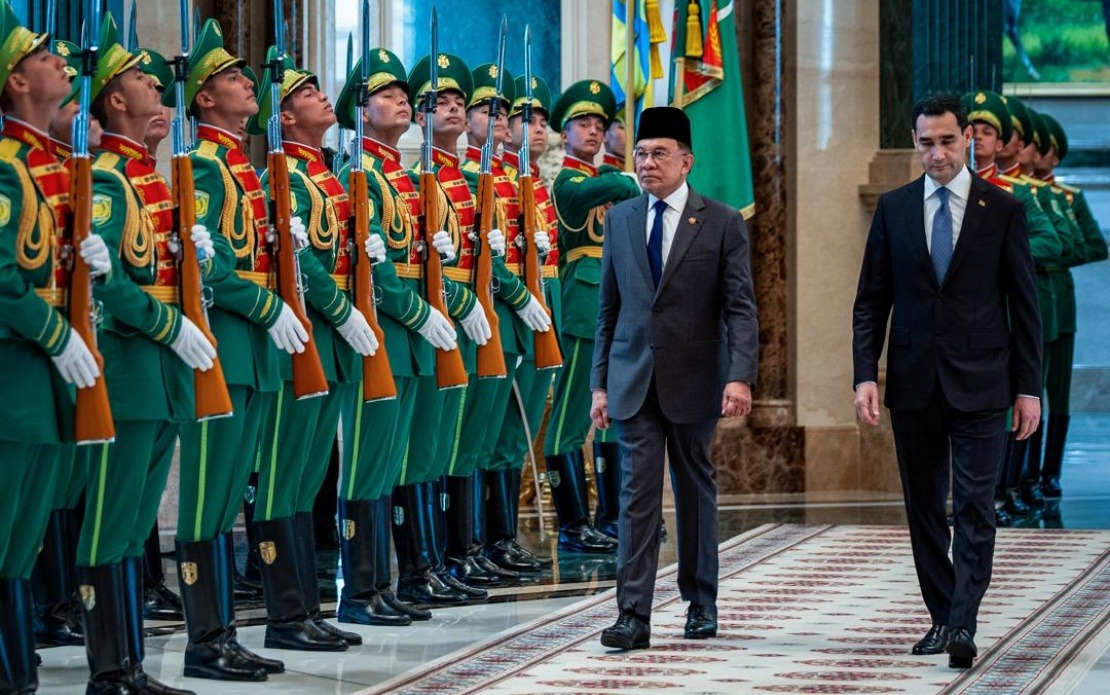
Prime Minister Datuk Seri Anwar Ibrahim was accorded full ceremonial honours at the Turkmenistan Presidential Palace in Ashgabat on June 19, underscoring the significance both nations attach to deepening their relationship. The visit, which commenced on June 18 and continues through a second day, represents the first official journey by Malaysia's 10th Prime Minister to this oil-rich Central Asian nation since his assumption of office in November 2022.
The reception itself carried considerable diplomatic weight. Upon his arrival, Anwar was greeted by Turkmenistan President Serdar Berdimuhamedov in a ceremony featuring a full military guard of honour and the simultaneous playing of both nations' national anthems—a gesture typically reserved for state visits of particular importance. Such protocol underscores Ashgabat's recognition of Malaysia's standing within the broader Islamic and developing world, while simultaneously signalling Kuala Lumpur's commitment to expanding engagement with resource-rich nations beyond its traditional Southeast Asian sphere.
The formal itinerary proceeded with customary diplomatic procedures designed to facilitate substantive dialogue. Anwar was subsequently introduced to key members of Turkmenistan's cabinet and senior government figures, allowing the Malaysian delegation to establish working relationships at multiple levels of the host administration. This structural approach to statecraft ensures that cooperation frameworks extend beyond the heads of state, creating institutional channels through which practical collaboration can flourish.
Following these ceremonial introductions, the two leaders engaged in what diplomats term a "four-eyed meeting"—a private, one-on-one session between heads of government without advisers present. Such intimate discussions typically address the most sensitive bilateral matters and allow for frank exchanges on issues requiring confidentiality. The format reflects the trust both leaders wish to establish and provides space for candid discussion about strategic priorities and shared concerns without the formality that characterises larger delegations.
The bilateral meeting that succeeded this private session broadened the discussion to include the full delegations of both nations. These expanded discussions traditionally focus on concrete areas of cooperation—trade and investment frameworks, cultural exchanges, educational partnerships, energy cooperation, and regional security concerns. For Malaysia, engagement with Turkmenistan offers particular strategic value given the country's significant natural gas reserves and its geographic position as a bridge between the Caspian region and Asian markets.
Turkmenistan holds considerable importance within Malaysia's broader Central Asian strategy. The country possesses vast hydrocarbon reserves, making energy security partnerships potentially valuable for Malaysia's long-term requirements. Additionally, as a predominantly Muslim nation with a sophisticated bureaucratic system, Turkmenistan represents a natural partner for Malaysian diplomatic, commercial, and cultural initiatives. The bilateral relationship, though historically modest in scale, carries potential for meaningful expansion across multiple sectors.
This visit arrives at a juncture when Malaysia actively broadens its international engagement profile. Under Anwar's leadership, the government has pursued what might be characterised as a recalibration of Malaysia's foreign policy—seeking to deepen ties with traditional partners while simultaneously exploring new opportunities in regions previously receiving limited diplomatic attention. The Central Asian journey reflects this strategic repositioning, signalling that Kuala Lumpur views the post-Soviet republics not as peripheral to its interests but as integral components of a diversified international engagement strategy.
For Southeast Asia more broadly, Malaysia's outreach to Central Asia carries subtle implications. The region's growing geopolitical significance—caught between Russian, Chinese, and Western spheres of influence—makes Malaysian engagement potentially valuable as a non-aligned perspective rooted in the Islamic world and the Global South. Malaysian diplomatic initiatives in Turkmenistan and comparable nations contribute to a broader narrative of South-South cooperation that emphasises mutual benefit over hegemonic influence.
The timing of this inaugural presidential visit also reflects Malaysia's institutional rhythms. As Anwar consolidates his tenure and his government settles into administrative patterns, the expansion of diplomatic travel becomes feasible. The two-day format allows sufficient time for substantive negotiations while maintaining the prime minister's commitments in Kuala Lumpur, representing a practical balance between ambition and administrative necessity.
Both nations appear positioned to translate ceremonial warmth into practical collaboration. The formal structures established during this visit—the introductions to cabinet members, the bilateral framework discussions—create scaffolding upon which concrete projects can be constructed. Whether cooperation ultimately extends to energy partnerships, cultural exchanges, or educational collaborations remains to be seen, but the diplomatic groundwork has been intentionally laid.
Looking forward, this visit may catalyse a recalibration in how Malaysia engages with Central Asia. Ashgabat's full-honours reception suggests receptiveness to enhanced ties, while Anwar's presence at the Presidential Palace demonstrates Malaysia's willingness to invest political capital in the relationship. The ultimate measure of success will emerge not from the ceremony itself, but from the substantive outcomes that follow—whether in bilateral trade growth, institutional partnerships, or shared regional initiatives that benefit both nations.

%22%2F%3E%3C%2Fpattern%3E%3C%2Fdefs%3E%3Crect%20width%3D%22100%25%22%20height%3D%22100%25%22%20fill%3D%22url(%23ph523ndg)%22%2F%3E%3Crect%20width%3D%22100%25%22%20height%3D%22100%25%22%20fill%3D%22url(%23ph523ndp)%22%2F%3E%3Ctext%20x%3D%2250%25%22%20y%3D%2250%25%22%20text-anchor%3D%22middle%22%20dominant-baseline%3D%22central%22%20fill%3D%22rgba(255%2C255%2C255%2C0.95)%22%20font-family%3D%22Georgia%2C%20'Times%20New%20Roman'%2C%20serif%22%20font-weight%3D%22700%22%20font-size%3D%22272%22%20letter-spacing%3D%22-0.02em%22%3EAnwar%3C%2Ftext%3E%3C%2Fsvg%3E)