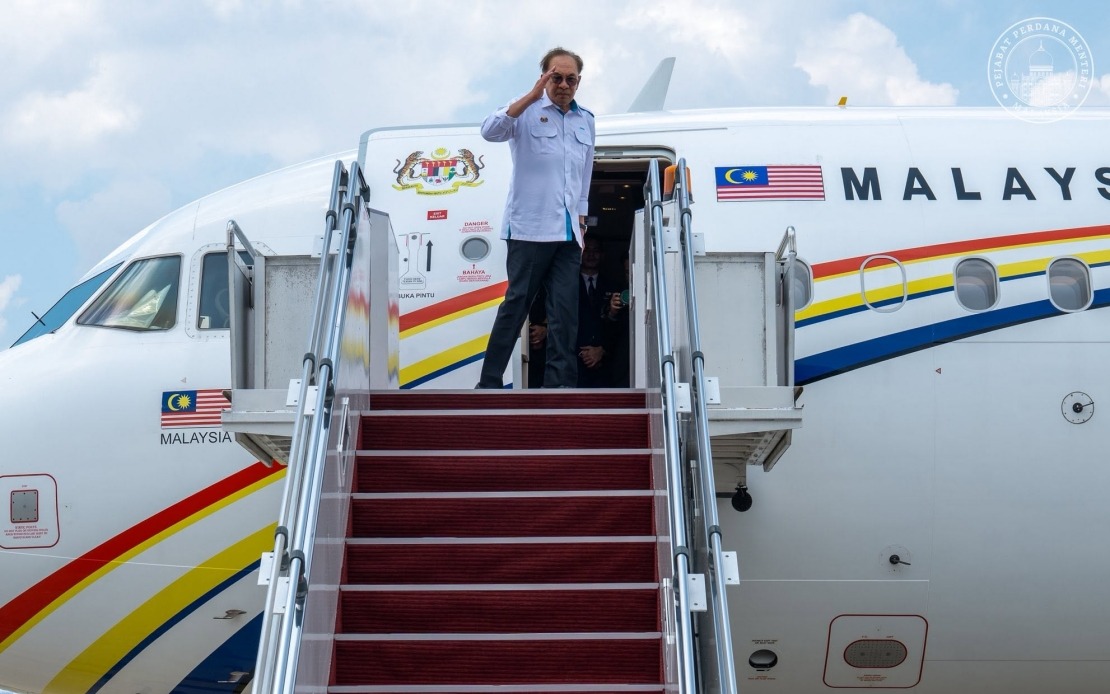
Prime Minister Datuk Seri Anwar Ibrahim departed Subang Air Base on June 16 to attend the ASEAN-Russia Commemorative Summit in Kazan, marking a significant diplomatic engagement that underscores Malaysia's commitment to strengthening regional partnerships beyond Southeast Asia. The summit represents a landmark moment in the long-standing relationship between the Association of Southeast Asian Nations and Russia, with the gathering set to take place from June 17 to 18.
Anwar's participation in Kazan carries considerable strategic weight, as he is scheduled to conduct bilateral discussions with Russian President Vladimir Putin on matters of mutual interest. Beyond the bilateral component, the Prime Minister will also be present at the Russia-ASEAN Business Forum, an event designed to foster commercial ties and explore investment opportunities between Russian enterprises and Southeast Asian counterparts. These engagements reflect Malaysia's broader effort to maintain pragmatic relationships across the Eurasian geopolitical landscape.
The delegation accompanying Anwar reflects the multifaceted nature of the engagement. Datuk Seri Johari Abdul Ghani, who holds the portfolio of Minister of Investment, Trade and Industry, will be present alongside Minister of Economy Akmal Nasrullah Mohd Nasir. This composition signals Malaysia's intention to advance economic and trade dimensions of the partnership, with both ministers able to negotiate on industrial cooperation, investment frameworks, and sectoral opportunities. Supporting officials from the Prime Minister's Office and Wisma Putra will provide institutional continuity and diplomatic expertise.
The summit itself commemorates thirty-five years of ASEAN-Russia diplomatic relations, a partnership formally established in Kuala Lumpur during 1991. This anniversary holds particular significance as it provides both parties with an opportunity to assess the trajectory of their engagement and recalibrate their strategic approach for the coming decades. The longevity of the relationship, despite geopolitical fluctuations, demonstrates the resilience of institutional frameworks connecting Southeast Asia with Moscow.
According to Wisma Putra's preparatory statement, the Kazan gathering will serve as a comprehensive review mechanism, allowing ASEAN and Russia to evaluate collaborative achievements spanning three and a half decades while simultaneously establishing parameters for future cooperation under the ASEAN-Russia Strategic Partnership framework. This dual focus—retrospective assessment and forward planning—ensures that discussions remain grounded in historical context while remaining responsive to contemporary regional challenges and opportunities.
The substantive agenda encompasses a remarkably broad spectrum of sectoral cooperation. Trade and investment discussions will likely emphasize tariff arrangements, supply chain integration, and joint ventures in strategic industries. Energy cooperation remains particularly salient given Russia's significant hydrocarbon reserves and ASEAN's considerable energy demand; discussions may explore liquefied natural gas contracts, alternative energy collaboration, and infrastructure development. Food security—an increasingly urgent concern across Southeast Asia amid climate volatility and supply chain disruptions—will feature prominently, with potential focus on agricultural technology transfer and market access arrangements.
Digital economy and technological advancement represent emerging dimensions of ASEAN-Russia engagement that reflect twenty-first-century priorities. Both regions possess complementary capabilities in information technology, artificial intelligence, and digital infrastructure development. Malaysia, as a middle-income nation with growing technological sophistication, stands to benefit from Russian expertise in certain high-tech sectors while potentially offering Southeast Asian market access and manufacturing capabilities to Russian companies. Science and technology collaboration could encompass research partnerships, academic exchanges, and joint development initiatives.
Cultural, educational, and people-to-people dimensions of the partnership should not be underestimated in their geopolitical significance. Educational scholarships enabling Southeast Asian students to study in Russian institutions, cultural festivals, and tourism promotion initiatives all contribute to deeper mutual understanding and soft power projection. These exchanges build constituencies within each region that favor closer ties and create networks that often persist across political transitions.
Following the Kazan programme, Anwar will undertake a subsequent official visit to Ashgabat, Turkmenistan, at the invitation of President Serdar Berdimuhamedow. This continuation reflects Malaysia's broader Central Asian engagement strategy and suggests coordinated diplomatic outreach across the Eurasian space. The Turkmenistan leg underscores that Malaysia's diplomatic calendar increasingly encompasses Central Asian interlocutors, a shift reflecting changing regional balances and Malaysia's diversification of partnerships.
The timing and composition of Anwar's delegation signal several analytical insights regarding Malaysia's contemporary foreign policy orientation. The presence of senior economic ministers alongside the Prime Minister indicates that economic statecraft ranks prominently alongside traditional diplomatic objectives. Malaysia is positioning itself as a serious participant in Russia-ASEAN relations rather than a passive member of a collective framework, seeking bilateral advantages while contributing to regional consensus. This balanced approach—simultaneous emphasis on ASEAN-wide cooperation and bilateral advantage—characterizes sophisticated middle-power diplomacy.
For Malaysian readers and regional observers, Anwar's participation carries implications extending beyond ceremonial diplomatic engagement. The visit potentially influences supply chain negotiations affecting consumer prices, establishes frameworks for technology transfer benefiting Malaysian industries, and positions Malaysia as a meaningful interlocutor in discussions shaping Eurasian economic architecture. In a region where countries navigate complex relationships with major powers, Malaysia's engagement with Russia through both ASEAN collective mechanisms and bilateral channels demonstrates strategic flexibility.
The summit's focus on practical cooperation rather than geopolitical confrontation reflects ASEAN's traditional preference for pragmatic engagement transcending ideological divides. Neither ASEAN nor Malaysia appears positioned to choose between major power blocs; instead, the strategy emphasizes extracting maximum benefit from diversified partnerships. In an era of renewed great power competition, this approach—neither confrontational nor subordinate—represents a distinctly Southeast Asian contribution to managing international relations.