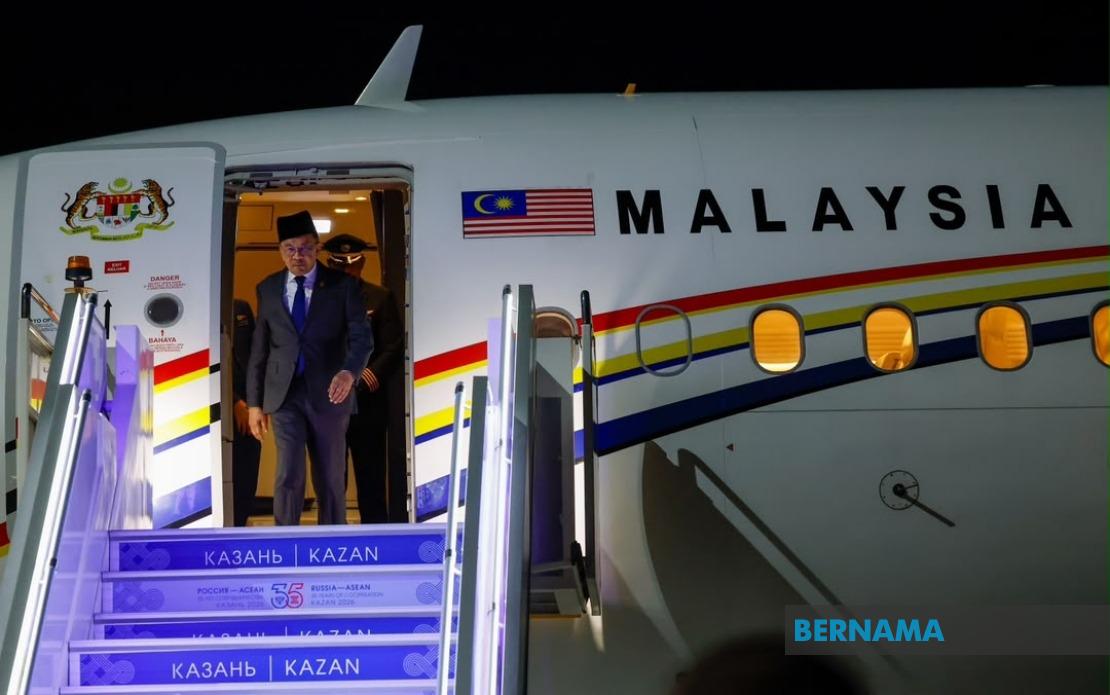
Prime Minister Datuk Seri Anwar Ibrahim touched down in Kazan on Sunday evening to participate in a milestone diplomatic gathering that underscores Malaysia's role in maintaining Southeast Asia's standing with major world powers. His aircraft landed at Kazan International Airport at 10:20 pm local time, beginning a two-day visit centred on the ASEAN-Russia Commemorative Summit scheduled for June 17-18. The timing of this engagement reflects Malaysia's broader strategic positioning in an era where middle powers must carefully balance relationships across competing geopolitical spheres.
The prime minister arrived accompanied by a substantial delegation that speaks to the importance attached to these discussions. Minister of Investment, Trade and Industry Datuk Seri Johari Abdul Ghani and Minister of Economy Akmal Nasrullah Mohd Nasir travelled with Anwar, signalling that economic and trade considerations sit at the forefront of Malaysia's agenda. Officials from the Prime Minister's Office and the Foreign Ministry rounded out the contingent, indicating that the visit encompasses both high-level political engagement and technical coordination across multiple government departments. Upon arrival, Malaysia's Ambassador to Russia Datuk Cheong Loon Lai formally received the prime minister, while the Russian side welcomed him through the Minister of Digital Development of Tatarstan Ilya Nachvin, Kazan Mayor Ilsur Metshin and State Protocol Department officials.
The summit itself carries symbolic significance as the bloc commemorates three and a half decades of formal relations. When ASEAN and Russia established diplomatic ties in Kuala Lumpur in 1991, the Cold War was ending and Southeast Asia was beginning its emergence as a region of significant economic weight. The relationship has matured substantially since then, moving from early post-Cold War positioning into genuine partnership across multiple sectors. This commemorative gathering provides both sides with an opportunity to take stock of achievements and reshape priorities for a new strategic era marked by great power competition, economic interdependence and shared environmental challenges.
Expectations for the summit reveal the breadth of contemporary cooperation between ASEAN and Russia. Discussions are anticipated to span traditional state concerns such as trade and investment flows, energy security and agricultural production, while incorporating newer priorities including digital economy development, scientific and technological advancement, cultural preservation and educational exchanges. This comprehensive agenda reflects how modern strategic partnerships must address both immediate economic interests and longer-term societal needs. For Malaysia specifically, these discussions offer opportunities to deepen bilateral arrangements while also helping shape ASEAN's collective position on issues affecting all member states.
The summit's expected output demonstrates the serious intent behind the gathering. Four substantive outcome documents are anticipated, beginning with the Kazan Declaration marking the 35th anniversary milestone and continuing with specialised joint statements on energy and cultural cooperation. A Comprehensive Plan of Action covering 2026-2030 will provide a roadmap for implementation of the broader ASEAN-Russia Strategic Partnership framework. These documents signal that both sides view this relationship as requiring structured, long-term commitment rather than ad-hoc engagement. The guiding principles embedded in these texts will shape practical cooperation across governments, businesses and civil society for years to come.
Malaysia's official positioning on this visit emphasises ASEAN Centrality, a concept that has become increasingly important as the region seeks to maintain influence in a world shaped by competing great powers. By participating actively in ASEAN-Russia engagement, Malaysia demonstrates commitment to ensuring that Southeast Asia remains a key player in regional diplomacy rather than becoming a passive arena for external competition. The Foreign Ministry's statement notes that Malaysia's participation reflects determination to strengthen ASEAN's external relations and advance practical cooperation with major Dialogue Partners in an increasingly complex geopolitical environment. This framing suggests that engagement with Russia is part of a deliberate strategy to diversify partnerships and avoid over-reliance on any single power.
During his Kazan stay, Anwar is scheduled to meet Russian President Vladimir Putin and conduct separate discussions with the Rais of the Republic of Tatarstan. These bilateral conversations complement the broader multilateral ASEAN-Russia summit and allow the prime minister to address Malaysia-specific interests. Topics likely to feature prominently include advocacy for dialogue and peace initiatives, measures to support economic resilience in the face of global uncertainties, advancement of energy and food security cooperation and efforts to deepen people-to-people connections. Each of these themes connects to both Malaysian national priorities and broader Southeast Asian concerns about stability and prosperity.
Anwar's visit to Kazan represents his third engagement with Russia since becoming prime minister in November 2022, indicating a pattern of sustained high-level diplomatic effort. His initial visit came in September 2024 when he attended the Eastern Economic Forum in Vladivostok, providing opportunity to engage with Russian officials on the margins of a major business and investment gathering. This was followed by a more formal state visit to Moscow in May 2025, during which the prime minister and President Putin discussed cooperation across an expansive range of sectors including trade, investment, agriculture, education, aerospace and energy. The frequency of these interactions suggests that both countries view bilateral relations as significant enough to merit regular top-level attention.
The progression of these visits reveals evolution in the relationship's depth. The Eastern Economic Forum appearance positioned Malaysia as a regional economic participant interested in Russian development initiatives. The Moscow visit elevated engagement to focus on bilateral partnerships between governments and suggested movement toward more structured cooperation frameworks. The Kazan summit now brings together the regional multilateral dimension through ASEAN's collective platform, allowing Malaysia to speak both for itself and as a representative of Southeast Asian interests. This layered approach to diplomacy demonstrates sophisticated understanding of how to maximise influence across multiple forums and relationships.
For Malaysian readers, the significance of this summit extends beyond bilateral Russia ties. The strength of ASEAN-Russia relations affects Malaysia's position within the bloc and Southeast Asia's capacity to manage regional challenges. Energy cooperation frameworks negotiated at such summits have implications for Malaysia's energy security and economic stability. Trade agreements emerging from these discussions could affect Malaysian businesses accessing Russian markets. Cultural and educational exchanges resulting from summit outcomes may influence opportunities for Malaysians seeking engagement with Russian institutions. Moreover, the summit's diplomatic outcomes reflect broader ASEAN positioning on global issues, which in turn shapes the regional environment in which Malaysia operates.
The timing of this visit also carries geopolitical weight. Occurring amid ongoing global tensions and economic uncertainties, the ASEAN-Russia engagement signals that Southeast Asia maintains diverse international relationships while pursuing ASEAN Centrality. Russia, facing international isolation on multiple fronts, appears equally committed to strengthening ties with a significant regional grouping. For Malaysia, participating actively in this engagement allows the country to position itself as a bridge-builder and advocate for dialogue-based solutions to international tensions, consistent with Anwar's stated emphasis on supporting peace and dialogue initiatives. This diplomatic role enhances Malaysia's standing as a thoughtful regional actor engaged with multiple global constituencies.
Looking forward, the documents adopted at the Kazan summit will shape ASEAN-Russia cooperation through 2030, a period likely to be marked by significant technological change, climate pressures and economic transitions. Malaysia's involvement in negotiating and implementing these frameworks will influence how the country navigates its own development challenges. Whether cooperation frameworks prioritise renewable energy development, support for regional supply chain resilience or people-to-people educational exchanges will depend on positions advocated by countries like Malaysia at such summits. The visit thus represents not merely ceremonial diplomacy but active shaping of the institutions and agreements that will govern regional and bilateral relationships in coming years.