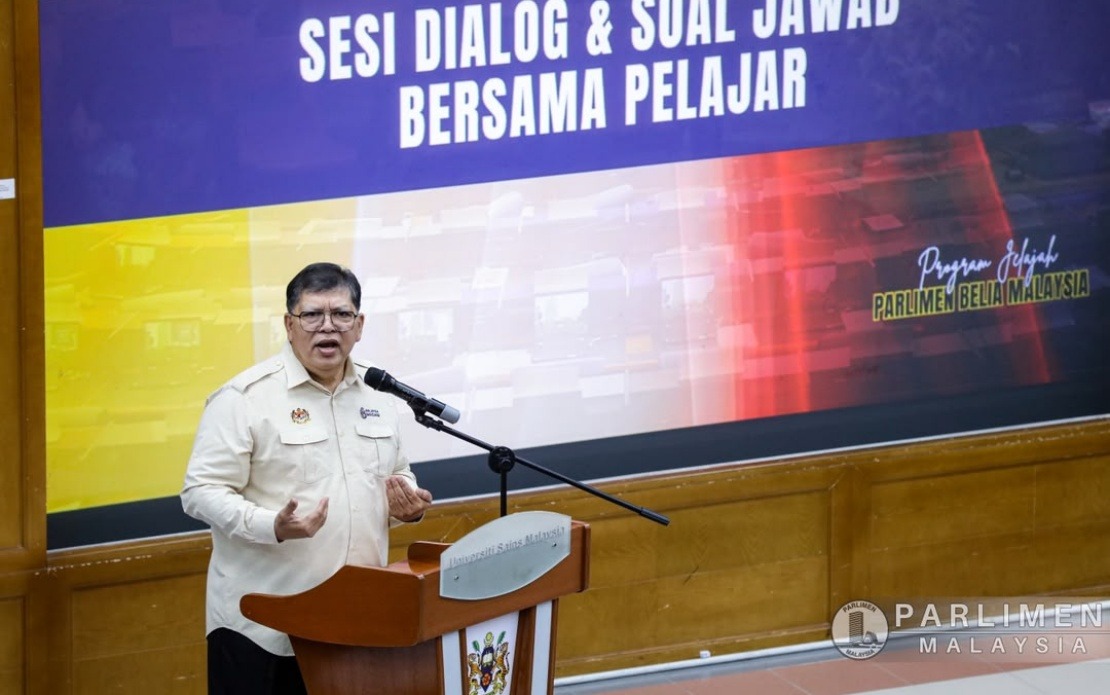
Tan Sri Johari Abdul, Speaker of the Dewan Rakyat, has issued a pointed reminder to Members of Parliament that their conduct carries far-reaching consequences, particularly as the Malaysian Youth Parliament (PBMy) prepares to convene on September 11. Speaking in the context of nurturing democratic values among the nation's emerging leaders, Johari stressed that Parliament must transcend its role as a forum for legislative debate and instead function as a credible democratic institution that commands public respect and serves as an authentic classroom for future generations.
The Speaker's remarks underscore a critical challenge facing Malaysia's parliamentary system: the conduct of elected representatives directly influences how young citizens perceive and engage with democratic institutions. Johari noted that Parliament is no longer a closed chamber where proceedings go unnoticed; instead, every utterance and gesture broadcast through social media and live television reaches millions of viewers. This heightened transparency means that the younger generation, watching closely through digital platforms, forms their understanding of democratic norms and parliamentary behaviour based on what they witness in the Dewan Rakyat. The implication is stark—if Parliament exhibits divisive, emotionally-charged or factually baseless debates, it transmits a corrupted model of democracy to youth observers.
Johari articulated a three-pronged standard that he expects MPs to uphold: proceedings must be dignified in their presentation, orderly in their execution, and grounded in integrity. Rather than performative grandstanding or personal attacks that dominate proceedings in some legislatures, he advocated for substantive discourse centred on solutions and the public interest. By doing so, Parliament would demonstrate that democracy is not merely a platform for partisan point-scoring but a sophisticated system designed to serve the nation's wellbeing. This philosophical repositioning is especially important for countries like Malaysia, where questions about institutional credibility and political polarisation occasionally surface in public discourse.
The Malaysian Youth Parliament initiative itself represents a significant structural evolution in how the nation engages its younger citizens in political processes. Originally launched in 2015 under the Ministry of Youth and Sports, the programme underwent a notable transition when the government agreed in October 2023 to transfer full management and implementation to Parliament Malaysia. This shift signals confidence in Parliament's capacity to mentor youth while simultaneously imposing accountability on the institution itself. The transfer also represents a recognition that legislative bodies, rather than youth ministry structures, possess the institutional gravitas and technical expertise to authentically simulate parliamentary processes.
The PBMy framework mirrors the actual Dewan Rakyat in its architecture, comprising 222 seats corresponding to parliamentary constituencies nationwide. However, rather than genuine political parties, participants establish non-partisan youth organisations registered with Parliament Malaysia. To date, more than ten such parties have been formed within the platform. This structure cleverly separates youth political education from partisan competition, allowing participants to engage with democratic procedures and debates without the immediate pressures of real electoral politics. The safeguard ensures that young leaders develop foundational democratic competencies before encountering the more fraught realities of electoral politics.
Parliament Malaysia has launched an extensive outreach campaign targeting 300,000 Malaysians aged between 18 and 30 to register for the forthcoming Youth Parliament election scheduled for August. The timeline reveals a carefully structured process: nominations opened on July 8, with official candidates announced on July 11. A 27-day campaign period runs from July 12 to August 7, culminating in a 24-hour online voting window from 10 am on August 8 to 10 am on August 9. This compressed schedule tests the capacity of youth organisations and candidates to mobilise supporters and articulate their platforms efficiently, mirroring real electoral pressures while remaining within a controlled educational environment.
The operational model of PBMy prescribes three sittings annually, each lasting two days, with members serving two-year terms. This cadence allows participants to develop sustained engagement with legislative issues rather than treating Parliament as a one-off ceremonial experience. Two-year tenures provide sufficient duration for members to author and shepherd through legislative proposals, build cross-party coalitions, and develop the relationship-building skills essential to parliamentary effectiveness. The September 11 opening ceremony marks the commencement of a new parliamentary term, establishing PBMy as an ongoing institutional feature rather than an episodic programme.
From a regional perspective, Malaysia's investment in youth parliamentary engagement positions the country among Southeast Asian nations taking seriously the cultivation of democratic citizenship. While some regional peers employ youth consultative mechanisms more loosely, PBMy's structural fidelity to actual parliamentary operations offers participants granular exposure to legislative complexity. This approach addresses a recognised challenge across the region: young citizens often lack concrete understanding of how legislative systems function, contributing to disengagement from democratic participation and susceptibility to populist narratives that delegitimise institutions.
The expanded registration effort to reach 300,000 potential participants represents an ambitious democratisation of access. By casting a wide net across all constituencies and deliberately targeting the 18-30 age bracket, Parliament signals that youth parliamentary experience should not be confined to politically connected families or urban elites. This inclusive approach could significantly broaden the pool of future leaders exposed to evidence-based policymaking and consensus-building practices. For a nation grappling with questions about inclusive political development and bridging generational divides, such outreach possesses both symbolic and substantive importance.
Speaker Johari's emphasis on exemplary parliamentary conduct must be understood within the context of Malaysia's democratic evolution. In recent years, parliamentary proceedings have occasionally exhibited heightened partisan tension and procedural irregularities that attracted public criticism. By framing the Youth Parliament initiative as creating accountability for the institution itself, Johari implicitly acknowledges that Parliament's capacity to mentor youth depends fundamentally on its own institutional renovation. The Youth Parliament thus functions simultaneously as an educational platform for emerging leaders and as a mirror reflecting the quality of democratic practice within Malaysia's legislative chambers.
The Malaysian Youth Parliament portal at https://pbmy.parlimen.gov.my/my/ provides comprehensive information and facilitates online registration. Interested young citizens should note the accelerated timeline; nominations and candidate announcements occur within days, leaving relatively brief windows for registration and campaign preparation. Early registration allows participants to develop meaningful platforms and build organisational capacity before the campaign period commences. For educators and community leaders invested in political literacy, the PBMy provides a structured framework through which to introduce students and youth constituents to parliamentary mechanics and democratic deliberation.
Ultimately, Johari's message articulates a mutually reinforcing relationship between parliamentary integrity and youth civic engagement. When Parliament functions with dignity, factual rigour and solution-focus, it legitimates democratic institutions in the eyes of younger observers who will inherit responsibility for sustaining them. Conversely, when youth experience Parliament as a living, functional institution rather than an abstract civic concept, they develop practical investment in its preservation and improvement. The Malaysian Youth Parliament thus represents not merely an educational initiative but a reciprocal undertaking wherein Parliament commits to exemplary conduct while young citizens commit to engaged democratic participation. This framework acknowledges that democratic health depends not on institutions alone but on the quality of engagement citizens bring to them.

%22%2F%3E%3C%2Fpattern%3E%3C%2Fdefs%3E%3Crect%20width%3D%22100%25%22%20height%3D%22100%25%22%20fill%3D%22url(%23ph523ndg)%22%2F%3E%3Crect%20width%3D%22100%25%22%20height%3D%22100%25%22%20fill%3D%22url(%23ph523ndp)%22%2F%3E%3Ctext%20x%3D%2250%25%22%20y%3D%2250%25%22%20text-anchor%3D%22middle%22%20dominant-baseline%3D%22central%22%20fill%3D%22rgba(255%2C255%2C255%2C0.95)%22%20font-family%3D%22Georgia%2C%20'Times%20New%20Roman'%2C%20serif%22%20font-weight%3D%22700%22%20font-size%3D%22272%22%20letter-spacing%3D%22-0.02em%22%3EAnwar%3C%2Ftext%3E%3C%2Fsvg%3E)