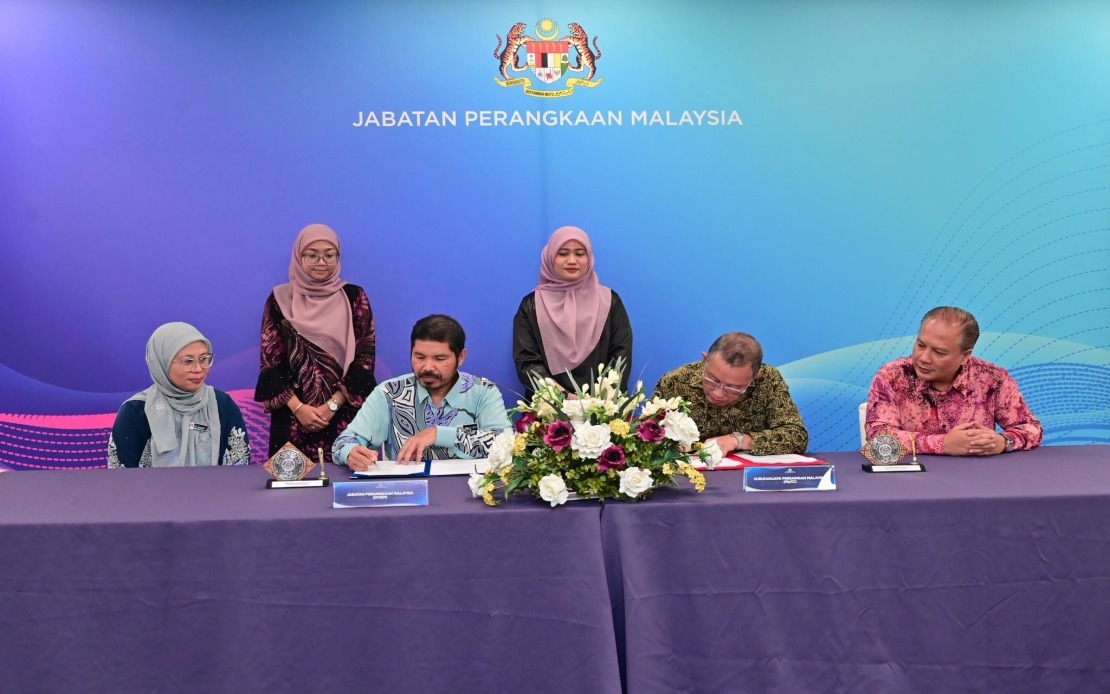
The Malaysia Competition Commission and the Department of Statistics Malaysia have formalized their strategic alliance through a memorandum of understanding designed to deepen cooperation on data analytics, economic evaluation, and institutional capability development. The agreement, inked at DOSM headquarters in Putrajaya on June 18, represents a significant step in creating a more evidence-based regulatory framework for monitoring competition and market dynamics across the Malaysian economy.
Tan Sri Idrus Harun, who chairs MyCC, and Datuk Seri Dr Mohd Uzir Mahidin, the nation's Chief Statistician, signed the accord in the presence of Datuk Iskandar Ismail, MyCC's chief executive, and Siti Asiah Ahmad, DOSM's Deputy Chief Statistician for Economic Programmes. The ceremony underscores the government's commitment to leveraging data and analytical rigour as foundational tools for effective economic policy implementation and competition law enforcement.
According to MyCC's statement on the partnership, the collaboration reflects broader government strategy to adopt data-driven methodologies when formulating and enforcing policies related to competitive market practices. The framework encompasses multiple dimensions of cooperation: systematic data exchange, joint capacity-building initiatives, and regular knowledge transfer between the two bodies. By pooling their respective expertise in competition analysis and statistical science, the organisations aim to develop more sophisticated tools for identifying and addressing anticompetitive behaviour across diverse sectors.
The timing of this agreement reflects global recognition that data has become a critical economic asset. MyCC views the partnership as essential for modernising how competition authorities approach market monitoring, particularly as digital platforms and data-intensive industries reshape economic structures. By enhancing the role of data analytics in competition economics, the commission positions itself to better understand market concentrations, pricing anomalies, and supply chain vulnerabilities that may indicate anticompetitive conduct.
Dr Mohd Uzir characterised the MoU as a mechanism for achieving deeper mutual understanding between the statistical and competition spheres. The agreement covers the reciprocal sharing of administrative data and economically relevant information, enabling DOSM and MyCC to conduct more rigorous cross-sector analyses. By combining statistical expertise with competition knowledge, the agencies can generate insights that neither could produce independently, such as comprehensive assessments of market structures and the factors driving price movements across industries.
Capacity development constitutes a cornerstone of the partnership. Both organisations commit to designing and delivering training programmes, facilitating staff exchanges, and establishing formal knowledge-sharing protocols. This human capital dimension ensures that competition investigators and statisticians develop complementary skill sets, creating a cohort of professionals equipped to tackle sophisticated economic questions spanning competition enforcement, consumer protection, and macroeconomic stability.
Joint sector monitoring represents another critical element. The two agencies will collaborate on tracking strategic economic sectors and evaluating how government policies affect competitive dynamics. This coordinated approach allows for more comprehensive assessment of whether policies achieve their intended effects without inadvertently creating barriers to fair competition or harming consumer interests. Such monitoring proves particularly valuable in regulated sectors, essential services, and markets where government procurement or subsidy policies intersect with private sector operations.
The partnership directly addresses challenges facing Malaysia's competition authority in an increasingly complex economic environment. Supply chain disruptions, digital market concentration, and cross-border e-commerce have created situations where traditional competition analysis proves insufficient without robust statistical underpinning. DOSM's comprehensive economic datasets, when analysed through a competition lens, can reveal patterns obscured by conventional market surveillance methods.
Consumer welfare improvements form an implicit objective of the collaboration. Transparent pricing, competitive service delivery, and efficient market functioning depend partly on regulators' ability to identify when anticompetitive practices inflate prices or reduce choice. By enhancing analytical capacity, the MyCC-DOSM partnership indirectly benefits consumers through more effective enforcement against cartels, abuse of dominance, and other practices that distort markets.
For Malaysian businesses, the agreement signals that competition enforcement will become increasingly data-driven and sophisticated. Companies operating in competitive industries should anticipate more granular scrutiny of pricing behaviour, market share dynamics, and supply chain patterns. Simultaneously, legitimate competitive conduct benefits from clearer regulatory frameworks grounded in evidence rather than anecdotal complaints or assumptions about market behaviour.
Regional implications merit attention as well. Malaysia's approach to data-centric competition enforcement may influence how other ASEAN nations structure their regulatory institutions. The ASEAN Economic Community framework emphasizes regional competition cooperation, and Malaysia's institutional innovations could provide models for harmonising competition enforcement methodologies across Southeast Asia.
The MoU explicitly recognises that stronger statistical understanding of market structures and price dynamics supports broader economic transparency and confidence. By helping safeguard business interests through fair competitive environments and protecting consumers against exploitative practices, the partnership reinforces the institutional infrastructure undergirding Malaysia's competitive economy. The collaboration demonstrates that modern competition authorities must evolve beyond traditional investigative methods, embracing data science and statistical innovation to remain effective in managing increasingly complex economic systems.

%22%2F%3E%3C%2Fpattern%3E%3C%2Fdefs%3E%3Crect%20width%3D%22100%25%22%20height%3D%22100%25%22%20fill%3D%22url(%23ph523ndg)%22%2F%3E%3Crect%20width%3D%22100%25%22%20height%3D%22100%25%22%20fill%3D%22url(%23ph523ndp)%22%2F%3E%3Ctext%20x%3D%2250%25%22%20y%3D%2250%25%22%20text-anchor%3D%22middle%22%20dominant-baseline%3D%22central%22%20fill%3D%22rgba(255%2C255%2C255%2C0.95)%22%20font-family%3D%22Georgia%2C%20'Times%20New%20Roman'%2C%20serif%22%20font-weight%3D%22700%22%20font-size%3D%22272%22%20letter-spacing%3D%22-0.02em%22%3EAnwar%3C%2Ftext%3E%3C%2Fsvg%3E)