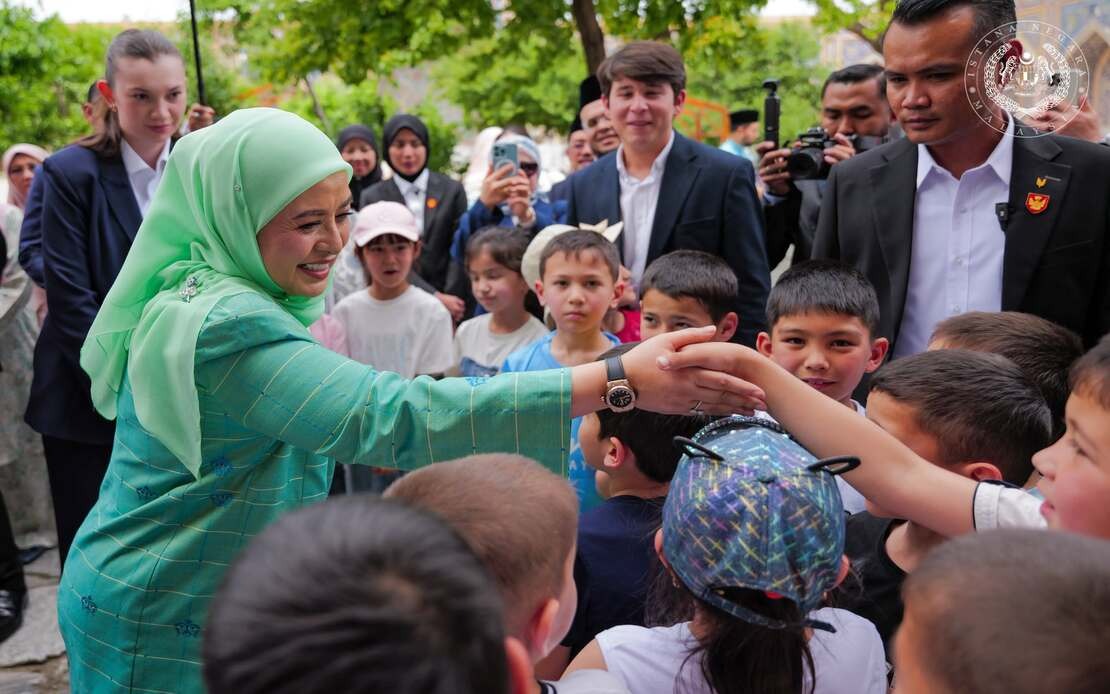
The importance of cultivating mutual respect across Malaysian society has been reinforced by Her Majesty Raja Zarith Sofiah, Queen of Malaysia, who identified this principle as one of the enduring foundations upon which national harmony rests. Speaking through a statement shared on the official Facebook page of Sultan Ibrahim Sultan Iskandar, the Queen emphasized that respect for one another has long been a defining characteristic of the Malaysian people, contributing significantly to the nation's cohesion and collective well-being.
In her message, Her Majesty stressed that courtesy and mutual regard must be actively fostered at every level of society, extending beyond domestic circles to encompass interactions with visitors and the international community. This emphasis on interpersonal respect reflects a broader understanding that social stability depends not merely on formal governance structures but on the daily choices individuals make when engaging with others, regardless of background or belief.
To underscore this message, the Queen drew upon Islamic teachings, particularly referencing a hadith recorded by Al-Bukhari and narrated through Abu Hurairah. In the hadith, Prophet Muhammad outlined three principles for believers: those who have faith in Allah and the Last Day must refrain from causing harm to their neighbours, must treat their guests with honour, and must either speak with goodness or maintain silence. This religious foundation provided Her Majesty with a powerful framework for discussing behaviour standards that transcend any single community within Malaysia's multicultural landscape.
The choice to invoke Islamic scholarship is particularly significant in the Malaysian context, where Islam holds a constitutionally recognized position while the nation remains home to adherents of multiple faiths. By grounding her message in hadith, the Queen addressed Muslims specifically while simultaneously promoting values—hospitality, neighbourly consideration, and mindful speech—that resonate across cultural and religious boundaries. This approach reflects the delicate balance Malaysia has historically maintained between its Islamic identity and its commitment to pluralism.
Her Majesty's recent conduct provides practical illustration of these principles. In February, the Queen engaged warmly with over 100 international tourists gathered at the main entrance of Istana Negara, the official royal residence. The interaction demonstrated her personal commitment to the values she articulates, showcasing graciousness toward foreign visitors and illustrating the kind of welcoming conduct that reinforces Malaysia's image as a hospitable nation. This moment highlighted how respect and courtesy extend beyond formal diplomatic channels to include everyday encounters between Malaysians and the global community.
The timing of the Queen's message carries significance for regional observers. Across Southeast Asia, nations face ongoing challenges related to social cohesion, including tensions between different ethnic and religious groups, debates over immigration and tourism, and questions about how traditional values can be preserved while embracing modern multicultural realities. Malaysia's historical experience managing these tensions—though imperfect—offers lessons for neighbours grappling with similar pressures. The Queen's emphasis on mutual respect as the binding agent of national unity speaks to this broader regional conversation.
For Malaysian readers, the Queen's intervention serves multiple functions. To the Muslim majority, it provides religious validation for inclusive social behaviour grounded in Islamic tradition. To religious minorities, it signals that principles of respect and non-harm enjoy endorsement from the highest echelons of the state. To civil society observers, it articulates a vision of harmony that depends on individual agency and daily ethical choices rather than state coercion alone. This multi-layered approach has proven effective in Malaysia's diplomatic and public messaging for decades.
The reference to maintaining silence when one cannot speak good represents a particularly nuanced teaching in contemporary contexts. In an age of rapid social media communication, the notion that restraint and careful speech constitute virtues worthy of religious emphasis addresses concerns about inflammatory rhetoric, misinformation, and online incivility that have strained community relations globally and within Malaysia itself. The Queen's invocation of this principle suggests that spiritual and cultural resources already embedded in Malaysian tradition can be mobilized to address modern social challenges.
Her Majesty's framing of mutual respect as foundational to both unity and well-being positions it as an instrumental rather than merely aspirational value. Rather than treating respect as a nice ideal detached from practical outcomes, the statement links it directly to concrete benefits: stronger social bonds, enhanced national stability, and improved collective prosperity. This pragmatic articulation may resonate with citizens concerned about security, economic development, and social stability, demonstrating that investment in interpersonal respect generates tangible returns.
The statement also implicitly addresses the question of responsibility for maintaining harmony. By emphasizing what Malaysians "have always upheld," the Queen invokes historical continuity while simultaneously challenging contemporary Malaysians to sustain these traditions. This framing prevents harmony from being treated as something to be achieved through government policy alone, instead positioning it as a responsibility distributed across the entire population. Each individual's choice to treat others with respect becomes, in this formulation, a contribution to national strength.
For businesses, civic leaders, and community organizers across Malaysia and the region, the Queen's message provides authoritative reinforcement for initiatives promoting cross-cultural understanding, interfaith dialogue, and inclusive workplace practices. Her endorsement of respect as a national cornerstone can legitimize organizational efforts that might otherwise be dismissed as idealistic or politically risky in increasingly polarized environments.

%22%2F%3E%3C%2Fpattern%3E%3C%2Fdefs%3E%3Crect%20width%3D%22100%25%22%20height%3D%22100%25%22%20fill%3D%22url(%23ph523ndg)%22%2F%3E%3Crect%20width%3D%22100%25%22%20height%3D%22100%25%22%20fill%3D%22url(%23ph523ndp)%22%2F%3E%3Ctext%20x%3D%2250%25%22%20y%3D%2250%25%22%20text-anchor%3D%22middle%22%20dominant-baseline%3D%22central%22%20fill%3D%22rgba(255%2C255%2C255%2C0.95)%22%20font-family%3D%22Georgia%2C%20'Times%20New%20Roman'%2C%20serif%22%20font-weight%3D%22700%22%20font-size%3D%22272%22%20letter-spacing%3D%22-0.02em%22%3EAnwar%3C%2Ftext%3E%3C%2Fsvg%3E)