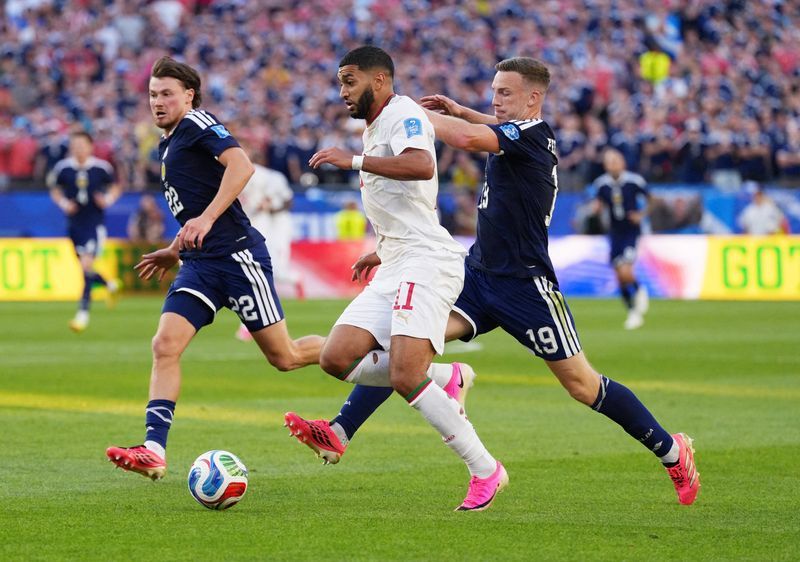
Morocco seized command of Group C with a dominant 1-0 victory over Scotland on Friday in Foxborough, Massachusetts, establishing themselves as the group's pacesetters with one round of matches remaining. The decisive moment came with startling swiftness: Ismael Saibari rifled past Scotland's goalkeeper just 71 seconds into play, marking the tournament's quickest goal and immediately shifting the momentum of a contest that would remain lopsided throughout.
What made the Moroccan performance particularly impressive was the comprehensive nature of their control. Though the scoreline suggested a narrow affair, the North Africans dictated play from kickoff, suffocating Scotland's midfield and exposing defensive vulnerabilities that the Scots would struggle to remedy. Saibari's opportunistic finish came after a swift transition saw Brahim Diaz deliver a pinpoint cross that found the forward in space behind the Scottish line—a gap created when centre-back Grant Hanley committed too early in his defensive positioning. The finish itself was clinical and emphatic, setting a tone of Moroccan dominance that would persist for the remainder of the encounter.
The early breakthrough proved psychologically damaging for Scotland, who had arrived in the fixture riding genuine optimism after claiming their first World Cup victory in 36 years against Haiti in their opening match. That qualification milestone had lifted spirits considerably around the Scottish camp, but the Moroccan assault dismantled any illusions of comfortable progression. From that early goal onward, the Scots found themselves constantly pursuing the game, reacting rather than initiating, a tactical predicament from which they never successfully extracted themselves.
Morocco's attacking verve extended well beyond Saibari's opening salvo. The North African outfit created multiple additional opportunities to stretch their advantage, with Azzedine Ounahi orchestrating play from the left flank and engineering a chance where two Moroccan attackers inexplicably failed to connect in the penalty area following Ounahi's cutback. Bilal El Khannouss forced a sharp save from Scottish goalkeeper Angus Gunn with a glancing header after the interval, while Saibari himself struck the post with a deflected effort that tested Scottish resolve further. Throughout the first half, Scotland registered no shots on target until deep in stoppage time, illustrating the severity of their tactical difficulties against Morocco's pressing intensity and superior movement.
The competitive context underscores Morocco's significance in this tournament. As semi-finalists in Qatar four years ago, the North Africans have established themselves among the world's more formidable footballing nations. Saibari's rapid strikes in consecutive matches—he also scored in Morocco's earlier draw against Brazil—mark him as a genuine attacking threat and suggest the Moroccans possess the incisive quality required to navigate their remaining fixtures successfully. The attacker's pending transfer to Bayern Munich, reportedly sealed after medical clearance, testifies to his calibre at club level as well.
The narrative surrounding Moroccan captain Achraf Hakimi added an uncomfortable undercurrent to proceedings, with Scottish supporters voicing displeasure toward the defender amid his involvement in an ongoing rape trial. Such incidents, regardless of their legal standing, inevitably introduce tension to international fixtures and can distract from purely footballing considerations. Nevertheless, Morocco's focus remained evident in their commanding execution.
With four points from two matches, Morocco sits atop Group C and holds genuine momentum entering their final group-stage assignment against Haiti on Wednesday. Scotland, conversely, finds itself in a precarious position with three points from two games, facing the daunting prospect of confronting five-time champions Brazil on the concluding matchday. For the Scots to progress, they would require a result against the Brazilian heavyweights while hoping Morocco's Haiti fixture produces a specific outcome—scenarios that appear mathematically possible but practically improbable. Brazil and Haiti also squared off on Friday evening, further determining the ultimate composition of Group C's qualification picture.
Morocco's emphatic performance reinforces their credentials as contenders capable of deep tournament runs. The combination of defensive solidity, midfield control, and clinical finishing proved overwhelming for a Scottish side that, whilst competitive in their opening victory, lacked the elite-level execution and composure required to compete against the tournament's elite teams. Azzedine Ounahi's pre-match assertion that Morocco aimed to reach the final now appears less like bravado and more like a realistic objective for a squad boasting genuine tournament pedigree and demonstrable quality.
The implications extend beyond Group C's immediate standings. For Southeast Asian observers monitoring the tournament, Morocco's resurgence represents a reminder that African football continues producing competitive squads capable of challenging established powerhouses. The North Africans' rise through recent tournaments—culminating in their Qatar semi-final appearance—demonstrates the continent's evolution as a serious force in global football, with players increasingly distributed among Europe's elite clubs.
Scotland's disappointing display, despite representing competitive football at the international level, highlights the gulf between established World Cup stalwarts and emerging challengers. The Scots demonstrated resilience in securing their previous triumph, but consistency at this elevated level demands the kind of sustained excellence that Morocco displayed throughout Friday's encounter. Their remaining fixture against Brazil provides opportunity for redemption and potential qualification, though such prospects appear slim given their current trajectory.

%22%2F%3E%3C%2Fpattern%3E%3C%2Fdefs%3E%3Crect%20width%3D%22100%25%22%20height%3D%22100%25%22%20fill%3D%22url(%23ph523ndg)%22%2F%3E%3Crect%20width%3D%22100%25%22%20height%3D%22100%25%22%20fill%3D%22url(%23ph523ndp)%22%2F%3E%3Ctext%20x%3D%2250%25%22%20y%3D%2250%25%22%20text-anchor%3D%22middle%22%20dominant-baseline%3D%22central%22%20fill%3D%22rgba(255%2C255%2C255%2C0.95)%22%20font-family%3D%22Georgia%2C%20'Times%20New%20Roman'%2C%20serif%22%20font-weight%3D%22700%22%20font-size%3D%22272%22%20letter-spacing%3D%22-0.02em%22%3EAnwar%3C%2Ftext%3E%3C%2Fsvg%3E)