Datuk Dr Zulkifli Hasan, the Minister in the Prime Minister's Department (Religious Affairs), has issued a clarion call to Malaysia's younger generation to channel the transformative lessons of Hijrah into tangible progress for the nation. Speaking in Putrajaya on June 16, Zulkifli emphasised that the youth possess considerable untapped potential that, if properly directed and inspired by Islamic teachings, could become a powerful force for national renewal and development. His remarks came as Malaysia prepared to observe the Maal Hijrah celebration, marking Prophet Muhammad's historic migration from Makkah to Madinah—an event regarded as a pivotal moment in Islamic history that fundamentally reshaped the trajectory of the Muslim community.
The concept of Hijrah extends beyond the literal journey undertaken by the Prophet; it represents a broader principle of migration towards righteousness, positive change, and the establishment of just institutions. For contemporary Malaysian youth navigating an increasingly complex social, economic, and technological landscape, Zulkifli framed Hijrah as a philosophical framework for personal transformation and collective responsibility. By internalising the values embodied in this historical migration—perseverance, moral conviction, community building, and resilience in the face of adversity—young Malaysians could become architects of constructive societal change across multiple domains including education, business, governance, and social welfare.
The 1448H/2026M Maal Hijrah celebration represents an intentional departure from previous years' approaches. Rather than organising a large-scale national gathering with considerable expenditure, organisers deliberately adopted a more modest format that aligns with broader government initiatives around energy conservation and resource management. This decision reflects heightened awareness of global supply chain disruptions and the need for sustainable resource allocation during uncertain economic times. The scaled-down approach, however, does not diminish the spiritual and educational significance of the commemoration; instead, it demonstrates how religious observance can coexist with pragmatic fiscal responsibility—a message particularly relevant to Malaysian youth often criticised for perceived materialism or disconnection from practical values.
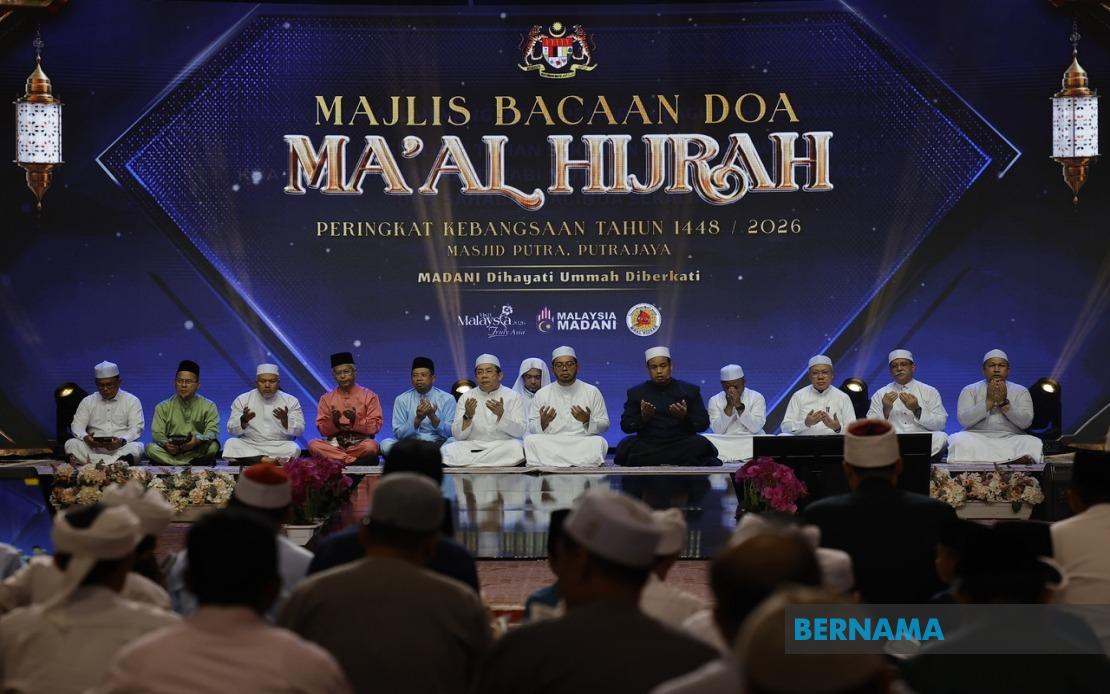
The centrepiece of the national celebration took place at Putra Mosque in the federal capital, selected deliberately as the symbolic starting point for the festivities. The choice of this particular venue carries considerable meaning beyond mere logistics. The mosque, as an architectural and institutional landmark, represents the foundational institution that Prophet Muhammad established upon arriving in Madinah—functioning simultaneously as a place of worship, community governance, education, and social welfare. By anchoring the 2026 celebration at Putra Mosque, organisers drew an explicit parallel between the Prophet's establishment of community infrastructure and Malaysia's ongoing efforts to strengthen civil society and institutional frameworks. The ceremony commenced at 7 am on June 17, coinciding with 1 Muharam 1448H, and featured the presentation of national and international Maal Hijrah Figure awards, recognising individuals who have embodied Hijrah principles through their professional and spiritual contributions.
Sultan Nazrin Shah, the Sultan of Perak, officiated the main ceremony, lending considerable royal patronage and institutional weight to the proceedings. The royal presence underscored the multi-layered significance of Maal Hijrah observance in Malaysia—simultaneously a religious commemoration, a national cultural celebration, and a state-sanctioned occasion for reflecting on shared values. This institutional legitimacy becomes particularly important in a multi-religious, multicultural democracy where Islamic observances occupy a unique constitutional position while remaining embedded within a broader framework of national identity and interfaith coexistence. The presence of royal leadership signals that Hijrah values—community building, institutional development, and principled migration towards justice—resonate beyond religious circles and carry national implications.
Supplementary programming extended the celebration's reach and educational impact. A keynote lecture scheduled for June 18 at the JAKIM Auditorium brought together prominent national and international Islamic figures to deliver addresses exploring diverse dimensions of the Hijrah spirit. Organisers anticipated approximately 1,000 participants would attend this intellectual exchange, creating a forum for dialogue between established religious scholars and engaged citizens from various backgrounds. These lectures aimed to move beyond ceremonial remembrance into substantive exploration of how historical lessons could inform contemporary challenges facing Muslim-majority nations and diaspora communities worldwide. The participatory nature of the lecture series reflects modern approaches to religious education that prioritise interactive engagement over passive reception of prescribed narratives.
For Malaysian audiences, particularly younger citizens navigating questions of identity, purpose, and social contribution, the Hijrah narrative offers several pertinent lessons. The migration of Prophet Muhammad and his followers represented not merely a change of location but a fundamental reorientation of priorities—abandoning material security and social status in pursuit of spiritual integrity and communal welfare. In contemporary Malaysia, where youth often confront tensions between commercial pressures, family expectations, and personal values, this historical example provides a philosophical template for making principled decisions even when they entail sacrifice or social friction. The Hijrah spirit, properly understood, encourages young people to question whether their current trajectories align with deeper convictions and whether they are contributing meaningfully to their communities' development.
Zulkifli's emphasis on reflection and internalisation suggests that the true value of Maal Hijrah observance lies not in ceremonial participation but in cultivating genuine psychological and behavioural transformation. This pedagogical approach aligns with contemporary educational theory emphasising deep learning over superficial knowledge acquisition. By encouraging youth to interrogate the Hijrah narrative and extract applicable principles, religious leaders invite younger Malaysians into an active intellectual engagement with their own faith tradition. This contrasts sharply with approaches that treat religious teachings as fixed doctrines requiring unquestioning acceptance. Instead, the framework proposed by Zulkifli permits young people to become interpreters and applicators of Islamic principles within their own lived contexts—as entrepreneurs building ethical businesses, as professionals upholding integrity despite pressures, as citizens advocating for just governance, or as community leaders addressing local concerns.
The energy conservation consideration underlying this year's scaled-down celebration also transmits a subtle but important message to Malaysian youth about sustainable living and responsible stewardship of national resources. The Hijrah spirit encompasses not only spiritual migration but also migration away from wasteful, exploitative, or unsustainable practices. By demonstrating that meaningful religious observance need not require lavish expenditures or energy-intensive logistics, organisers model the compatibility between spiritual commitment and environmental consciousness—an increasingly important concern for younger generations globally who prioritise climate action and resource sustainability. This practical integration of values into operational decisions illustrates how Hijrah principles can reshape institutional practices and normalise more efficient approaches to communal gatherings.
Looking beyond immediate ceremonial dimensions, the 2026 Maal Hijrah celebration reflects Malaysia's ongoing efforts to position Islamic values as central to national development narratives. By explicitly connecting Hijrah to youth empowerment and positive change, religious authorities articulate a vision of Islam that emphasises dynamic engagement with contemporary challenges rather than withdrawal or nostalgia for idealised historical periods. This forward-looking approach becomes particularly significant in a Southeast Asian context where multiple nations grapple with balancing religious identity, modernisation pressures, and pluralistic governance structures. Malaysia's model—combining royal institutional support, inclusive educational programming, and explicit connection to youth development—offers a template that other Muslim-majority nations and communities might study or adapt.