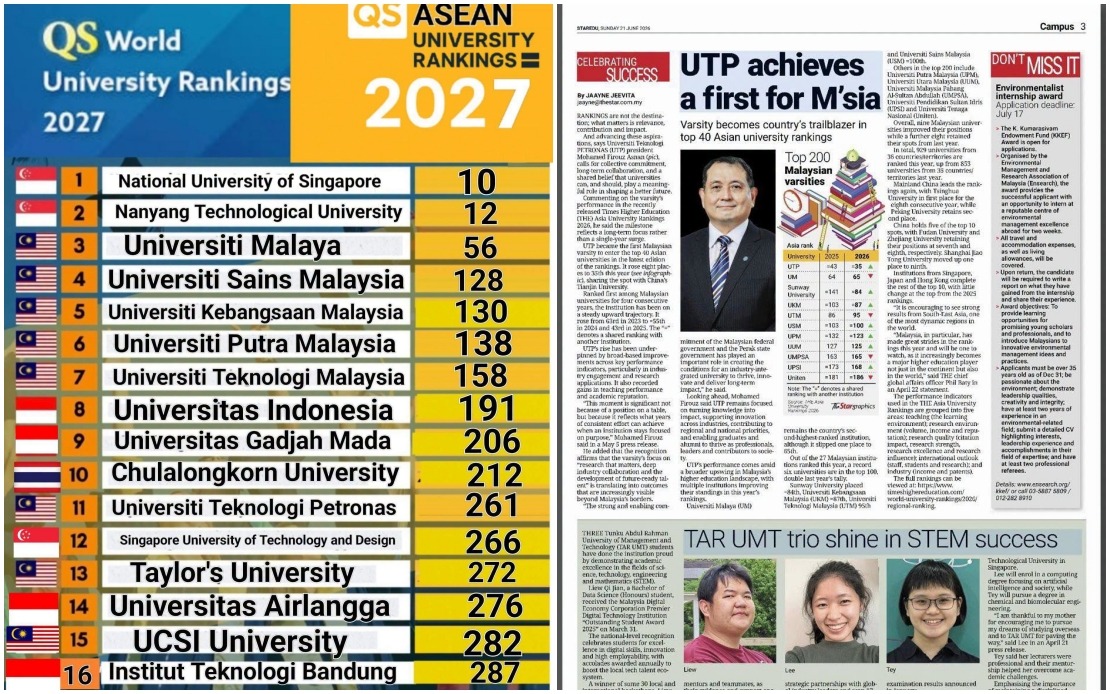
Datuk Seri Dr Zambry Abd Kadir, Malaysia's Higher Education Minister, has hailed the latest wave of international university rankings as validation of the nation's emergence as a credible education destination on the global stage. The pronouncement comes as Malaysian tertiary institutions continue to gain ground in regional and worldwide assessment metrics, a development that carries significant implications for the country's knowledge economy and its ability to attract international students and research partnerships.
Universiti Teknologi Petronas has achieved a historic milestone by becoming the first Malaysian university to crack Asia's top 40, securing 35th position in the Times Higher Education Asia University Rankings 2026. This represents a substantial leap from its 43rd place finish in the previous year's edition, underscoring the capacity of local institutions to achieve rapid advancement when strategic investments in research, faculty development, and infrastructure are effectively deployed. The breakthrough is particularly significant because it signals to potential international collaborators and prospective students that Malaysian universities can compete on equal footing with established institutions across the broader Asian region.
The minister's remarks reflect a nuanced understanding of what university rankings represent in the modern higher education landscape. While emphasizing that rankings should not be treated as the ultimate measure of institutional success, Zambry acknowledged their undeniable role as a barometer of quality, international reputation, and competitive positioning. This balanced perspective recognises that rankings, despite their limitations, do influence how prospective students, employers, and research partners evaluate institutions—making them a practical consideration for universities seeking to expand their global footprint and influence.
The broader cohort of Malaysian universities has also demonstrated resilience and improvement across various ranking frameworks. The latest assessment shows 27 local institutions included in the THE Asia rankings, a substantial showing for a nation of Malaysia's size. More impressively, six universities have now penetrated the top 100 threshold in Asia, while eleven have achieved positions within the top 200. These figures represent concrete progress in a competitive environment where established Asian powerhouses in countries like South Korea, Japan, China, and Singapore have long dominated the upper echelons of international rankings.
The momentum reflects collective institutional effort across both public and private higher education sectors. Universiti Malaya, as the nation's oldest and most established university, continues to feature prominently, while mid-tier institutions like Sunway University and specialist research-focused universities such as Universiti Kebangsaan Malaysia, Universiti Teknologi Malaysia, and Universiti Sains Malaysia have all strengthened their positions. The diversity of institutions achieving recognition—from comprehensive universities to those with focused mandates—suggests that improvement is not concentrated in a single institution but rather distributed across the system, indicating genuine systemic progress rather than isolated success stories.
For Malaysia, these achievements carry strategic weight beyond academic prestige. The nation has long pursued a deliberate policy of positioning itself as a regional education hub, competing with Thailand, Vietnam, and Singapore for international student enrolments and research collaborations. Strong international rankings directly support this objective by enhancing the perceived value of Malaysian degrees in global employment markets and facilitating partnerships with leading universities elsewhere. International students often use rankings as a primary filter when selecting universities, making improvements in these assessments commercially significant for institutions and economically beneficial for the nation through tuition fees and associated spending.
The involvement of private institutions like Sunway University and UNITEN in this ranking success also underscores the sector's maturation. Malaysia's private university landscape has evolved considerably over the past two decades, with several institutions now offering research output and academic rigor comparable to public counterparts. This diversification means that Malaysia's education competitiveness is not solely dependent on government-funded universities, providing resilience and allowing the nation to offer prospective students genuine choice between different institutional models and specializations.
Zambry's acknowledgement of the multifaceted contributors to this success—lecturers, researchers, students, alumni, staff, and industry partners—reflects the understanding that international ranking improvements require institutional ecosystems rather than top-down mandates. Research productivity, which heavily weights most global rankings, depends on adequate funding, modern facilities, faculty autonomy, and meaningful collaboration between academia and industry. The ranking gains therefore suggest that Malaysia has made genuine investments in research infrastructure and created incentive structures that motivate academics to pursue rigorous scholarship and publish in high-impact journals.
However, the achievements also highlight unfinished business. While six universities in the top 100 represents progress, it remains modest compared to other regional competitors. Thailand has multiple universities in Asia's top 50, while Singapore dominates the top tier entirely. China and India, despite their large numbers of lower-ranked institutions, also field numerous universities in the elite rankings tiers. For Malaysia to consolidate and extend its gains, sustained investment in research facilities, competitive faculty recruitment and retention, and infrastructure development will prove essential.
The ranking improvements carry particular relevance for Southeast Asia and the wider Indo-Pacific region. As geopolitical competition intensifies and nations seek to build competitive advantages through knowledge creation and talent development, strong universities become strategic assets. Malaysia's progress demonstrates that middle-income countries can build world-class institutions through deliberate policy and investment, offering a model for neighboring economies pursuing similar objectives. Furthermore, as regional mobility of students and researchers increases, Malaysian universities with improved international standing become more attractive nodes in Pan-Asian research and education networks.
Looking forward, Zambry's call to maintain the momentum of excellence suggests the government views ranking improvements as part of a longer strategic journey rather than a destination. This orientation aligns with global best practice in higher education policy, which recognizes that institutional quality improvements operate on extended timescales and require consistency across political cycles and budget cycles. For Malaysian universities seeking to sustain and build upon their recent gains, the imperative will be translating ranking positions into tangible benefits—whether through attracting higher-quality doctoral candidates, securing premium research funding, or establishing partnerships with leading institutions that further enhance their research capabilities and global visibility.