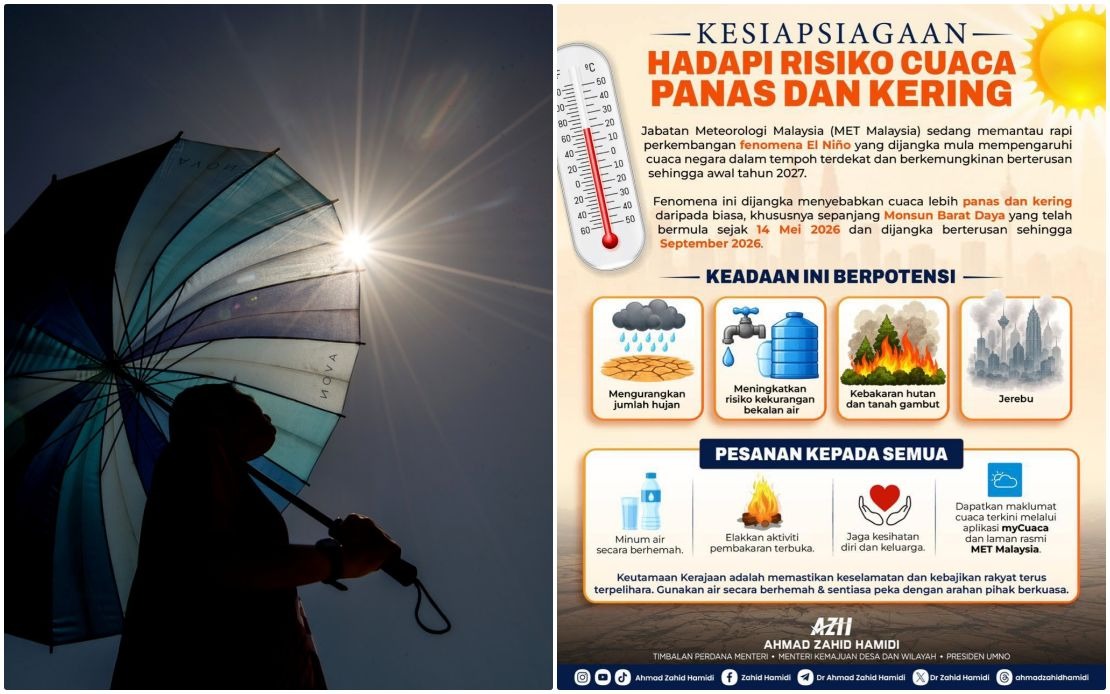
Malaysia faces an extended period of hotter and drier weather as the El Niño phenomenon gains momentum, potentially affecting the country through to early 2027, according to a warning issued by Deputy Prime Minister Datuk Seri Dr Ahmad Zahid Hamidi on June 15. The climatic disruption arrives at a critical moment as the Southwest Monsoon, which commenced on May 14, is forecast to continue until September, creating conditions where El Niño's drying effects will be particularly pronounced.
Ahmad Zahid, who chairs the Central Disaster Management Committee, underscored the multifaceted risks accompanying this extended dry period. Beyond elevated temperatures, the phenomenon threatens to diminish rainfall across numerous regions, potentially straining water supplies during peak consumption months. The combination of heat and aridity creates ideal conditions for uncontrolled fires to spread rapidly through forests and peatland areas—a recurrent challenge in Southeast Asia that extends beyond Malaysia's borders and periodically threatens neighbouring nations with transboundary haze. This interconnected environmental risk highlights why El Niño monitoring carries regional significance beyond domestic weather forecasting.
The Deputy Prime Minister's statement emphasised citizen preparedness as a cornerstone of national resilience. He specifically encouraged Malaysians to adopt water conservation practices, avoid open burning activities that could trigger wildfires, and prioritise health precautions for vulnerable populations, including children, the elderly, and those with existing respiratory conditions. This public advisory reflects a shift toward distributed responsibility, positioning ordinary citizens as active participants in climate adaptation rather than passive recipients of government protection. The messaging acknowledges that effective disaster mitigation requires coordinated action across governmental bodies, private enterprises, and households.
To support public awareness and real-time decision-making, Ahmad Zahid directed citizens toward the myCuaca application and official channels operated by the Malaysian Meteorological Department (MetMalaysia). The emphasis on accessing authoritative information sources represents an effort to counter potential misinformation and ensure that weather preparedness guidance derives from scientifically grounded analysis. In an era where weather-related misinformation circulates rapidly through social media, directing the public to verified institutional sources becomes an implicit component of crisis communication strategy.
MetMalaysia's director-general, Dr Mohd Hisham Mohd Anip, reiterated the agency's assessment that El Niño will intensify temperature and reduce precipitation, particularly during the Southwest Monsoon phase when atmospheric circulation patterns concentrate the phenomenon's effects. The meteorological agency's explicit confirmation validates Ahmad Zahid's public advisory and provides technical credibility to the government's messaging. The Southwest Monsoon's continuation through September means Malaysia faces approximately four months during which El Niño conditions will be most acute, a period spanning the traditional dry season when water demand peaks and fire danger escalates considerably.
The projected timeline extending into early 2027 suggests this is not a transient weather disruption but rather a multi-year climatic episode requiring sustained adaptation measures. For Malaysian policymakers, this extended outlook necessitates revisiting water management infrastructure, agricultural strategies, and emergency response protocols. Agricultural sectors dependent on monsoon rainfall, particularly smallholder farming communities in peninsular and East Malaysian regions, face production uncertainties that could ripple through food security assessments and commodity pricing. The government's advance notice provides these sectors with extended opportunity to adjust planting schedules, irrigation approaches, and crop selection to accommodate anticipated drier conditions.
The fire risk dimension carries particular weight given historical precedents. The 2015 El Niño triggered widespread Indonesian peatland fires whose smoke blanketed Malaysia and Singapore, severely degrading air quality and generating public health crises across the region. Similar episodes in 1997-1998 caused ecological and economic disruption that persisted for months. Preventing recurrence of such scenarios requires proactive land management, enforcement of open burning prohibitions, and transnational cooperation with neighbouring countries managing similar climate pressures. Ahmad Zahid's emphasis on avoiding open burning activities implicitly acknowledges this regional vulnerability.
Water shortage risks deserve particular scrutiny within Malaysia's context. While the country receives substantial annual precipitation overall, El Niño-driven rainfall reduction concentrates during specific periods when demand peaks. Urban centres relying on reservoir systems face potential supply constraints if recharge rates decline below consumption rates. The Federal Territories, Selangor, and other densely populated regions maintain water security contingency plans, yet extended dry periods stress these systems. Industries dependent on water, including palm oil processing, semiconductor manufacturing, and power generation, must anticipate supply variability and implement contingency measures. Such preparations require months of advance planning, making early warnings economically valuable.
The government's stated commitment to continuous situation monitoring and responsive action represents standard disaster management protocol yet carries practical implications. Emergency services must pre-position equipment, train personnel for heightened fire season demands, and coordinate with local authorities responsible for water allocation. Healthcare systems should prepare for increased heat-related medical emergencies, particularly among populations lacking adequate cooling resources. These preparations, multiplied across dozens of government agencies and thousands of local implementations, constitute the infrastructure through which early warning systems translate into concrete protection.
The El Niño episode also intersects Malaysia's climate change adaptation agenda. While El Niño represents a cyclical natural phenomenon, its intensification and duration may reflect broader climate system changes. Scientists debate whether anthropogenic climate change amplifies El Niño episodes or alters their frequency, but the practical implications remain similar: Malaysian institutions must build adaptive capacity for increasingly variable and extreme weather patterns. This particular El Niño episode offers opportunity to test and refine response mechanisms that will prove essential in managing future climatic disruptions of greater or lesser severity.
For Malaysian residents, the practical implications centre on immediate behavioural adjustments and medium-term planning. Households should store adequate water reserves, service air conditioning systems, ensure prescribed medications remain accessible for heat-vulnerable family members, and stay informed through authoritative channels. Agricultural and industrial enterprises should review water usage efficiency and explore alternative supply sources. Communities vulnerable to flooding during heavy monsoon periods paradoxically face drought risks during El Niño, requiring flexible emergency protocols capable of addressing opposing extremes.
The regional dimension of El Niño impacts extends beyond Malaysia's shores, affecting agricultural production and water availability across Southeast Asia. Thailand, Vietnam, and other neighbouring economies face analogous challenges, creating potential for coordinated adaptation strategies and information sharing. Regional meteorological cooperation through institutions like the ASEAN Secretariat becomes instrumental in managing transnational environmental consequences. The haze phenomenon particularly demonstrates how weather systems ignore political boundaries, making collective preparation essential.
Moving forward, the period through early 2027 will test Malaysia's institutional capacity for sustained climate adaptation. Success will be measured not by dramatic interventions but by countless incremental adjustments across millions of households and thousands of enterprises that collectively reduce vulnerability to heat, fire, and water shortage. Ahmad Zahid's advisory marks the beginning of an extended public engagement process through which government, media, and citizens collaboratively navigate climatic challenges.