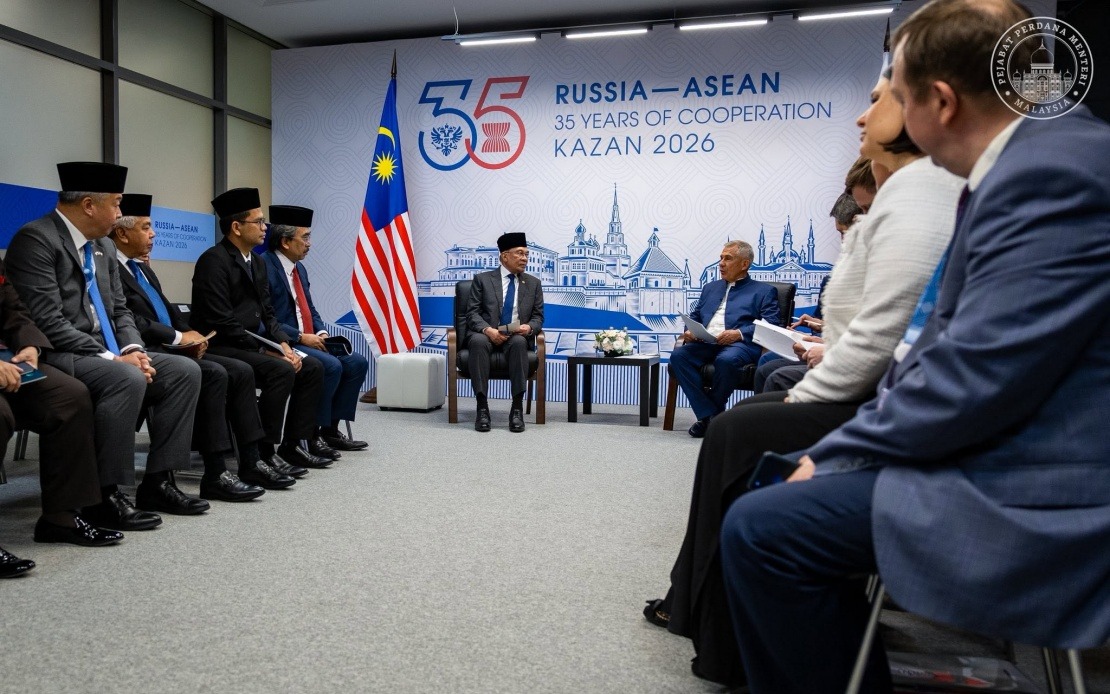
Prime Minister Datuk Seri Anwar Ibrahim has identified substantial opportunities for deepening Malaysia's engagement with the Republic of Tatarstan, one of Russia's most economically and culturally significant regions. The announcement came following his bilateral meeting with Rustam Minnikhanov, the Rais or Head of Tatarstan, shortly after arriving in Kazan for a two-day working visit. The discussion encompassed a diverse range of sectors where both nations could collaborate to mutual advantage, reflecting Malaysia's broader strategic approach to expanding partnerships across emerging markets and non-traditional allies in Eurasia.
During his engagement with Minnikhanov, Anwar identified energy infrastructure as a natural focal point for expanded cooperation. Tatarstan's prominence as a major oil-producing region within Russia positions it as a logical partner for Malaysian entities operating in the petroleum sector. The Prime Minister emphasised particular interest in downstream operations, refining and petrochemical activities, areas where Malaysian expertise and capital have demonstrated considerable capability across ASEAN and the broader region. This sectoral emphasis reflects Malaysia's strategic interest in diversifying its energy partnerships beyond its traditional Middle Eastern and Southeast Asian suppliers and investors, particularly as global energy markets undergo transition.
Beyond energy, the bilateral discussion encompassed emerging sectors increasingly important to both nations' economic development trajectories. Trade and investment frameworks received attention as mechanisms for facilitating deeper commercial engagement. Educational partnerships and talent exchange programmes were identified as vehicles for building long-term institutional connections between Malaysian and Tatar institutions. The tourism sector, capitalising on Malaysia's established expertise in attracting visitors and Tatarstan's historical and cultural significance, was similarly highlighted as a domain with untapped potential. The halal industry—where Malaysia has positioned itself as a global standard-setter and certification hub—represents a particularly intriguing avenue given Tatarstan's substantial Muslim population and cultural heritage, creating natural complementarities.
Anwar and Minnikhanov also explored the role of the Kazan Forum as a platform for strengthening business networking and identifying strategic investment opportunities. The discussion extended to digital economy initiatives and innovation partnerships, reflecting both regions' aspirations to participate in twenty-first century technological advancement. These conversations occurred within the context of broader ASEAN-Russia engagement, positioning bilateral Malaysia-Tatarstan cooperation as a component of the wider strategic relationship between Southeast Asia's leading economic power and the Russian Federation.
The Prime Minister noted that Kazan had received recognition as the Islamic World Cultural Capital 2026 from the Islamic World Educational, Scientific and Cultural Organisation, a designation reflecting the city's deep historical roots in Islamic scholarship, cultural expression and intellectual tradition. This status carries implications for Malaysian engagement beyond purely commercial transactions, suggesting potential for scholarly and cultural exchanges that could enhance mutual understanding between Malaysia's predominantly Muslim population and Tatarstan's significant Islamic heritage. Anwar's acknowledgment of President Vladimir Putin's Strategic Vision Group, established to bridge Russia and the Islamic world, signals Malaysia's appreciation for diplomatic frameworks facilitating dialogue between different civilisational spheres.
Anwar's visit to Kazan occurs within the context of the ASEAN-Russia Commemorative Summit, representing the highest-level engagement platform between the ten-member regional association and Russia. The bilateral meeting with Tatarstan's leadership should be understood as part of Malaysia's broader diplomatic strategy to strengthen ASEAN-Russia relations while simultaneously pursuing bilateral opportunities with constituent regions of the Russian Federation. This two-pronged approach reflects Malaysia's growing sophistication in pursuing diplomatic and economic objectives across multiple governmental levels within larger federal or complex political structures.
Tatarstan itself represents an economically significant entity within the Russian Federation. Located approximately 800 kilometres east of Moscow at the confluence of the Volga and Kazanka rivers, Kazan functions as Russia's third major centre after Moscow and Saint Petersburg. The city's population of approximately 1.3 million inhabitants, combined with its status as a major industrial and financial hub, makes it a consequential partner for Malaysian enterprises seeking Russian market entry. The region boasts a history extending beyond one thousand years and maintains distinctive cultural characteristics that set it apart within the broader Russian context.
Anwar's delegation included several cabinet-level ministers whose participation underscores the significance Malaysia attaches to the visit. Datuk Seri Johari Abdul Ghani, the Investment, Trade and Industry Minister, accompanied the Prime Minister, signalling focus on commercial and investment dimensions of the bilateral engagement. Akmal Nasrullah Mohd Nasir, the Economy Minister, similarly participated, indicating attention to macroeconomic frameworks and institutional coordination. Support from officials within the Prime Minister's Office and the Foreign Ministry ensured adequate diplomatic and administrative capacity to explore substantive cooperation opportunities and document agreements emerging from high-level discussions.
The ASEAN-Russia relationship itself has deepened considerably since formal dialogue relations commenced in 1991. Russia's elevation to full ASEAN Dialogue Partner status in 1996 represented formal institutional integration into ASEAN's external engagement architecture. The subsequent upgrade to Strategic Partnership in 2018 reflected both parties' commitment to expanding cooperation across political and security domains alongside economic and socio-cultural dimensions. Malaysia's particular emphasis on bilateral opportunities with Tatarstan should be situated within this expanding institutional framework, demonstrating how bilateral engagements between Malaysia and Russian sub-national entities can contribute to broader ASEAN-Russia strategic objectives.
For Malaysian policymakers and business stakeholders, the identified cooperation opportunities with Tatarstan represent avenues for geographic diversification of Malaysia's economic and strategic interests. As Malaysia navigates increasingly complex great power dynamics in the Indo-Pacific region, strengthening ties with Russia's constituent regions offers opportunities to build relationships that transcend geopolitical tensions affecting other dimensions of international relations. Energy cooperation particularly addresses Malaysia's enduring interest in securing reliable hydrocarbon supplies and downstream investment opportunities, while educational and technology partnerships could position Malaysian institutions and enterprises within emerging innovation ecosystems. Anwar's emphasis on reciprocal benefits suggests Malaysia's intention to structure these partnerships as mutually advantageous arrangements rather than extractive relationships, potentially establishing foundations for durable long-term engagement.