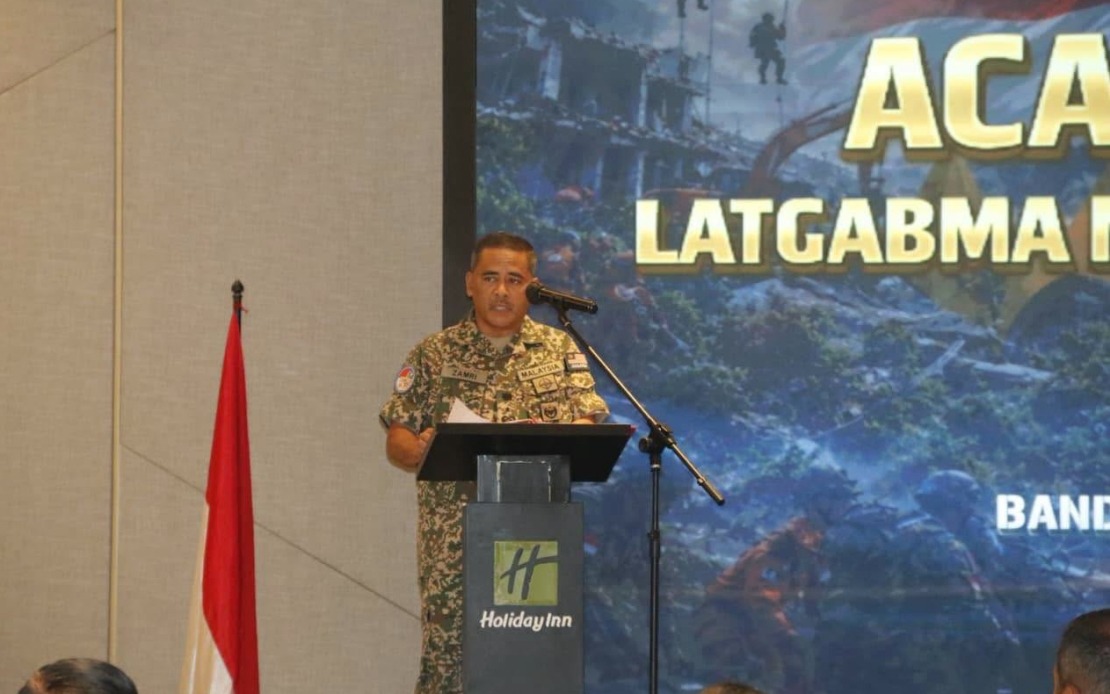
Malaysia and Indonesia have embarked on an ambitious 13-day combined military exercise in Lampung, Sumatra, reinforcing strategic defence cooperation between the two Southeast Asian neighbours. The LATGABMA MALINDO DARSASA 12AB/2026 operation, jointly coordinated by the Malaysian Armed Forces (MAF) and the Indonesian National Armed Forces (TNI), brings together 719 personnel from various government agencies, civilian rescue organisations, and armed services branches. This substantial commitment underscores the deepening security partnership between Kuala Lumpur and Jakarta at a time when regional stability increasingly depends on bilateral coordination and mutual trust among military institutions.
The exercise represents far more than routine training activity, according to Brigadier General Datuk Zamri Othman, Commander of the 1st Infantry Brigade and chief of the MAF Exercise Planning Group. He emphasised that the operation serves as tangible proof of the strategic fraternity binding the two nations together. Rather than isolated manoeuvres focused solely on conventional combat scenarios, the exercise deliberately integrates land, maritime, and air operational concepts whilst simultaneously testing joint procedures and building confidence among frontline personnel. This multidimensional approach reflects how modern defence cooperation must address the full spectrum of security challenges facing both countries.
The contemporary security landscape confronting Malaysia and Indonesia extends well beyond traditional military threats. Maritime crime, smuggling networks, terrorism, sophisticated cyber attacks, and natural disasters now constitute the primary preoccupations for defence planners in both capitals. Zamri articulated the imperative driving this exercise: the increasingly intricate security environment demands that both nations systematically strengthen their defence partnerships. The shared waters of the Strait of Malacca, the extensive maritime boundaries between them, and their mutual vulnerability to terrorism and transnational crime all necessitate coordinated responses that only regular, realistic training can achieve.
The LATGABMA MALINDO DARSASA exercise has deep institutional roots, tracing its origins back to 1984 when Malaysia and Indonesia first formalised their joint training mechanisms. Operating through two permanent structures—the General Border Committee and the Malaysia-Indonesia Joint Training Committee—the exercise has evolved into a triennial event conducted on a rotating basis between the two nations. The previous edition took place in Pekan, Pahang in 2023, where participants trained specifically for counter-terrorism scenarios. This established rhythm of engagement demonstrates how seriously both governments regard military-to-military relationships as a foundation for broader diplomatic cooperation.
The decision to conduct this year's exercise in Bandar Lampung reflects sophisticated scenario planning grounded in genuine geographical and hazard realities. Lampung Province sits at the intersection of three active tectonic plate boundaries, rendering it one of Indonesia's most seismically active and disaster-prone regions. This geological reality transforms the exercise location into an ideal training ground for humanitarian assistance and disaster response operations. Rather than constructing artificial scenarios divorced from regional experience, planners deliberately leveraged Lampung's vulnerability to natural hazards to create training conditions with maximum authenticity and relevance.
The exercise programme encompasses ten primary disaster scenarios derived directly from Indonesia's traumatic experience with major earthquakes and tsunamis, particularly those affecting southern Sumatra in recent decades. Participants work through initial disaster response protocols, management of mass casualties, assessment and response to infrastructure damage, emergency medical procedures, coordination of international assistance, and the critical transitions from emergency response to stabilisation and ultimately to recovery phases. This progression mirrors the actual lifecycle of major disaster events and ensures that military personnel develop competencies extending far beyond initial rescue operations into longer-term stabilisation efforts.
The operational training component involves 463 TNI personnel, 150 MAF soldiers, representatives from Malaysia's National Disaster Management Agency, Indonesian police specialists, and personnel from Indonesian search and rescue, health, disaster management, and civil protection agencies. This inter-agency composition reflects contemporary understanding that effective disaster response requires seamless coordination across military and civilian institutions. Participating units conduct integrated force training exercises incorporating rope rescue techniques, rappelling operations, emergency medical procedures, and field hospital establishment. Such practical skills form the foundation upon which effective rescue and humanitarian operations depend.
Beyond traditional rescue operations, the exercise incorporates community benefit activities demonstrating military utility for civilian welfare. The Engineering Civil Action Programme addresses infrastructure deficits in target communities through repair of uninhabitable structures and construction of concrete roads in villages within the exercise zone. Simultaneously, the Medical Civic Action Programme delivers health screenings, eyeglass distribution, and blood donation services through local health centres. These integrated civil-military activities serve dual purposes: they provide genuine community benefit whilst simultaneously training military personnel in non-combat operations that increasingly dominate contemporary security agendas.
The cyber security component of the exercise addresses the emerging threat landscape that Malaysia and Indonesia both face. Training covers technical attack methodologies including reconnaissance operations, network enumeration, credential compromise, man-in-the-middle interception, spoofing techniques, and data feed manipulation. This instruction ensures that both armed forces develop defensive capabilities against adversaries operating in digital domains. As critical infrastructure, government communications, and military command systems grow increasingly dependent on digital technologies, cyber resilience has become as essential as traditional military readiness.
For Malaysia specifically, participation in this exercise carries particular strategic significance. As the smaller and less populous of the two nations, Malaysia gains invaluable experience through exposure to Indonesian defence doctrine, technology integration, and operational procedures. The exercise provides Malaysian commanders and personnel with direct insight into TNI capabilities and approaches, facilitating interoperability that could prove essential during genuine emergencies. Beyond immediate training benefits, the exercise reinforces Malaysia's position within Southeast Asian security architecture and demonstrates commitment to regional stability through active military engagement with its largest neighbour.
The bilateral defence relationship between Malaysia and Indonesia extends far beyond ceremonial exchanges or high-level diplomatic visits. Through mechanisms like LATGABMA MALINDO DARSASA, both nations translate their stated commitment to regional cooperation into concrete operational engagement. The exercise establishes personal relationships among military personnel at all levels, builds mutual understanding of operational challenges, and creates institutional pathways for coordinating responses to transnational threats. In a region where maritime disputes and terrorism transcend national boundaries, such regularised cooperation represents prudent strategic investment.
Looking forward, the success of this exercise will likely influence planning for subsequent iterations and potentially inform broader defence cooperation initiatives between the two countries. As climate change intensifies natural disasters across Southeast Asia and transnational security threats evolve in sophistication, the demand for joint training and coordinated response capabilities will only grow. Malaysia and Indonesia, separated by shared waters and connected by complementary security interests, appear well positioned to deepen their military partnership in ways that benefit both nations and contribute to broader regional stability.

%22%2F%3E%3C%2Fpattern%3E%3C%2Fdefs%3E%3Crect%20width%3D%22100%25%22%20height%3D%22100%25%22%20fill%3D%22url(%23ph523ndg)%22%2F%3E%3Crect%20width%3D%22100%25%22%20height%3D%22100%25%22%20fill%3D%22url(%23ph523ndp)%22%2F%3E%3Ctext%20x%3D%2250%25%22%20y%3D%2250%25%22%20text-anchor%3D%22middle%22%20dominant-baseline%3D%22central%22%20fill%3D%22rgba(255%2C255%2C255%2C0.95)%22%20font-family%3D%22Georgia%2C%20'Times%20New%20Roman'%2C%20serif%22%20font-weight%3D%22700%22%20font-size%3D%22272%22%20letter-spacing%3D%22-0.02em%22%3EAnwar%3C%2Ftext%3E%3C%2Fsvg%3E)