The concept of hijrah—spiritual and moral renewal—took centre stage across Malaysia on June 17 as the nation observed Maal Hijrah 1448H/2026 with a series of coordinated celebrations. The events, organised under the theme "MADANI Dihayati, Ummah Diberkati" (MADANI Lived, Ummah Blessed), underscored how the Prophet Muhammad's historical migration to Medina continues to inspire contemporary Islamic thought around personal transformation and societal progress. For Malaysian Muslims, this annual observance serves as a moment of reflection on individual and collective advancement within the framework of Islamic principles and governance.
The central ceremony in Kuala Lumpur drew approximately 5,000 attendees and featured an array of spiritual and intellectual programming designed to reinforce the deeper significance of hijrah beyond its historical context. Participants engaged with Quranic recitations, listened to scholarly religious addresses, and witnessed the presentation of national honours recognising individuals who embody the values of spiritual leadership and community service. This multi-faceted approach reflects how contemporary Malaysia integrates Islamic observance with civic recognition, acknowledging that religious renewal and national development are interconnected concepts within the MADANI framework that shapes the country's governance philosophy.
Deputy Prime Minister Datuk Seri Fadillah Yusof and Minister in the Prime Minister's Department (Religious Affairs) Dr Zulkifli Hasan attended the main event, signalling the government's commitment to promoting Islamic values as central to national identity and institutional development. Their presence alongside religious scholars and community leaders demonstrated the state's role in facilitating dialogue between traditional Islamic knowledge and modern governance structures. This alignment has become increasingly important for Malaysia as it navigates the challenges of maintaining religious cohesion while advancing as a multi-ethnic, multi-faith nation with significant Muslim-majority demographics.
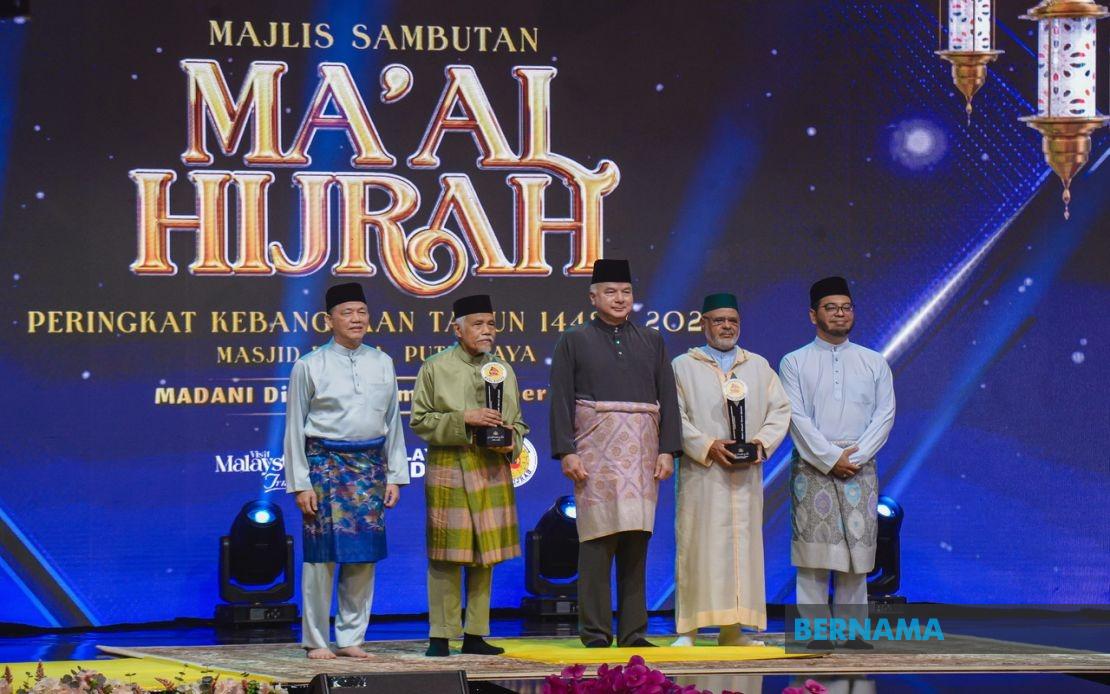
The highlight of the ceremony came when Sultan Nazrin Shah, who also holds the title of Sultan of Perak, conferred the National Tokoh Maal Hijrah Award upon Prof Emeritus Datuk Dr Osman Bakar, rector of the International Islamic University Malaysia (IIUM). Osman Bakar's recognition reflects Malaysia's appreciation for academic leadership that bridges Islamic scholarship with contemporary international discourse. IIUM, as a premier institution blending Islamic studies with modern professional training, exemplifies how Malaysia positions itself as a centre for Islamic learning that engages with global intellectual currents while maintaining traditional religious grounding.
The International Tokoh Maal Hijrah Award was bestowed upon Dr Ahmad Al-Raysuni, a distinguished Moroccan Islamic jurisprudence scholar, highlighting Malaysia's recognition of cross-border Islamic intellectual exchange. This honouring of a prominent foreign Islamic thinker underscores how Maal Hijrah celebrations extend beyond national boundaries to celebrate contributions to global Islamic civilisation. For Malaysia's Islamic diplomacy, such recognitions strengthen ties with Muslim-majority nations and position the country as a platform where diverse Islamic scholarly traditions converge and are mutually respected.
Parallel celebrations in Sabah reflected how the Maal Hijrah observance permeates regional consciousness throughout the federation. An event in the state, attended by approximately 1,000 people, welcomed Tun Musa and his wife Toh Puan Faridah Tussin, with Chief Minister Datuk Seri Hajiji Noor and organising committee chairman Datuk Dr Mohd Arifin Mohd Arif facilitating proceedings. The presence of state leadership in these celebrations indicates how Islamic observances serve as occasions for affirming regional unity and commitment to shared spiritual values, even as Malaysia's federal structure maintains state-level religious administration.
Recognition in the male category of the Tokoh Maal Hijrah Award went to community activist Datuk Ag Sharin Alimin, a former director of the Sabah Islamic Religious Affairs Department, whose career trajectory from bureaucratic leadership to community engagement exemplifies the transition many senior Islamic administrators make in Malaysia. Similarly, former Sabah deputy state secretary Datuk Masnah Matsalleh received honours in the female category, acknowledging women's contributions to Islamic institutional life and governance—a recognition that reflects Malaysia's gradual expansion of women's roles in religious administration and leadership structures.
Among the most poignant moments was Ahmad Samsuri's presentation of the award to Jusoh @ Muda Ismail, a 95-year-old Quranic teacher whose decades of service transmitting Islamic knowledge represent the continuity of traditional Islamic education alongside modern institutional frameworks. As the adopted student of the venerated Tuan Guru Haji Mat Lintar, Jusoh embodies a chain of Islamic learning that stretches across generations, connecting contemporary Malaysia to its Islamic heritage. Honouring such individuals ensures that the contributions of grassroots religious educators receive national recognition alongside those of prominent scholars and administrators.
The 1448H date marks the Islamic calendar year, and Maal Hijrah observances typically fall in mid-June on the Gregorian calendar, making these celebrations annual anchors for Malaysia's Islamic civic calendar. The integration of spiritual programming with formal state recognition creates an institutional space where individual piety and public service are presented as complementary rather than competing values. This reflects Malaysia's particular approach to Islam as a civilisational force encompassing personal morality, institutional leadership, and collective social responsibility.
These nationwide celebrations carry significance beyond religious observance, functioning as platforms where Malaysia articulates its identity as an Islamic nation committed to democratic governance and multi-ethnic coexistence. The MADANI framework, which underpins this year's theme, represents the government's attempt to define Islamic values in terms that resonate with contemporary concerns about inclusive prosperity, quality leadership, and social cohesion. By tying hijrah—the Islamic concept of purposeful migration and renewal—to MADANI's principles, celebrations position spiritual transformation as inseparable from national development objectives.
For Malaysia's broader region, these events offer insights into how a Muslim-majority democracy attempts to harness Islamic cultural identity as a force for institutional strengthening and social unity. The recognition of international Islamic scholars alongside local community leaders suggests a vision of Islam that is simultaneously rooted in Malaysian contexts and engaged with global Islamic intellectual traditions. As Southeast Asia continues to grapple with questions of how religious identity integrates with secular governance and plural societies, Malaysia's Maal Hijrah celebrations exemplify one approach: formalising Islamic observance within state structures while emphasising that religious renewal serves broader national cohesion and development.