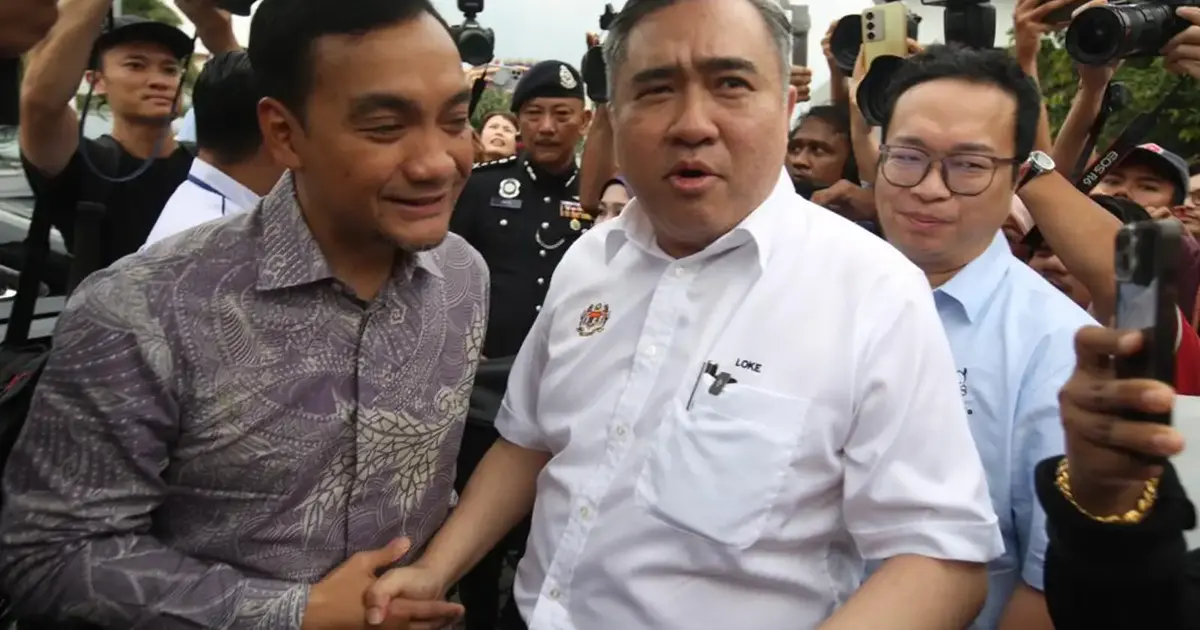
Transport Minister Anthony Loke and Johor Menteri Besar Onn Hafiz Mohamad demonstrated a cautious professionalism at their first face-to-face meeting since their recent online exchange, signalling that despite the digital friction, both figures remain committed to maintaining the working relationship necessary for governance at federal and state levels.
The encounter unfolded at an event hosted by the transport ministry, where the two political figures were brought together under circumstances that underscored the interconnected nature of Malaysian politics and administration. Although the meeting appeared outwardly cordial, the underlying currents of their prior disagreement were barely submerged, manifesting in pointed but measured remarks that suggested the tension has not entirely dissipated.
Onn Hafiz took the opportunity to deliver what amounted to a subtle rebuke during his remarks at the event. The Johor Menteri Besar noted that his schedule had required significant rearrangement to accommodate the transport ministry gathering, implying that the invitation had arrived with insufficient advance notice. This comment, while phrased diplomatically, carried the weight of criticism—a gentle reminder that such ministerial functions required more careful coordination when involving state leaders with demanding administrative responsibilities.
The nature of their prior online disagreement, though not explicitly outlined in detail, reflected the broader tensions that periodically emerge between federal ministries and state governments in Malaysia's system of governance. Such friction is not uncommon given the overlapping jurisdictions and competing interests that characterise centre-state relations, particularly when different political coalitions hold power at different levels. Loke's DAP background and Onn Hafiz's UMNO affiliation represent distinct political traditions within Malaysia's complex coalition landscape, adding another dimension to their relationship.
The decision to keep the recent meeting relatively formal and cordial reflects an understanding among senior Malaysian political figures that public disputes, however satisfying in the moment, can undermine effective administration and public service delivery. Both leaders recognise that transport matters—infrastructure development, funding allocation, and regulatory frameworks—require cooperation across political lines and between federal and state authorities. Allowing personal animosity or party rivalry to override these pragmatic necessities would ultimately harm their constituents.
For transport ministry operations across Malaysia, the relationship between the federal minister and state leadership in Johor carries particular significance. Johor, as Malaysia's second-largest state by population and an economic powerhouse, plays a crucial role in national infrastructure projects and transport corridors. Many major initiatives, from the pan-Borneo Highway to port developments and public transport systems, require harmonious federal-state cooperation. When such relationships become strained, implementation can suffer, timelines can slip, and costs may escalate.
The event itself represented the ministry's attempt to engage with state-level leadership, likely involving transportation matters that necessitate collaborative input. Whether the discussion centred on funding allocation, development approvals, regulatory alignment, or project prioritisation, the presence of both Loke and Onn Hafiz suggested that substantive issues required resolution. The short notice that characterised the invitation—as Onn Hafiz's pointed comment suggested—may have reflected scheduling pressures within the federal ministry or an unexpected development requiring urgent attention.
For Malaysian observers and political analysts, this encounter offered insight into how senior figures handle interpersonal and political friction while maintaining the institutional framework that keeps government functioning. The ability to move past public digital exchanges and engage professionally in person demonstrates political maturity and commitment to national interests above factional concerns. In a federation where centre-state dynamics periodically generate tension, such diplomatic navigation remains essential.
The implications for transport policy and infrastructure development in Johor remain to be seen. Whether this cordial reunion translates into smoother cooperation on pending projects will depend on the substantive agreements reached and the willingness of both parties to follow through with implementing commitments. The measured tone of their interaction suggests a mutual interest in preventing further escalation, though the underlying issues that prompted their initial online dispute may require more fundamental resolution.
Moving forward, observers will watch whether this first post-spat meeting inaugurates a period of improved federal-state coordination or represents merely a temporary truce before further tensions emerge. Given the political diversity within Malaysia's power structure and the genuine differences that exist between DAP and UMNO philosophies, some friction is perhaps inevitable. However, the ability demonstrated here to compartmentalise political differences from administrative necessity offers hope that such disputes need not derail governance or service delivery to Malaysians relying on effective transport infrastructure and policy.