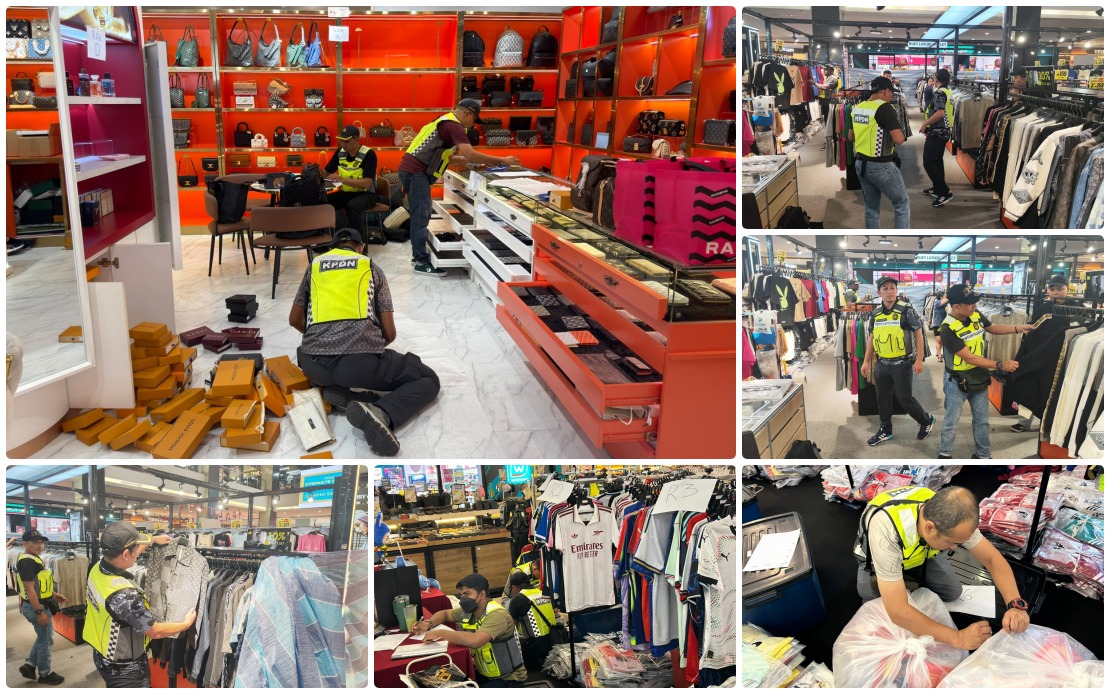
The Ministry of Domestic Trade and Cost of Living (KPDN) has delivered a decisive blow against intellectual property infringement in Johor, executing coordinated raids that culminated in the seizure of RM600,000 worth of counterfeit merchandise across three separate premises in Johor Bahru on June 15. The enforcement action, announced by ministry leadership this week, underscores intensifying efforts to combat organised counterfeiting operations that have proliferated across Malaysia's retail landscape, particularly in high-traffic commercial hubs.
According to KPDN's enforcement director-general Datuk Azman Adam, the operation emerged from a comprehensive month-long intelligence-gathering phase centred on traders distributing illicit goods through major supermarket chains. The investigation revealed a sophisticated distribution network where suspects were not merely retailing counterfeit items but actively supplying other traders downstream, suggesting a more elaborate supply chain than simple point-of-sale violations. This structural sophistication indicates that the operation posed a wider threat to the integrity of Malaysia's branded goods market than isolated retail infringements.
The seized inventory encompassed a diverse portfolio of luxury categories, demonstrating the breadth of counterfeiting activity. Enforcement teams recovered clothing, handbags, wallets, belts, and perfumes bearing unauthorised trademark applications, alongside accompanying business documentation. The variety reflects counterfeiter sophistication in replicating multiple product categories under recognisable brand names, a diversification strategy that maximises market penetration and complicates detection. Such product range suggests the operation was not targeting a niche consumer segment but rather aiming for broad retail accessibility across multiple consumer demographics.
The four individuals detained—identified as the premises owner, caretaker, and two others involved in operational management—now face investigation under Section 102(1)(c) of the Trademark Act 2019, a provision specifically addressing possession of goods bearing wrongfully applied trademarks with intent for commercial distribution. The targeting of management-level figures rather than merely street-level vendors signals KPDN's strategic focus on dismantling operational infrastructure rather than pursuing peripheral actors. This approach recognises that sustainable counterfeiting suppression requires incapacitating the organisations orchestrating these schemes.
The legal consequences outlined for conviction carry substantial deterrent implications. Individual offenders face maximum penalties of RM10,000 per item or three-year imprisonment for first offences, escalating to RM20,000 per item or five-year sentences for repeat violations. For corporate entities, penalties climb to RM15,000 per item initially, doubling to RM30,000 for subsequent infractions. These graduated penalty structures reflect legislative intent to impose escalating costs on recidivism, though enforcement effectiveness ultimately depends on prosecution success and consistent application across jurisdictions.
Counterfeiting represents a particularly insidious form of commercial violation in Southeast Asian markets, where brand consciousness among consumers intersects with price sensitivity and limited product authentication awareness. Malaysia's position as a regional trade hub and manufacturing centre has historically rendered it vulnerable to counterfeiting operations that leverage local logistics infrastructure and port facilities to distribute goods regionally. The Johor location, adjacent to Singapore and with established commercial networks, creates particularly favourable conditions for such operations, making the state a logical enforcement priority.
The economic implications extend beyond the immediate RM600,000 seizure. Counterfeit operations erode intellectual property protections that legitimate Malaysian manufacturers and brand licensees depend upon for competitive differentiation. International luxury and mainstream brands operating in Malaysia lose both direct sales and brand equity when consumers encounter inferior counterfeit products masquerading under authentic trademarks. This degradation of brand perception creates externalities affecting Malaysia's attractiveness as a market for legitimate premium goods, potentially discouraging brand investment and official distribution expansion.
Consumer protection dimensions warrant equal emphasis. Purchasers unknowingly acquiring counterfeit goods experience direct quality degradation—counterfeit perfumes may contain undisclosed chemical compositions posing health risks, handbags deteriorate prematurely, and clothing fails durability expectations. Beyond individual dissatisfaction, aggregated counterfeiting undermines consumer confidence in retail environments, particularly supermarkets prominently named in KPDN's statement. When major retail chains inadvertently stock counterfeit merchandise, consumers question verification mechanisms across product categories, contaminating trust even in legitimately stocked inventory.
The month-long intelligence phase preceding the operation reflects evolving KPDN methodology that prioritises investigative depth over spontaneous enforcement. Rather than opportunistic raids, this intelligence-driven approach identifies systematic distribution networks, potentially intercepting goods before retail placement. Such methodology represents sophistication advancement, though scaling these operations across Malaysia's diverse commercial landscape presents resourcing challenges. Johor's selection may reflect available enforcement capacity concentration rather than comprehensive national coverage.
Regional dimensions merit consideration for Malaysian businesses and consumers. Counterfeiting suppression in Malaysia influences regional product flows, as Singapore's stricter enforcement and higher labour costs have historically attracted counterfeit manufacturing relocation to lower-cost jurisdictions including parts of Malaysia. KPDN's operational intensity thus generates spillover deterrent effects throughout Southeast Asia's informal commercial networks. Conversely, Malaysia remains an attractive transit point for counterfeits destined for broader regional distribution, meaning even vigorous domestic enforcement captures only portions of the counterfeiting ecosystem.
Datuk Azman's statement that KPDN will intensify ongoing enforcement operations signals sustained commitment rather than episodic crackdowns. This messaging addresses concerns that trademark enforcement remains inconsistent or concentrated in visible, high-profile operations while systemic vulnerabilities persist. Sustained intensity requires adequate budget allocation, specialised training, coordination across state enforcement units, and intelligence sharing with customs authorities managing border movements. Without these structural supports, announcement of intensified operations may represent aspiration rather than achievable policy commitment.
The Johor operation's success ultimately depends on downstream prosecution outcomes and sentencing severity. Substantial seizures carry limited deterrent impact if conviction rates remain modest or sentences approach minimum levels. Counterfeiting operations typically operate with cost-benefit calculations where seizure losses constitute business expenses rather than existential threats. Only when prosecution certainty and penalty severity reach thresholds where continued operation becomes economically irrational do enforcement operations generate genuine supply-side disruption. KPDN's success metrics should thus extend beyond seizure valuations to include conviction rates, sentencing patterns, and measurable reductions in counterfeit prevalence across enforcement jurisdictions.
Moving forward, the operation highlights persistent vulnerabilities in Malaysia's retail ecosystem and intellectual property protection infrastructure. While point-of-sale enforcement remains necessary, deeper systemic solutions require manufacturer investment in authentication technologies, retail partner verification protocols, and consumer education regarding brand differentiation. KPDN's role necessarily remains reactive enforcement, but sustainable counterfeiting suppression ultimately demands proactive business strategies and informed consumer decision-making complementing government intervention.

%22%2F%3E%3C%2Fpattern%3E%3C%2Fdefs%3E%3Crect%20width%3D%22100%25%22%20height%3D%22100%25%22%20fill%3D%22url(%23ph523ndg)%22%2F%3E%3Crect%20width%3D%22100%25%22%20height%3D%22100%25%22%20fill%3D%22url(%23ph523ndp)%22%2F%3E%3Ctext%20x%3D%2250%25%22%20y%3D%2250%25%22%20text-anchor%3D%22middle%22%20dominant-baseline%3D%22central%22%20fill%3D%22rgba(255%2C255%2C255%2C0.95)%22%20font-family%3D%22Georgia%2C%20'Times%20New%20Roman'%2C%20serif%22%20font-weight%3D%22700%22%20font-size%3D%22272%22%20letter-spacing%3D%22-0.02em%22%3EAnwar%3C%2Ftext%3E%3C%2Fsvg%3E)