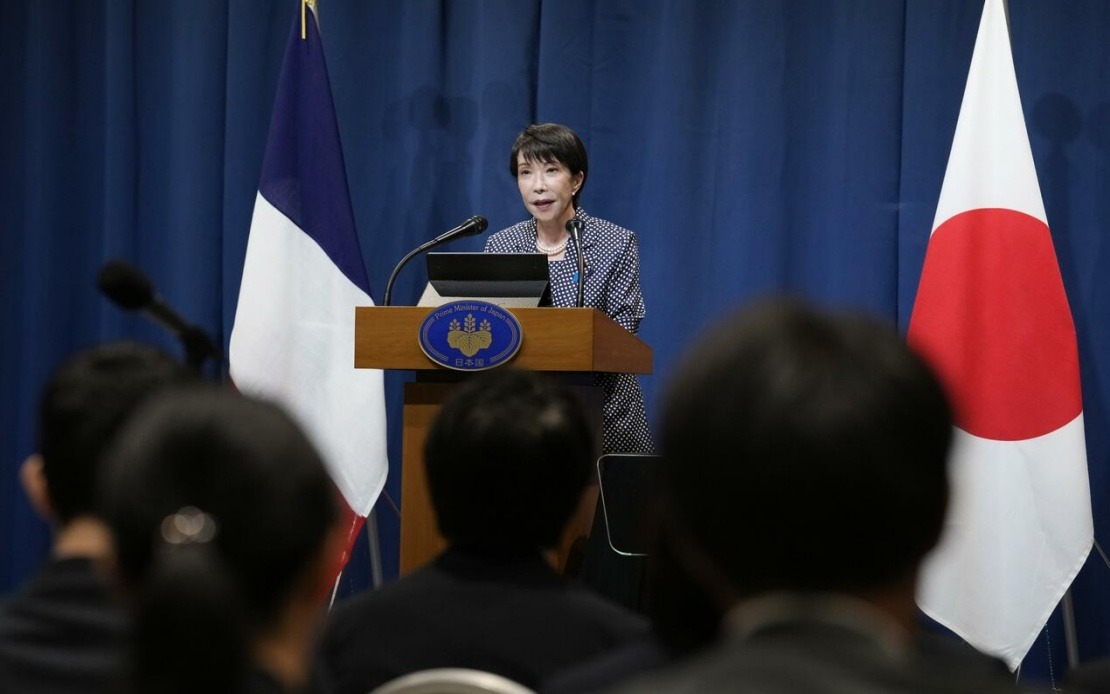
Prime Minister Sanae Takaichi's government faces a troubling political headwind as her Cabinet's public backing has eroded to 55.8 per cent, marking the lowest point since she assumed the premiership last October, according to a fresh Kyodo News poll released Sunday. The decline reflects mounting public anxiety about Japan's economic trajectory amid global uncertainties, particularly the unfolding tensions affecting resource-dependent Asian economies through disruptions to critical shipping lanes and energy supplies.
The timing of this dip is particularly significant for the region, as Japan navigates a complex balancing act between maintaining alliance commitments and protecting its substantial commercial interests in volatile regions. The government's standing deteriorates just as the international landscape shifts, with the United States and Iran announcing preliminary peace negotiations that include Tehran's commitment to reopening the Strait of Hormuz. For resource-scarce Japan and its Southeast Asian neighbours, such geopolitical developments carry outsized importance, given the region's heavy reliance on Middle Eastern energy sources flowing through these critical waterways.
Japanese public opinion on military involvement reflects this cautious sentiment. The weekend survey revealed that 54.7 per cent of respondents oppose dispatching the Japanese Self-Defence Forces to contested waterways for commercial vessel protection, while 36.6 per cent support such intervention. This nearly three-to-five ratio suggests substantial public resistance to military deployments overseas, a posture rooted in Japan's constitutional constraints and historical experience. The positioning is instructive for Southeast Asian nations wrestling with their own maritime security challenges and great power competition in waters off their coasts.
Japan's economic struggles constitute the deeper layer of political vulnerability for Takaichi's administration. Households across the country continue bearing the burden of elevated living costs, a phenomenon that translates directly into eroded public confidence in leadership. This inflationary pressure transcends Japan's borders—Southeast Asian economies face comparable price pressures that constrain consumer spending and dampen growth prospects, making the Japanese experience a cautionary tale about managing stagflationary conditions.
The consumption tax debate revealed in the poll captures these economic anxieties with striking clarity. A plurality of 43.9 per cent of respondents indicated acceptance of reducing the consumption tax on food and beverages from the current 8.0 per cent to 1.0 per cent, provided such cuts accelerate delivery of relief to struggling families. This conditional support reveals pragmatic voters willing to entertain creative policy solutions. A further 22.6 per cent advocated for complete elimination of the tax on consumables, aligning with pledges made by ruling coalition parties to address household financial distress through targeted tax relief.
The fracturing of public support into multiple policy preferences—ranging from modest reduction to complete elimination—suggests that Takaichi's government faces pressure to act decisively on cost-of-living measures. Half-measures risk disappointing constituencies across the political spectrum. For Malaysian and other regional observers, the contrast is noteworthy: while Japan debates consumption tax relief, many Southeast Asian nations employ different mechanisms like targeted cash transfers or subsidies to assist vulnerable populations, reflecting distinct governance philosophies and revenue structures.
These domestic pressures arrive precisely when Japan's international role faces expanding demands. The broader West Asia conflict and its economic consequences have rippled through Asian supply chains and energy markets, creating secondary pressures on governments to demonstrate competent stewardship. Japan's diplomatic juggling act—managing alliance obligations, protecting commercial interests, and responding to public wariness about military involvement—mirrors challenges facing regional peers grappling with great power competition.
The polling snapshot ultimately reflects a government wrestling with the eternal tension between managing immediate household economics and addressing longer-term strategic positioning. Takaichi's Cabinet entered office with expectations of renewed dynamism, but the approval trajectory suggests those initial hopes may be fading. Whether through tax relief measures, energy security policies, or clearer articulation of Japan's regional strategy, the administration must reverse declining confidence or face accumulating political difficulties ahead.
For Southeast Asia, the Japanese experience carries instructive weight. Economic management directly correlates with public confidence in leadership, a lesson applicable across the region. Furthermore, the public resistance to military deployments abroad resonates with similar sentiment in several ASEAN nations, where citizens prefer economic engagement over strategic confrontation. Finally, the intersection of domestic inflation with geopolitical uncertainty presents a complex policy challenge that transcends national boundaries, suggesting that coordinated regional approaches to economic resilience may serve mutual interests more effectively than isolated national responses.