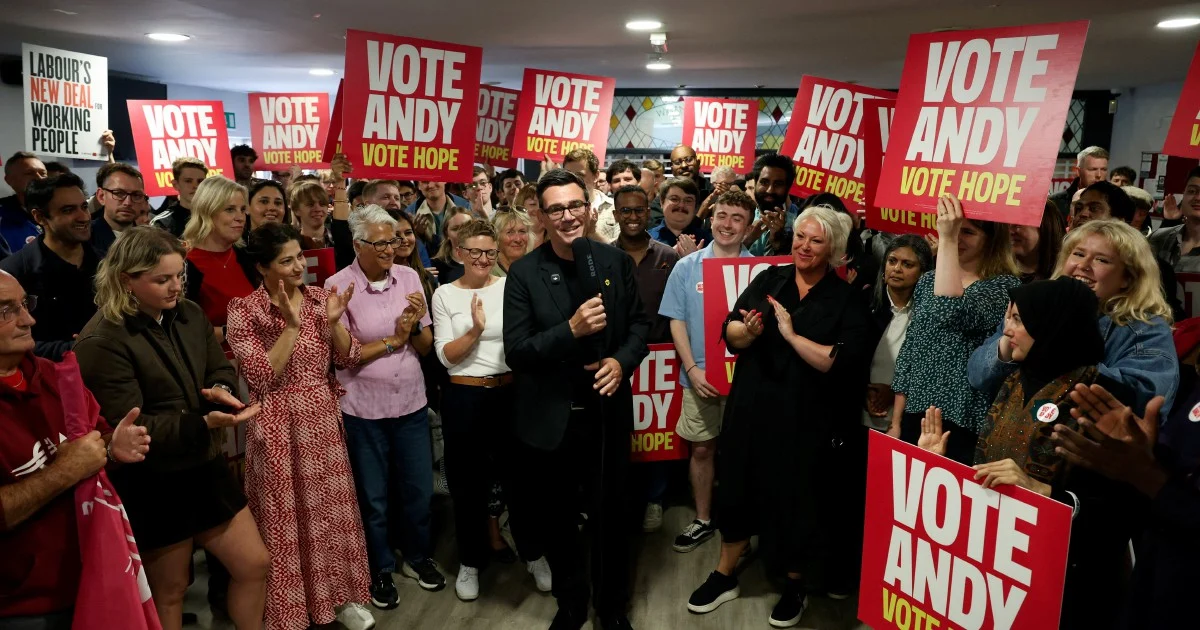
Andy Burnham's aspirations to launch a serious challenge against Prime Minister Keir Starmer for the Labour leadership may receive an unexpected boost from the deep divisions now destabilizing Britain's conservative political movements. The former Manchester mayor faces a crucial test in the Makerfield by-election on Thursday, where he will attempt to secure a parliamentary seat—a necessary precondition for any genuine bid to lead the nation. However, his path to victory appears unexpectedly smooth, not primarily because of his own political magnetism, but rather due to the fracturing of the right-wing vote between the traditional Conservative Party and the insurgent Reform UK movement.
The split between these two populist forces represents a significant realignment in British politics. The Conservatives, once dominant under previous administrations, have found themselves outflanked by Reform UK, which has captured significant support among voters dissatisfied with the political establishment. This fragmentation means that anti-Labour voters in Makerfield face a choice rather than presenting a unified opposition, allowing Burnham to potentially win with a smaller percentage of the overall vote than would normally be required. In electoral systems where first-past-the-post voting prevails, such divisions among opposition parties can prove decisive, particularly in constituencies where neither conservative faction commands overwhelming support.
Burnham himself, having spent considerable time building a profile as a regional political figure, brings substantive experience to his potential leadership candidacy. His tenure leading Greater Manchester demonstrated administrative capability and an understanding of devolved governance structures that increasingly matter within the UK's constitutional arrangements. Yet Thursday's result, should it favour him, would owe as much to the strategic miscalculations and ideological disputes among Conservative and Reform figures as to any personal political achievements. This dynamic reflects a broader pattern wherein leadership changes can be determined as much by the weaknesses of opponents as by the strengths of frontrunners.
For Malaysian observers of British politics, this situation illuminates how electoral mechanics and party fragmentation shape democratic outcomes in ways that transcend individual candidate quality. Malaysia's own political landscape has experienced similar dynamics, where opposition vote-splitting between competing parties with overlapping voter bases has historically influenced seat distributions in parliament. The principle that disunited opposition movements inadvertently strengthen alternative candidates remains universally applicable across Westminster-influenced democracies throughout Southeast Asia and beyond.
The timing of Burnham's bid carries particular significance given Labour's current dominance under Starmer's leadership. The Prime Minister enjoyed a substantial election victory, leaving Labour with a commanding parliamentary majority. Within this context, Burnham's maneuvering to establish himself as a potential successor reflects the natural jockeying that occurs within governing parties, particularly when the current leader appears secure. His determination to secure a seat suggests he intends to position himself as a serious contender should circumstances eventually change, though the timeline for such developments remains entirely speculative.
Conservative Party divisions underlying this situation reflect genuine ideological and strategic tensions rather than mere personality clashes. Reform UK, under Nigel Farage's leadership, has aggressively promoted nationalist and eurosceptic messaging that appeals to voters feeling alienated from mainstream politics. The Conservatives, meanwhile, attempt to recapture these voters while maintaining broader electoral appeal. This fundamental tension proves impossible to fully reconcile, creating space for competitors like Burnham to advance.
The Makerfield constituency itself carries historical significance within British politics. As a traditional Labour stronghold, the seat's representation has long reflected working-class concerns and values central to the party's original political project. Burnham's candidacy represents an attempt to restore Labour's grip on such constituencies at a time when various demographic and economic shifts have created uncertainty about traditional voting patterns. His victory would consolidate Labour's hold rather than representing a dramatic breakthrough.
Looking ahead, the structural vulnerabilities now apparent in British conservatism may persist beyond Thursday's vote. If Reform UK continues gaining support and Conservative Party recovery remains elusive, the fragmentation of right-wing politics could shape multiple electoral contests. For Burnham specifically, establishing his parliamentary credentials represents a crucial stepping stone toward more ambitious political objectives. Whether he ultimately achieves the Labour leadership remains contingent on numerous future developments, but Thursday's result will provide essential momentum for his efforts.
For regional observers in Southeast Asia, the broader lesson concerns how political systems navigate periods of transition and realignment. Britain's experience demonstrates that even established parties can face serious challenges when new movements successfully mobilize previously disengaged voter constituencies. Malaysia's political scene has witnessed comparable dynamics as voters have gradually shifted their support patterns across multiple election cycles. Understanding these mechanisms of political change proves valuable for anyone seeking to comprehend contemporary democratic politics across Westminster-influenced nations.