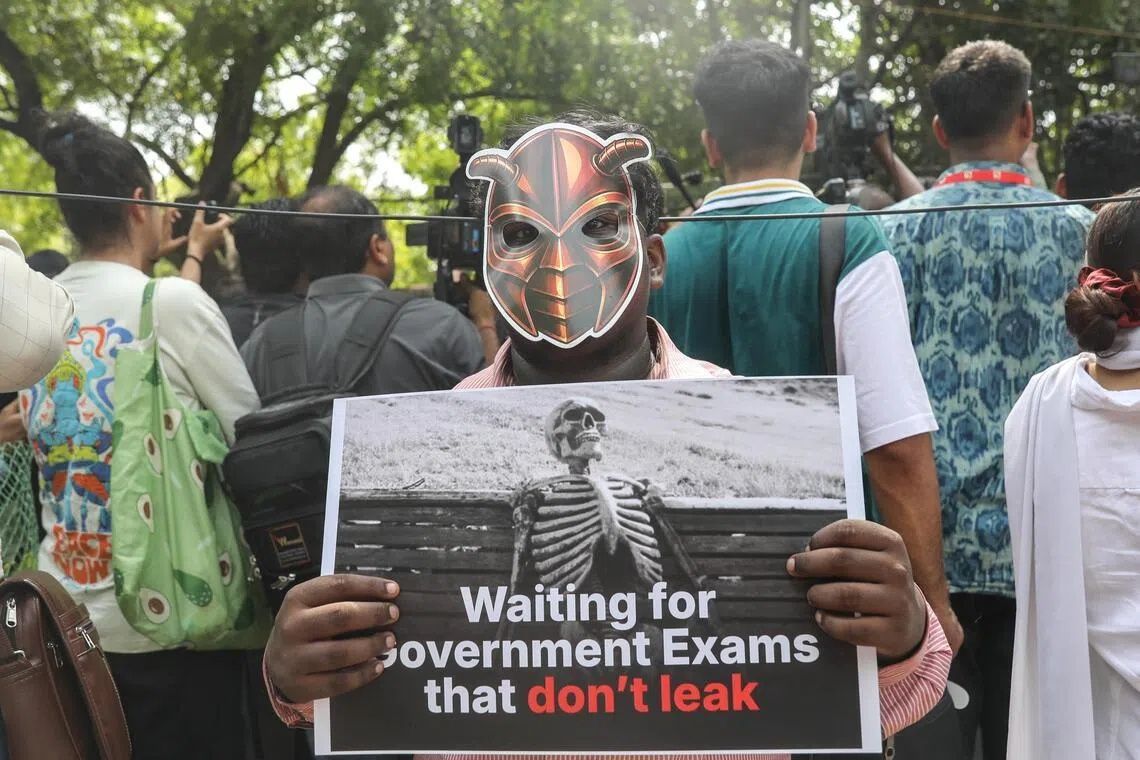
India's education system faced a critical juncture on Sunday, June 21, as 2.2 million prospective medical students sat for a retest under unprecedented security arrangements. The examination, known as the National Eligibility cum Entrance Test, represents the sole pathway to securing places in the country's medical colleges, making it one of Asia's most consequential competitive assessments. The decision to hold the retest came after authorities scrapped the May examination following a significant breach in which question papers were leaked before the official testing window, triggering a national crisis of confidence in the examination machinery.
The scale of the security deployment underscored the gravity of the situation. Authorities mobilised over 200,000 officials, including law enforcement personnel, to oversee the examination across testing centres nationwide. The National Testing Agency, India's exam conducting body, implemented what it termed a "multi-layered security framework" designed to prevent any recurrence of the fraudulent activity that had compromised the previous attempt. This framework incorporated biometric authentication systems to verify candidate identity, artificial intelligence-powered camera surveillance to monitor testing centres in real time, and GPS tracking technology to monitor the physical movement of question papers from printing facilities through to distribution at examination sites.
The paper leak scandal exposed vulnerabilities in India's examination ecosystem and ignited broader concerns about educational integrity. The failure materialised alongside a separate marking controversy affecting nearly two million high school students, where allegations emerged that the online grading system had assigned incorrect marks to numerous candidates or credited results to wrong individuals. Together, these incidents created a perfect storm of public dissatisfaction, prompting widespread student demonstrations and parental outcry that escalated into demands for the resignation of Education Minister Dharmendra Pradhan.
The investigation into the leak revealed the involvement of organised criminal networks operating within India's vast coaching industry. Authorities identified a chemistry lecturer as the alleged orchestrator of the fraudulent scheme, highlighting how insider involvement remained central to examination fraud. The Central Bureau of Investigation made arrests in connection with the case, though broader network disruption proved challenging. Messaging platforms, particularly Telegram, had served as communication channels through which leaked materials circulated among cheating syndicates seeking to capitalise on candidates' desperation to secure medical college seats.
Telegram's leadership rejected the notion that a week-long restriction on the application would substantially address the underlying problems. Pavel Durov, the company's head, argued that such bans merely displaced criminal activity to alternative platforms rather than tackling the root cause. He contended that the fundamental issue lay with individuals inside the examination system willing to leak confidential materials for financial gain, suggesting that technological restrictions alone could not solve an integrity problem rooted in human corruption.
The intense competitive pressure surrounding India's medical entrance examinations creates an environment conducive to fraud. With approximately 2.2 million candidates vying annually for just over 100,000 undergraduate seats, acceptance rates remain extremely low. This scarcity of positions has catalysed the emergence of a massive coaching industry, where private institutions promise to maximise candidates' chances through intensive preparation programmes. The lucrative nature of this sector, combined with candidates' willingness to resort to any advantage, creates powerful incentives for criminal exploitation.
The retest commenced at 2 p.m. local time, with security protocols designed to be more rigorous than previous iterations. The expanded surveillance infrastructure and real-time monitoring systems reflected lessons learned from the breach. However, security experts acknowledge that no system remains entirely immune to determined fraudsters, particularly when insider participation is involved.
Beyond institutional measures, the scandal sparked unusual political responses that illustrated the depth of public frustration. A satirical movement calling itself the "Cockroach People's Party" emerged in May and rapidly accumulated millions of followers through social media, using humour and satire to channel youth anger over educational mismanagement. The movement's central demand—the resignation of Education Minister Dharmendra Pradhan—reflected broader sentiment that systemic failures demanded accountability at the highest governmental levels.
The controversy also revealed concerning trends in youth mental health, with Indian media reporting that several teenagers had taken their own lives in the aftermath of the initial examination cancellation. These tragic incidents underscored the psychological burden that high-stakes examinations place on young Indians and the devastating consequences when examination integrity collapses.
For Malaysia and other Southeast Asian nations, India's examination crisis offers sobering lessons about the vulnerabilities inherent in large-scale competitive testing systems. As education systems across the region expand digital infrastructure and scale up entrance examinations, the Indian experience demonstrates that technological sophistication alone cannot guarantee integrity without robust institutional safeguards, effective anti-corruption mechanisms, and cultural shifts that discourage insider participation in fraud schemes.
The retest represented India's attempt to rebuild institutional credibility and restore public confidence in its examination system. Success would require not merely completing a single secure examination, but implementing systemic reforms that address the underlying incentive structures enabling fraud. The coming months would reveal whether the security measures implemented prove sufficient to prevent recurrence or whether deeper institutional transformation becomes necessary.

%22%2F%3E%3C%2Fpattern%3E%3C%2Fdefs%3E%3Crect%20width%3D%22100%25%22%20height%3D%22100%25%22%20fill%3D%22url(%23ph40xibg)%22%2F%3E%3Crect%20width%3D%22100%25%22%20height%3D%22100%25%22%20fill%3D%22url(%23ph40xibp)%22%2F%3E%3Ctext%20x%3D%2250%25%22%20y%3D%2250%25%22%20text-anchor%3D%22middle%22%20dominant-baseline%3D%22central%22%20fill%3D%22rgba(255%2C255%2C255%2C0.95)%22%20font-family%3D%22Georgia%2C%20'Times%20New%20Roman'%2C%20serif%22%20font-weight%3D%22700%22%20font-size%3D%22272%22%20letter-spacing%3D%22-0.02em%22%3EMITRA%3C%2Ftext%3E%3C%2Fsvg%3E)