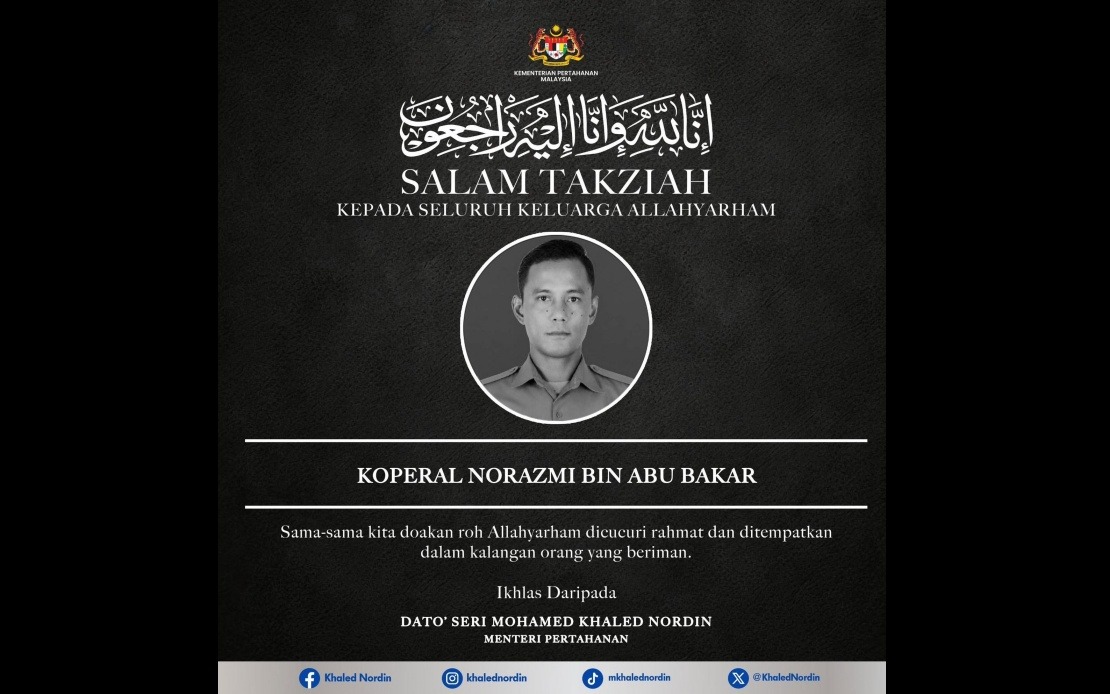
The Malaysian government and Defence Ministry have conveyed their sympathies to the families of Corporal Norazmi Abu Bakar and Private Siti Khadijah Sungip, who lost their lives in an explosion during a grenade-throwing training exercise on Sunday morning. The incident, which occurred at Hobart Camp firing range in Gurun, Kedah, has prompted senior officials to pledge support for the bereaved families during this difficult period.
Defence Minister Datuk Seri Mohamed Khaled Nordin released a statement expressing his profound sorrow over the deaths of the two servicemembers. In his message, the minister emphasised that both the ministry and government stand united with the families in their time of grief, praying that they will find the fortitude to endure the tragedy that has befallen them.
Corporal Norazmi served with the 6th Battalion, Royal Malay Regiment, while Private Siti Khadijah was assigned to the 1st Squadron, Royal Army Engineers Regiment. Both personnel sustained severe injuries when the blast occurred at approximately 10:57 am. Despite rapid evacuation efforts, both soldiers succumbed to their injuries while being transported to Sultan Abdul Halim Hospital in Sungai Petani.
In his social media statement, Minister Khaled Nordin appealed for prayers on behalf of the deceased, requesting divine mercy for their souls and forgiveness of their transgressions. The message reflected the government's respect for the fallen servicemembers and acknowledged the significance of their sacrifice in the line of duty.
The Malaysian Army swiftly confirmed the identities of the victims and provided initial details of the accident. Army Chief General Tan Sri Azhan Md Othman has since instructed military authorities to launch a comprehensive investigation to establish the precise circumstances that led to the blast. Such inquiries are standard protocol following operational accidents involving explosives and live ammunition exercises.
Grenade-throwing training represents a critical component of military preparation, designed to equip soldiers with practical skills in handling explosive devices and understanding tactical deployment. However, such exercises carry inherent risks, and even with rigorous safety protocols and experienced supervision, accidents can occur. The incident underscores the hazards that military personnel face during routine training activities.
The tragedy highlights ongoing concerns about occupational safety within the armed forces. Military training environments, particularly those involving explosives and weapons systems, demand meticulous attention to safety procedures, equipment maintenance, and personnel training. Each such incident prompts reviews of existing protocols to identify potential gaps or areas requiring strengthening.
For the Malaysian Army, this accident represents a sobering reminder of the costs associated with military operations and training. Both victims represented the backbone of the armed forces—professional servicemembers committed to defending national security. Their deaths will likely resonate throughout their respective units and across the broader military community.
The circumstances of the incident, particularly how two trained personnel came to be fatally injured during a controlled training exercise, will likely be scrutinised closely by the investigating team. Potential factors under examination may include equipment malfunction, procedural deviation, training adequacy, or environmental conditions that could have contributed to the tragedy.
This incident also draws attention to the broader issue of military safety culture in Southeast Asia. Regional armed forces regularly conduct similar training exercises, and sharing of investigative findings and safety lessons from such incidents contributes to preventing future tragedies across the region's defence establishments.
The loss of these two servicemembers extends beyond military circles, affecting their families, communities, and the nation as a whole. Military fatalities during peacetime operations often generate public discussion about resource allocation, training standards, and the support systems available to military personnel and their dependents.
As the investigation progresses, the findings will likely inform recommendations for procedural adjustments or enhanced safety measures within the Malaysian Army. Such measures are essential to protect personnel who place their lives at risk in service of the nation, even during routine training activities away from active conflict zones.