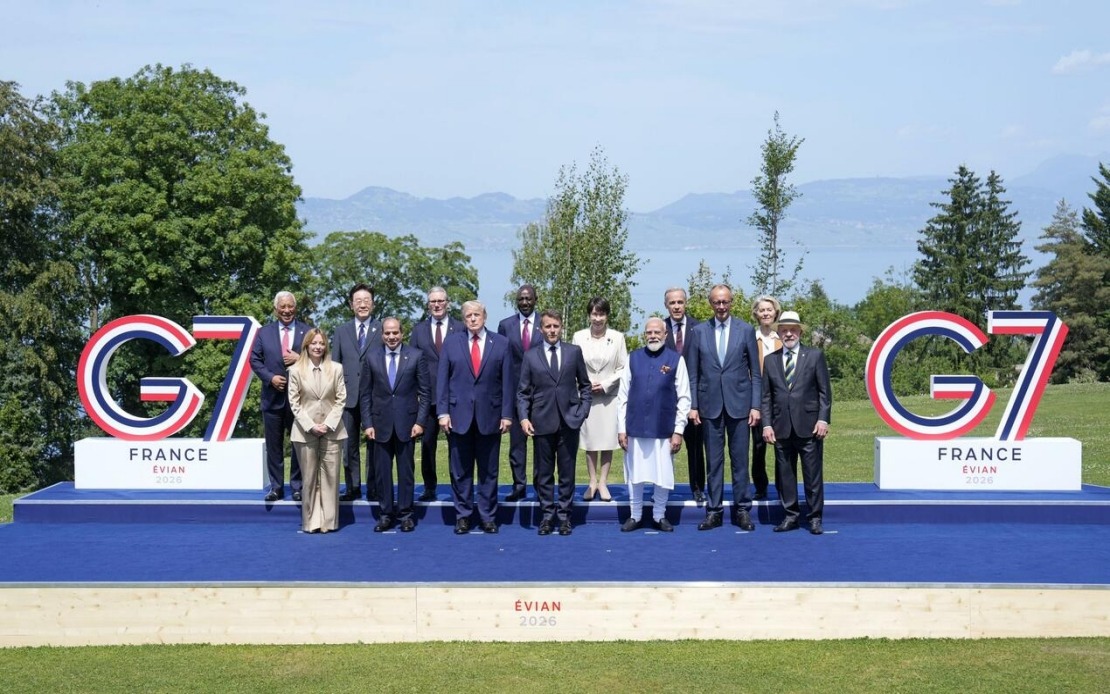
The world's leading industrialized democracies demonstrated rare unity on Ukraine this week when G7 leaders gathered at their annual summit in Evian-les-Bains, a lakeside resort town in eastern France. Despite escalating tensions between Washington and its European allies over trade, military commitments, and geopolitical ambitions, the seven-nation bloc produced a consensus on maintaining pressure against Russian aggression while pursuing a negotiated settlement. The agreement came after Ukrainian President Volodymyr Zelenskyy presented directly to the group, detailing Kyiv's evolving battlefield needs and diplomatic objectives.
US President Donald Trump struck a notably different tone from previous American administrations by emphasizing negotiation over confrontation, declaring that Russia should "make a deal" given the enormous human toll the war has exacted on both belligerents. Trump framed the conflict not as an ideological struggle but as a costly stalemate ripe for resolution, suggesting that both nations had incurred unsustainable losses. This positioning reflected Trump's broader foreign policy philosophy of ending protracted conflicts through bilateral bargaining rather than through sustained support for proxy actors or alliance-based containment strategies.
The Trump administration's leverage point in these negotiations appears connected to energy markets and sanctions architecture. The president indicated that the United States might reimpose certain sanctions on Russian oil that had been temporarily lifted to stabilize global prices following recent military actions in Iran. Trump attributed the possibility of renewed sanctions to improved oil market conditions resulting from his administration's success in negotiating reopened shipping through the Strait of Hormuz, a critical chokepoint for international energy supplies. This linkage between Middle Eastern diplomacy and Ukraine strategy illustrates how Washington views these conflicts as interconnected rather than compartmentalized regional problems.
Zelenskyy's public messaging from the summit emphasized air defence strengthening and diplomatic acceleration, signalling Ukraine's pragmatic approach to balancing military capability with peace negotiations. By highlighting air defence rather than offensive capability requests, Zelenskyy demonstrated understanding of the complex politics surrounding Western military support, particularly given the European reluctance to escalate weapons provision without clear diplomatic off-ramps. His commitment to "making Russia end its war" through diplomacy reflected the reality that Ukrainian leverage derives not merely from battlefield success but from demonstrating to Western partners that military support yields diplomatic dividends.
Japanese Prime Minister Sanae Takaichi articulated concerns that extended well beyond Ukraine's borders, warning against unilateral territorial changes achieved through military force. Her emphasis on Russia-North Korea military cooperation and deepening Russia-China ties reflected Tokyo's acute awareness that the broader Indo-Pacific security architecture faces destabilization if revisionist powers succeed in remapping geopolitical boundaries. For Malaysia and Southeast Asian nations, Takaichi's warnings signal that the Ukraine conflict serves as a test case for whether established international norms against conquest can survive concerted challenges from authoritarian coalitions.
French President Emmanuel Macron's hosting role underscored Europe's stake in shaping the peace process rather than merely supporting Zelenskyy's military objectives. By inviting additional nations including Brazil, Egypt, India, Qatar, South Korea, and the United Arab Emirates, France positioned the summit as addressing global rather than merely Atlantic concerns. This expansion of the summit's diplomatic footprint acknowledges that emerging markets increasingly influence international negotiations through their economic weight and their capacity to provide alternative frameworks for geopolitical alignment. Southeast Asian nations, though not formally included, understand that any Ukraine settlement architecture will influence subsequent negotiations over contested territorial arrangements in their own region.
The working lunch on Middle Eastern affairs revealed how interconnected contemporary conflicts have become. G7 leaders and representatives from Egypt, Qatar, and the UAE discussed the war in Iran alongside Ukraine, recognizing that energy markets, shipping routes, and weapons supplies link these theatres into an integrated strategic challenge. Takaichi's insistence on ensuring "free and safe navigation" in critical shipping channels directly concerns Malaysia, whose maritime trade depends on unobstructed passage through numerous global chokepoints. The preliminary US-Iran agreement to reopen the Strait of Hormuz carries profound implications for Southeast Asian economies dependent on reliable energy imports and uninterrupted trade flows.
The G7's agenda on development finance reform addresses a structural challenge that remains largely absent from mainstream coverage of great power competition. By acknowledging that traditional official development assistance proves insufficient for addressing developing nations' needs, the group signalled awareness that China's Belt and Initiative approach and other alternative financing models have exposed gaps in the Western-led development framework. France's push toward creating "mutually beneficial partnerships" that mobilize private capital represents an implicit recognition that exclusive reliance on concessional government aid no longer matches the scale of infrastructure investment required across the Global South. For Malaysia and its peers, this represents an opportunity to leverage competition among developed nations while ensuring that development financing remains truly development-oriented rather than serving primarily geostrategic interests.
The joint declaration's emphasis on reforming development cooperation while accounting for "strategic interests" reveals candid acknowledgment that development assistance and geopolitical positioning have become inseparable. Western nations increasingly frame development financing as competition against Chinese and Russian influence, meaning that developing countries must navigate complex calculations about which partnerships advance genuine development versus those primarily serving donor nations' strategic objectives. Malaysia's experience with various infrastructure financing offers demonstrates the necessity of evaluating these offers on their substantive merits rather than accepting them as costless expressions of partnership.
The summit's outcomes demonstrate that despite Trump's unconventional approach and significant transatlantic disagreements, consensus remains possible on fundamental questions of international order. The G7's continued commitment to supporting Ukraine while simultaneously pursuing negotiation suggests that even in an era of great power competition, established democracies can coordinate responses to aggression. However, the depth of this commitment will test itself when negotiations begin and when members must decide whether diplomatic compromise requires reducing military support or accepting territorial concessions that contradict stated principles about borders established by international law.
For Southeast Asian observers, the summit illuminates both reassuring and concerning trends. The G7's reaffirmation of commitment to international law and against unilateral territorial change provides doctrinal support for regional positions on maritime disputes. Simultaneously, the demonstrated fragility of G7 unity on several issues and the visible friction between the United States and its traditional allies suggest that the Western-led order may prove less reliable in guaranteeing regional stability than previous generations assumed. Malaysia and its neighbours must accordingly deepen regional mechanisms for cooperation while maintaining productive relationships with multiple major powers rather than relying on any single provider of security or economic stability.