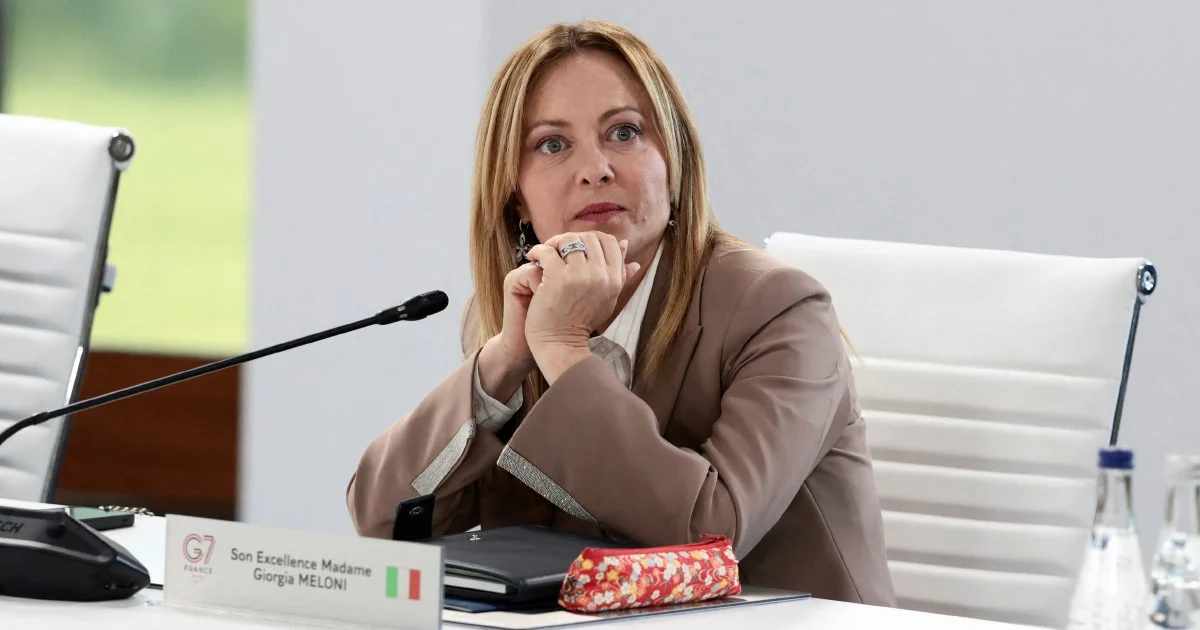
When Donald Trump assumed office for his second term as United States president in 2025, Italian Prime Minister Giorgia Meloni stood out as the sole European leader granted an invitation to his inauguration ceremony. That singular honour signalled what many observers anticipated would be the beginning of an exceptionally warm partnership between the American administration and Italy, one that could reshape the balance of power within the European Union and reshape Rome's traditional diplomatic alignments.
Meloni's initial positioning alongside Trump suggested a fundamental realignment in European politics. As a right-wing populist leader who had championed national sovereignty and questioned aspects of EU supranationalism, she appeared ideologically compatible with Trump's nationalist agenda. Her attendance at the inauguration was widely interpreted as symbolic validation of her standing within Trump's circle and as evidence that the incoming administration would prioritise bilateral relations with Rome over broader European institutional structures.
However, the honeymoon period proved remarkably short-lived. In subsequent months, Meloni transformed from a presumed Trump confidante into an increasingly pointed critic of American policies and presidential decisions. This unexpected shift has reverberated across European capitals and within the transatlantic alliance, forcing analysts to reassess the durability of nationalist political partnerships and the continuing relevance of traditional diplomatic channels in an era of personalised international relations.
For Malaysian and Southeast Asian observers, the Meloni-Trump reversal carries significant implications. Europe's internal divisions directly influence how the Western bloc projects unified diplomatic pressure on global issues ranging from trade negotiations to great power competition in the Indo-Pacific. If Europe's nationalist leaders cannot maintain cohesive positions with their American counterparts, the consistency of Western messaging in the region becomes questionable, potentially creating space for other powers to advance their strategic interests more effectively.
Meloni's criticism of Trump reflects several underlying tensions. As an Italian nationalist, she remains constrained by EU membership obligations and the complex balancing act of maintaining credibility within both Rome's domestic political base and the broader European institutional framework. Trump's more transactional approach to international relationships and his willingness to challenge NATO commitments create friction with Italy's security interests, which remain fundamentally tied to the alliance structure. Additionally, Trump's trade policies and tariff regimes directly threaten Italian export-dependent industries, particularly luxury goods and manufacturing sectors that depend on American market access.
The deterioration of Meloni-Trump relations also illustrates the instability inherent in relationships built primarily on personal rapport rather than institutional anchors. Unlike relationships grounded in formal treaties, shared security architectures, or established diplomatic protocols, purely personal political alignments lack resilience when interests diverge or when the personal factors that drove initial bonding become secondary to concrete policy outcomes. European leaders who aligned closely with Trump may now find themselves in awkward positions, having invested political capital in a relationship that provides fewer tangible benefits than anticipated.
From a Southeast Asian perspective, this dynamic underscores why traditional multilateral frameworks remain valuable despite their limitations. While the ASEAN Regional Forum and other regional mechanisms are often criticized for lacking enforcement mechanisms, they provide consistent platforms for dialogue that do not depend on the fluctuating personal relationships between individual leaders. The instability demonstrated by the Meloni-Trump relationship suggests that small and medium powers should continue developing regional partnerships and diversifying their external relationships rather than betting heavily on bilateral arrangements with major powers that could shift unexpectedly.
Meloni's willingness to criticise Trump publicly also reflects broader European frustration with American unilateralism. The Trump administration's approach to NATO burden-sharing, its handling of trade disputes, and its strategic calculations regarding Ukraine and other regional conflicts have generated genuine anxiety among European leaders who cannot simply dismiss the American president but also cannot afford to subordinate their own national interests entirely to Washington's preferences.
For Italy specifically, Meloni confronts a delicate balancing act. Italy's economy depends significantly on transatlantic trade and investment, yet it is also constrained by EU rules that limit how far it can deviate from collective European positions. The Italian government must navigate between demonstrating sufficient independence to satisfy its populist electorate while maintaining the diplomatic relationships necessary to secure EU support for its priorities. This explains why Meloni can afford to criticise Trump—she has alternative partnerships available through EU mechanisms that Trump's America cannot match.
The broader significance of this shift lies in what it reveals about the fragility of the current international order. Leaders who came to power promising to remake the global system through personal relationships and nationalist assertion of power now discover that such approaches generate as many complications as solutions. Meloni's evolution from Trump ally to Trump critic suggests that even leaders sympathetic to nationalist, anti-establishment politics recognise the institutional and economic realities that constrain their freedom of action.
Looking forward, the Meloni-Trump dynamic will likely influence how other European leaders calculate their own relationships with the Trump administration. Rather than seeking close personal alignment, European governments may increasingly opt for managed distance—maintaining necessary diplomatic and security relationships while preserving sufficient autonomy to act independently when vital national interests are at stake. This more cautious approach could actually serve Europe's long-term interests better than either uncritical alignment or open confrontation would allow.