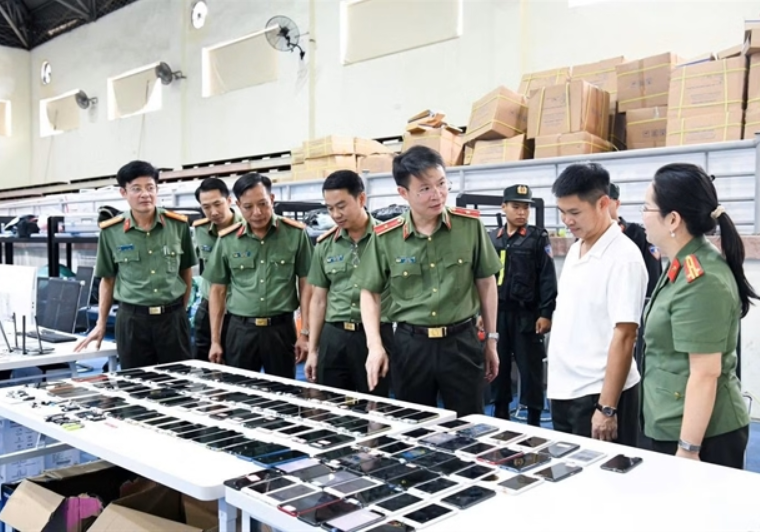
Police in Phu Tho province in northern Vietnam announced charges against four individuals on Thursday, June 18, over an alleged conspiracy to transplant an international online fraud operation from Cambodia into Vietnamese territory. The investigation and subsequent enforcement action represent a significant disruption of what authorities described as a transnational criminal logistics network designed to circumvent intensifying law enforcement pressure in neighbouring Cambodia.
The investigation originated when Vietnamese law enforcement identified a coordinated group with demonstrated connections to foreign-operated cybercrime enterprises operating across Cambodia. Intelligence suggested the network was actively preparing to shift its base of operations across the border into Vietnam, capitalizing on what organisers apparently believed would be a more conducive environment as Cambodian authorities stepped up their own crackdown against similar illicit activities.
The alleged mastermind of the relocation scheme was identified as Zhao Wei Zhong, a 37-year-old Chinese national who investigators believe entered Vietnam following instructions from a superior operating abroad. According to police accounts, Zhao's primary responsibility was to establish the necessary infrastructure—secure housing, utilities, and other logistical requirements—needed to accommodate an anticipated wave of workers transferring from the Cambodian operation. This advance preparation work typifies how sophisticated transnational crime networks compartmentalize their operations and delegate specific responsibilities across borders.
Zhao's background in the fraud sector proved particularly valuable to the conspiracy. Police revealed that he had previously worked at Chinese-managed scam call centres operating in Cambodia, where his tenure allowed him to develop professional relationships and operational knowledge that directly informed his planning for the Vietnam expansion. During his time in Cambodia, Zhao established crucial connections with two Vietnamese nationals: Tran Thi Thu Huong, aged 24, and Dình Nam, aged 27, both resident in Bac Ninh province in the north. These individuals became essential to Zhao's groundwork efforts.
Following his arrival in Vietnam, Zhao leveraged these pre-existing connections to recruit Huong and Nam into active roles supporting the logistics operation. The pair's assignments encompassed language interpretation services critical for coordinating with foreign operatives, transportation services to facilitate site surveillance and movement of personnel, and reconnaissance activities aimed at identifying suitable accommodation venues. The reliance on local Vietnamese contacts reflects a common operational pattern among transnational crime groups, which typically embed themselves within communities through trusted associates who can navigate local systems with cultural and linguistic fluency.
The conspiracy also implicated Nguyen Thanh Long, a 43-year-old Hanoi resident, who investigators determined played a significant support role in arranging the logistical framework underpinning the scheme. Long's involvement suggests the network had expanded its recruitment beyond the immediate circle of Zhao's acquaintances, extending into the capital where additional expertise and connections could facilitate housing acquisition, document procurement, and other administrative prerequisites.
Vietnamese police conducted extensive evidence gathering before moving to enforcement, apparently ensuring their case possessed sufficient documentation before initiating prosecutions. On June 17, following the completion of this investigative phase, authorities filed formal charges against three of the four suspects: Zhao, Huong, and Long faced allegations of organising the illegal entry and residency of foreign nationals within Vietnamese territory. Each of these three individuals was placed into pretrial detention, reflecting the severity with which Vietnamese authorities regard the offences.
Dình Nam faced identical charges but received differentiated treatment from the judicial system. Rather than custodial detention, Nam was subjected to a movement restriction order—a protective measure less severe than incarceration that confines individuals to their registered residence while legal proceedings advance. This distinction possibly reflects prosecutorial assessment of Nam's relative culpability compared to his co-conspirators, or alternatively, considerations regarding his cooperation with authorities during the investigation phase.
The physical evidence recovered from properties connected to the suspects further illustrates the scale and sophistication of the intended operation. Police seized a substantial cache of electronic equipment including 73 computers, 134 mobile devices, 34 USB storage drives, and 20 Wi-Fi routers, all items specifically procured for establishing a functioning scam call centre. This equipment stockpile demonstrates that the conspiracy had advanced considerably beyond preliminary planning stages, having already invested financial resources into acquiring specialised infrastructure.
For Southeast Asian readers, this case exemplifies a troubling regional trend wherein criminal enterprises displaced by enforcement actions in one jurisdiction opportunistically relocate to neighbouring territories perceived as presenting lower enforcement risk. The successful interdiction in Phu Tho underscores both the increasing coordination among law enforcement agencies in the region and the persistent adaptability of transnational criminal networks. Vietnam's intensified focus on cybercrime operations, coupled with Cambodia's parallel enforcement efforts, has created competitive pressure forcing these enterprises to seek new operating bases.
The involvement of a Chinese national as orchestrator reflects the global dimensions of modern online fraud networks, which leverage international recruitment pools and coordinate across multiple sovereign jurisdictions. These operations typically target victims across borders through digital means, making them inherently difficult for individual nations to combat unilaterally. The Malaysian context remains relevant given the region's shared vulnerability to similar schemes and the importance of developing coordinated regional responses to transnational cybercrime.
The dismantling of this particular operation prior to full operationalisation represents a significant enforcement achievement, as it prevented what would likely have become a highly disruptive criminal enterprise. Had the relocation succeeded, Vietnamese citizens would potentially have faced increased exposure to sophisticated scam campaigns, while the presence of such an operation would have damaged Vietnam's broader efforts to establish itself as a trusted destination for legitimate international business investment and cooperation.
Moving forward, this case underscores the necessity for enhanced information sharing and coordinated enforcement initiatives among regional law enforcement agencies. As criminal networks demonstrate increasing sophistication in exploiting jurisdictional boundaries and enforcement capability differentials, Southeast Asian nations must develop more robust mechanisms for rapid intelligence exchange and cross-border operational coordination to effectively counter these persistent transnational threats.

%22%2F%3E%3C%2Fpattern%3E%3C%2Fdefs%3E%3Crect%20width%3D%22100%25%22%20height%3D%22100%25%22%20fill%3D%22url(%23ph523ndg)%22%2F%3E%3Crect%20width%3D%22100%25%22%20height%3D%22100%25%22%20fill%3D%22url(%23ph523ndp)%22%2F%3E%3Ctext%20x%3D%2250%25%22%20y%3D%2250%25%22%20text-anchor%3D%22middle%22%20dominant-baseline%3D%22central%22%20fill%3D%22rgba(255%2C255%2C255%2C0.95)%22%20font-family%3D%22Georgia%2C%20'Times%20New%20Roman'%2C%20serif%22%20font-weight%3D%22700%22%20font-size%3D%22272%22%20letter-spacing%3D%22-0.02em%22%3EAnwar%3C%2Ftext%3E%3C%2Fsvg%3E)