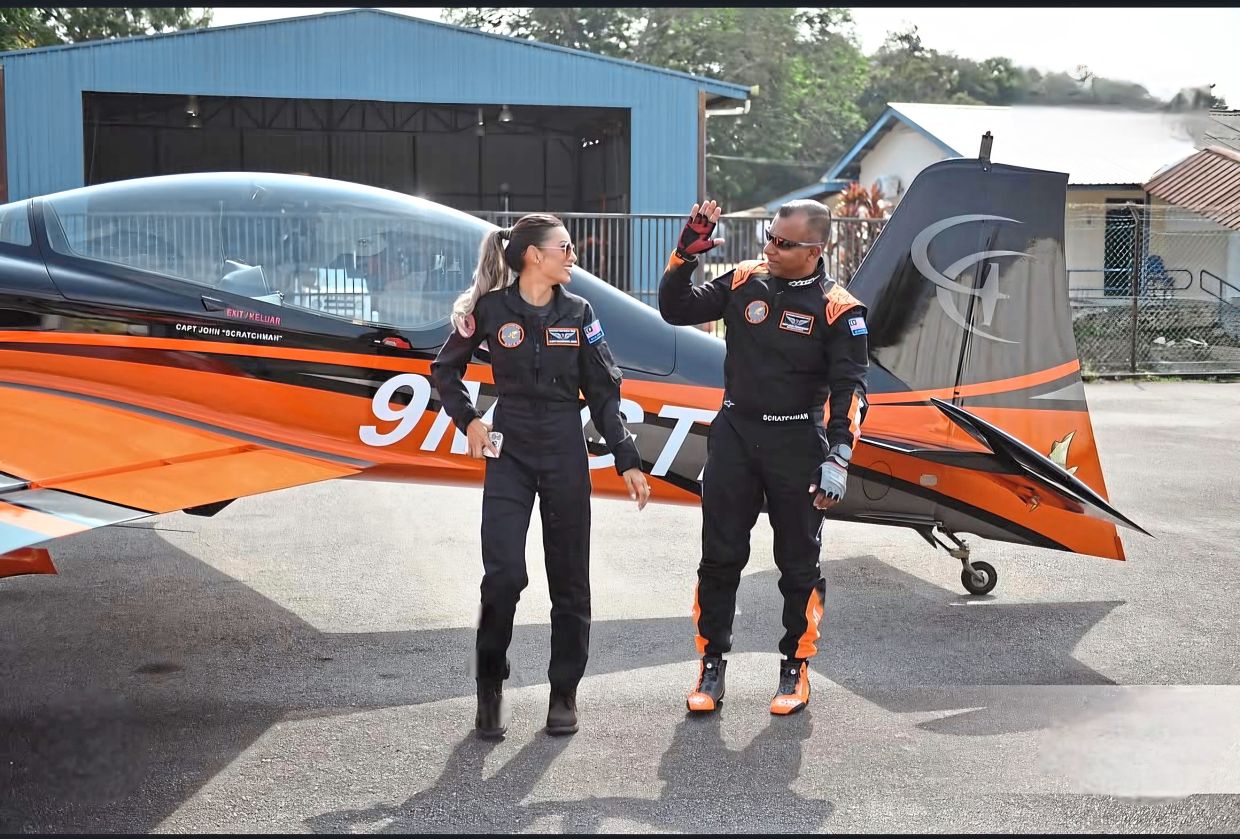
Samantha Laura John represents a growing breed of Malaysian professionals who have inherited not just their parents' ambitions but their passion for the skies. At 26, she recently completed flight school in Ipoh and earned her pilot's license in 2025, becoming part of an aviation legacy that runs deep in her family. Her father, Lieutenant-Colonel (Retired) John Sham Alagarsamy, served 26 years as a Royal Malaysian Air Force fighter pilot, instructor and examiner before transitioning to commercial aviation in 2019. Today, the pair shares more than bloodlines – they share a deep commitment to the profession that has defined their lives.
Growing up in military households across multiple Malaysian air force bases shaped Samantha's worldview from childhood. Her father's postings took the family from Labuan to Kuantan, then Alor Setar and Butterworth in Penang, exposing her to the discipline and purpose that characterizes military life. Rather than seeing these frequent relocations as destabilizing, Samantha views them as formative experiences that instilled values beyond the typical civilian upbringing. Witnessing firsthand the responsibility that RMAF pilots bear in safeguarding Malaysia's airspace and maritime borders left an indelible impression on her understanding of service and duty.
Yet Samantha's path to the cockpit was not entirely straightforward. After completing her International General Certificate of Secondary Education, she initially explored different career directions. In 2018, she enrolled in a two-year cadet pilot programme with an airline based in Sepang, Selangor, hoping to find her professional calling in aviation. Although the role proved rewarding in many respects, she discovered it did not align with her deeper aspirations. The experience, however, clarified her true passion: she wanted to be a pilot, not merely work within the aviation industry in a supporting capacity. This realization prompted her to pursue formal flight training, ultimately leading to her graduation and licensure.
Her father's philosophy on parenting and career guidance prioritizes personal autonomy while encouraging ambitious thinking. John Sham Alagarsamy has always maintained that he never forced his children to follow his example, instead offering guidance rooted in aspiration. His oft-repeated wisdom – "if they aim for the stars, at least they'd reach the sky" – reflects a parenting approach that balances support with independence. He encouraged his children to dream boldly, believing that larger ambitions naturally lead to greater achievements. This hands-off yet inspirational approach appears to have worked, as Samantha developed her passion for aviation organically rather than through parental pressure.
Beyond his military credentials, John Sham Alagarsamy has carved out a remarkable civilian aviation profile. He holds the distinction of being Malaysia's first and only civil aviator recognized by the Civil Aviation Authority of Malaysia for aerobatics expertise. Over the years, he has performed at major airshows including the Langkawi International Maritime and Aerospace Exhibition, where he has demonstrated aerobatic maneuvers in the GB1 GameBird aircraft. These performances have showcased Malaysian aviation capability on international stages and inspired younger generations interested in aviation careers. His transition from military to commercial aviation, followed by specialization in aerobatics, demonstrates the breadth of career possibilities within the aviation sector.
Interestingly, John's talents extend well beyond the aviation realm. He is also an accomplished musician and professional deejay who performs under the moniker "Scratchman." In 1992, he won the Malaysian Open DJ Competition during the vinyl and turntablism era, proving his versatility across completely different professional domains. This multifaceted career trajectory – spanning military aviation, commercial flying, aerobatics instruction, and music production – presents an unconventional model of professional development that many Malaysian parents might not typically envision for their children. Yet it demonstrates that diverse skills and passions need not compete; they can coexist and enrich one's overall contribution to society.
Although Samantha now holds a valid pilot's license, her current professional focus centers elsewhere. She is based in Kota Kinabalu, where she operates an event management company alongside her husband, David Chong, 30. Additionally, she provides vocal coaching services to clients in the region. This apparent departure from aviation does not represent abandonment of her father's world but rather a temporary navigation around life's practical demands. Samantha remains committed to eventually returning to commercial aviation as a full-time career, viewing her current pursuits as part of a longer professional arc rather than a permanent deviation.
When Samantha describes the experience of flying, her words reveal the psychological and cognitive dimensions that attract many to aviation careers. Once in the cockpit, she explains, total focus and environmental awareness become non-negotiable requirements. The pilot must simultaneously track multiple information streams – altitude, speed, navigation, weather, communications – while maintaining situational awareness in what she characterizes as "six dimensions." This meditative yet mentally demanding state appeals to her deeply, offering a form of therapeutic engagement that few other professional activities can replicate. For many pilots, this cognitive immersion represents the true draw of the profession, transcending the mechanical or technical aspects that outsiders typically associate with flying.
The broader phenomenon of children following parents into aviation is well-documented in Malaysian and regional contexts. Sisters Safia Amira Abu Bakar and Safia Anisa Abu Bakar followed their father Captain Abu Bakar Shafie into aviation careers, demonstrating that intergenerational aviation legacies are not isolated occurrences but rather part of a discernible pattern. Academic research from Universiti Teknologi Malaysia's social science journal supports these observations, with studies titled "Parental Influence and Undergraduates' Career Choice Intentions" indicating that strong parent-child relationships, effective communication, and mutual trust significantly influence career decisions. These factors encourage younger generations to explore professional pathways their parents have navigated while developing their own approaches to those careers.
Yet Samantha's relationship with her father transcends the typical parent-child dynamic, reflecting values instilled through decades of military discipline and family cohesion. When speaking about John, she exhibits not merely affection but profound respect, evident in her tone and manner. This blend of closeness and deference stems directly from her upbringing on military bases where hierarchy, discipline, and social propriety held particular significance. John himself attributes this dynamic to intentional parenting practices grounded in lived example rather than explicit instruction. He notes that children typically learn more from observing parental behavior than from heeding their words, suggesting that his own professional conduct, ethical standards, and commitment to service provided the template for Samantha's character development.
John's recognition with the Most Gallant Order of Military Service (Kesatria Angkatan Tentera) during his RMAF tenure acknowledges contributions that extended beyond routine pilot duties. Such decorations typically reward exceptional service, leadership, or sacrifice. For John, the honor represents not personal achievement alone but rather the foundation upon which his family's values rest. He views success and honor as measured by the positive impact individuals leave on others, particularly their children, who internalize values through observation and experience. This philosophy explains why Samantha's path to the cockpit feels less like career replication and more like purposeful continuation of a family mission centered on service, excellence, and dedication.
As Malaysia's aviation sector continues evolving, the growing presence of women in pilot roles – still relatively uncommon when Samantha began her journey – signals shifting professional demographics and expanding opportunities. Her generation of female pilots benefits from decades of advocacy and the examples set by earlier aviation pioneers. Yet familial encouragement remains crucial, particularly when parents model successful careers in traditionally male-dominated fields. Samantha's story thus resonates beyond her immediate family circle, offering Malaysian youth, particularly young women, a contemporary example of how parental influence, personal determination, and professional passion intersect to shape meaningful careers. Her eventual return to commercial aviation, whenever that occurs, will add another chapter to Malaysia's evolving aviation narrative and potentially inspire the next generation of pilot families.

%22%2F%3E%3C%2Fpattern%3E%3C%2Fdefs%3E%3Crect%20width%3D%22100%25%22%20height%3D%22100%25%22%20fill%3D%22url(%23ph523ndg)%22%2F%3E%3Crect%20width%3D%22100%25%22%20height%3D%22100%25%22%20fill%3D%22url(%23ph523ndp)%22%2F%3E%3Ctext%20x%3D%2250%25%22%20y%3D%2250%25%22%20text-anchor%3D%22middle%22%20dominant-baseline%3D%22central%22%20fill%3D%22rgba(255%2C255%2C255%2C0.95)%22%20font-family%3D%22Georgia%2C%20'Times%20New%20Roman'%2C%20serif%22%20font-weight%3D%22700%22%20font-size%3D%22272%22%20letter-spacing%3D%22-0.02em%22%3EAnwar%3C%2Ftext%3E%3C%2Fsvg%3E)