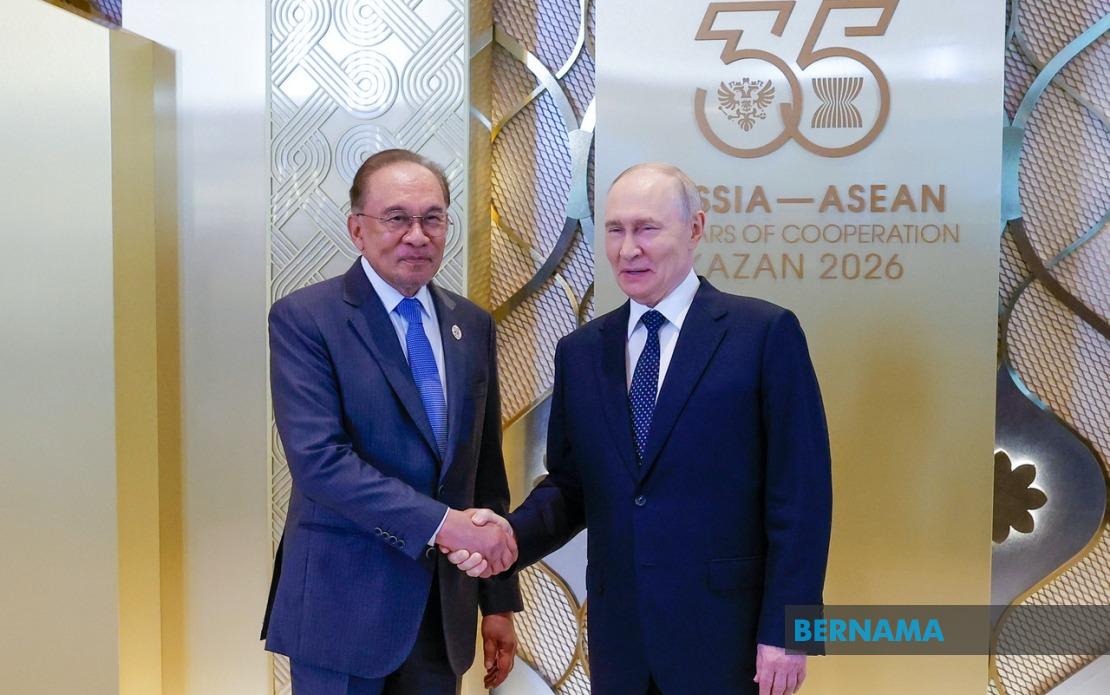
Prime Minister Datuk Seri Anwar Ibrahim has underscored the vital role that structured engagement mechanisms play in fostering diplomatic relations and trust-building among nations navigating an increasingly complex global landscape. Speaking at the ASEAN-Russia Commemorative Summit in Kazan on June 18, Anwar emphasized that in an era marked by persistent geopolitical uncertainties and multifaceted challenges, deliberate platforms for dialogue and interaction serve as indispensable channels for advancing mutual comprehension between countries. The remarks come as Malaysia and other ASEAN member states seek to deepen their engagement with Russia across multiple domains, reflecting the region's commitment to maintaining balanced and pragmatic international partnerships.
Anwar, who travelled to Kazan, the capital and largest city of Tatarstan, to represent Malaysia at the two-day summit held from June 17 to 18, articulated that such high-level gatherings transcend ceremonial significance. Beyond the formal exchanges and bilateral meetings, these summits provide substantive opportunities for national leaders to establish rapport, clarify positions on shared interests, and identify concrete areas where collaborative efforts can generate tangible benefits for all participating nations. The emphasis on mutual benefit reflects Malaysia's broader foreign policy approach of ensuring that international engagements yield positive outcomes for both parties, rather than serving narrow geopolitical agendas.
During a gala dinner hosted by President Vladimir Putin at the summit, Anwar observed that the event functioned as a meaningful venue for strengthening the bonds of friendship and facilitating candid discussions among assembled leaders. Such occasions, though often overshadowed by the formal proceedings of multilateral meetings, frequently prove instrumental in building the personal relationships and informal networks that underpin diplomatic progress. The setting and atmosphere at such gatherings can enable leaders to communicate with greater candour and develop a deeper appreciation for each other's perspectives and national priorities, elements that become increasingly important when formal negotiations prove challenging.
Anwar highlighted that the commemorative summit served a dual purpose by simultaneously celebrating Russia's considerable cultural, historical, and heritage contributions while providing a platform for substantive diplomatic engagement. This dimension is particularly relevant for Southeast Asian nations seeking to expand their understanding of Russia beyond Western-dominated narratives, as cultural and historical exchanges often precede and facilitate deeper political and economic cooperation. By acknowledging Russia's rich civilizational legacy, Anwar's remarks signal Malaysia's openness to building relationships based on mutual respect and recognition of each nation's unique position and contributions to the international community.
The timing of such engagement initiatives carries significance for Malaysia and ASEAN as a whole. As the region navigates complex relationships with major powers and confronts transnational challenges ranging from maritime security to economic cooperation, the availability of dialogue platforms becomes increasingly valuable. The ASEAN-Russia Commemorative Summit provides a structured mechanism for discussing issues of mutual concern, from trade and investment to regional security and cultural exchange, without the tensions that might characterize more adversarial bilateral relationships. For Malaysia specifically, maintaining constructive relations with Russia aligns with its non-aligned foreign policy tradition and commitment to maintaining multiple strategic partnerships.
Anwar's position as both Prime Minister and Finance Minister positions Malaysia to explore opportunities for economic cooperation with Russia, a dimension that engagement platforms can effectively facilitate. While Western sanctions have limited Russia's economic integration with global markets, ASEAN nations maintain the flexibility to pursue pragmatic commercial relationships, provided such interactions do not conflict with their own international obligations. The summit environment allows Malaysian officials to assess potential areas for trade, investment, and technology cooperation while understanding Russian perspectives on regional economic developments and global financial dynamics.
The concept of building trust through repeated engagement reflects a long-established principle in international relations that frequent interaction, when conducted in good faith, tends to reduce misunderstandings and create pathways for cooperation even among nations with divergent interests. From Malaysia's perspective, consistent engagement with Russia ensures that the country maintains open communication channels and avoids isolation or miscalculation that could arise from prolonged absence of dialogue. This approach proves particularly prudent for a Southeast Asian nation that values strategic autonomy and seeks to avoid being pressured into taking sides in great power competitions.
For ASEAN as a collective entity, the commemorative summit represents an important affirmation of the organization's commitment to inclusive regional diplomacy and its capacity to maintain relationships with multiple international partners simultaneously. ASEAN's centrality in regional affairs depends partly on its ability to engage constructively with major powers while preserving its own agenda and decision-making autonomy. Platforms such as this summit reinforce ASEAN's relevance as an interlocutor and its position as a region that cannot be taken for granted by any global power seeking influence in Southeast Asia.
The emphasis on mutual understanding in Anwar's remarks suggests an implicit recognition that sustainable international cooperation requires more than transactional exchanges or strategic calculations. It demands a genuine appreciation for differing national perspectives, historical experiences, and strategic concerns. By framing the summit through this lens, Malaysia signals its commitment to relationship-building that extends beyond immediate material benefits and acknowledges the importance of establishing foundations of respect and comprehension upon which longer-term cooperation can be constructed.
Looking ahead, the success of such engagement platforms will likely be measured not merely by immediate agreements or declarations, but by whether they facilitate incremental improvements in bilateral relations, reduce the prospect of miscalculation, and create opportunities for identifying areas of genuine convergence. For Malaysia and other ASEAN states, the ability to maintain constructive relationships with Russia while simultaneously engaging with Western nations and other regional powers will remain essential to their strategy of strategic flexibility and non-alignment in an increasingly multipolar world order.