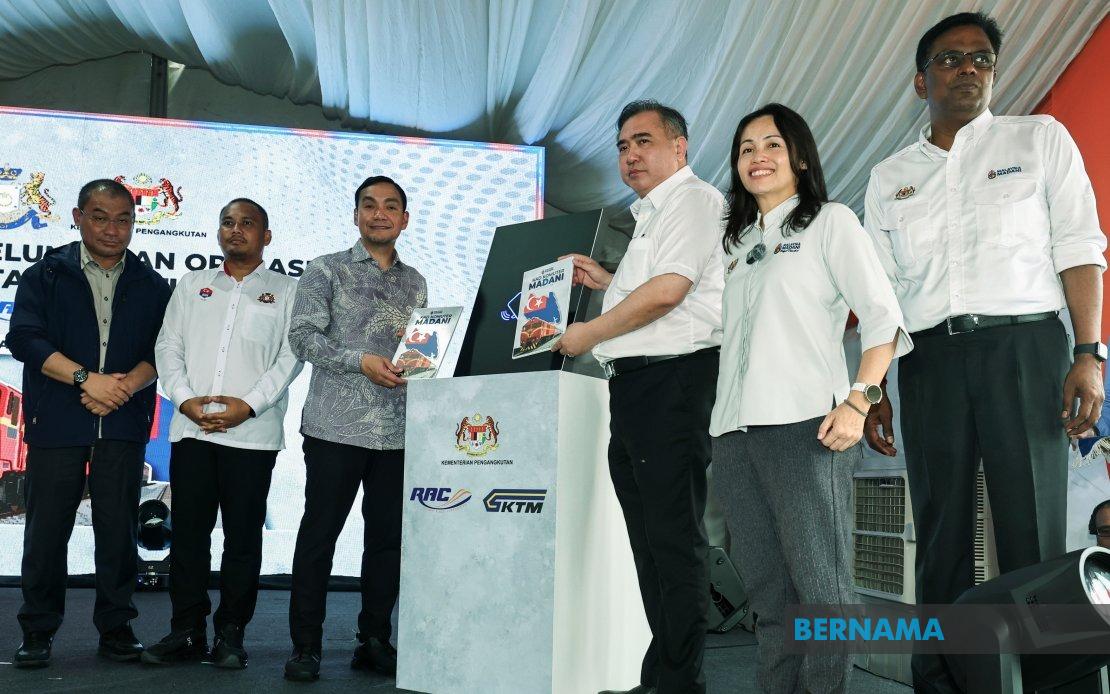
Johor Menteri Besar Datuk Seri Onn Hafiz Ghazi has called the Elevated Autonomous Rapid Transit (E-ART) project indispensable in managing traffic flows across Johor Bahru once the Johor Bahru-Singapore Rapid Transit System (RTS) Link commences service next year. Speaking during the launch of the Southern Shuttle train service at KTM Kulai Station, Onn Hafiz characterised the elevated transit system as a fundamental component of the state capital's long-term transport architecture, essential to absorbing the surge in passenger volumes that the cross-border RTS Link will generate.
The Johor leader's remarks underscore growing anxiety within government circles about the capacity of existing infrastructure to handle anticipated demand. When the RTS Link opens, substantially higher numbers of commuters will transition between public transport modes and road networks, potentially creating significant bottlenecks at key nodes such as JB Sentral. Current planning assumes the E-ART will function as a critical dispersal mechanism, channelling passengers away from congested arteries and reducing dependence on bus and private vehicle movements through the city centre.
Onn Hafiz acknowledged that interim measures currently underway—including the expansion of Park & Ride facilities and deployment of intelligent traffic management systems at JB Sentral—represent necessary but temporary responses to anticipated congestion. However, he emphasised these stopgap interventions cannot substitute for structural solutions. The short and medium-term initiatives represent transitional support while more comprehensive infrastructure development proceeds, yet their limitations become apparent when considering the sheer volume of cross-border movement the RTS Link will accommodate.
The scale of the challenge is substantial. Johor Bahru's resident population alone stands at approximately 1.8 million, a figure approaching Penang's total demographic. This burgeoning urban centre functions simultaneously as Malaysia's primary international gateway, with heavy daily cross-border traffic to Singapore amplifying pressure on local transport networks. The convergence of domestic and transnational movement patterns creates cumulative strain that conventional road-based infrastructure struggles to manage efficiently.
As a major commercial and residential hub serving cross-border workers, tourists, and traders, Johor Bahru requires transport systems that combine both capacity and connectivity. The RTS Link will concentrate thousands of additional daily passengers at specific interchange points, necessitating secondary distribution networks capable of rapidly dispersing crowds to multiple destinations across the metropolitan area. Without such systems, the efficiency gains from improved cross-border connectivity risk being negated by localised congestion and bottlenecks.
The E-ART project, conceived as an elevated automated system, offers distinct operational advantages over conventional rail or bus networks. Its dedicated right-of-way eliminates interaction with road traffic, permitting consistent service intervals and travel times regardless of external congestion. Automated operation reduces labour costs and enhances frequency, allowing deployment of smaller vehicles at closer intervals—a configuration particularly suited to dispersing passengers from concentration points rather than consolidating them on high-capacity trunk services.
Onn Hafiz framed federal commitment to the E-ART as essential political intervention with tangible public benefit. He argued that project delivery would constitute meaningful federal government action directly improving daily life for Johor residents, particularly through congestion reduction and enhanced mobility choices. This framing reflects heightened awareness among state leadership that infrastructure competence increasingly shapes public perceptions of governmental effectiveness at both state and federal levels.
The arrival of Transport Minister Anthony Loke and Deputy Communications Minister Teo Nie Ching (Kulai MP) at the Southern Shuttle launch signals federal-level attention to Johor's transport agenda. Their presence acknowledges the strategic importance of coordinating cross-border connectivity with domestic urban mobility systems. The government appears committed to sequencing these infrastructure investments coherently, recognising that the RTS Link's benefits could be substantially compromised by inadequate local distribution capacity.
For Malaysian observers, the E-ART project represents a test case of whether the country can implement innovative transit solutions at scale. Elevated autonomous systems remain relatively uncommon in Southeast Asian cities, and successful deployment in Johor Bahru could establish a model for other metropolitan areas grappling with congestion. The project's advancement also signals federal determination to strengthen Johor's position as a regional economic engine, with modern transport infrastructure serving as competitive advantage.
The timing proves critical. The RTS Link is already substantially advanced in construction, with operations commencing within months. Any delays in E-ART project commencement risk creating a period of acute congestion once cross-border ridership activates, before dispersal capacity becomes available. Onn Hafiz's public emphasis on project urgency reflects internal government concern about this implementation sequence—the existing gap between RTS Link launch readiness and E-ART preparedness.
Successful delivery requires sustained federal budget allocation, procurement of specialised technology, and coordination across multiple government agencies. The project's scale and innovation profile make it vulnerable to the typical delays affecting major infrastructure initiatives in Malaysia. Onn Hafiz's public advocacy effectively pressures federal authorities to maintain momentum and avoid deferral, embedding the project within political discourse where delivery becomes a measure of governmental credibility.
The broader context reveals deepening recognition among Malaysian policymakers that cross-border integration requires simultaneous attention to domestic transport systems. Isolated focus on the RTS Link itself, without complementary urban mobility improvements, produces suboptimal returns on investment. The E-ART project represents this systems-level thinking, acknowledging that seamless cross-border movement depends on coherent metropolitan transport networks extending well beyond the border crossing point itself.