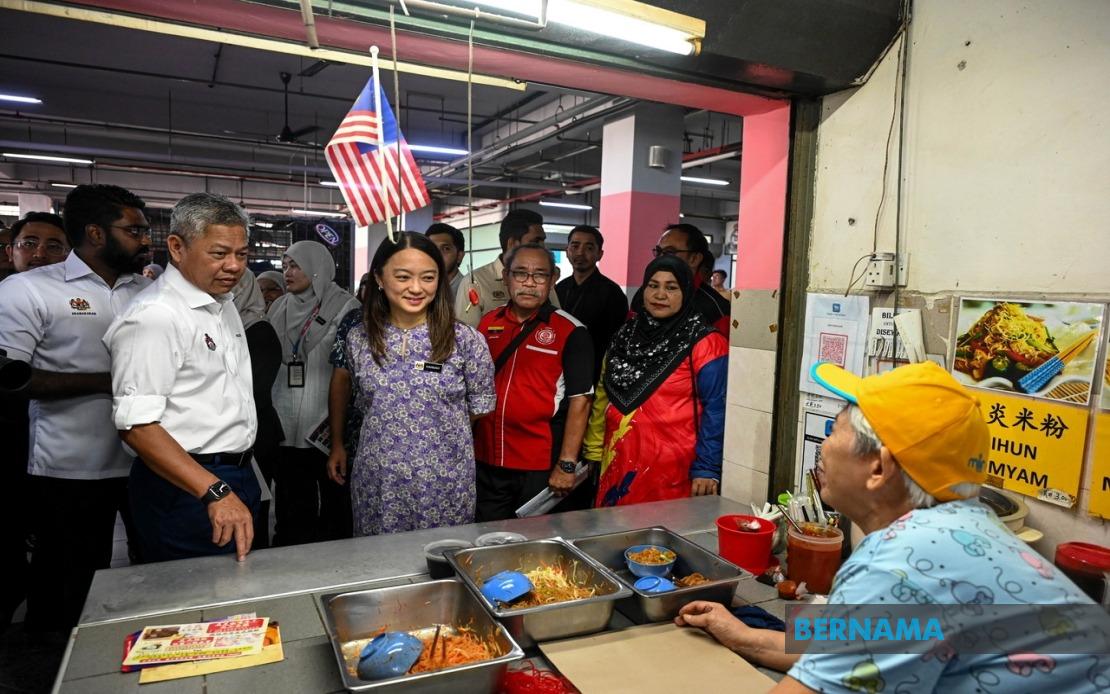
Kuala Lumpur City Hall has committed RM200 million to a comprehensive modernisation programme spanning 287 hawker sites throughout the capital, marking one of the most ambitious interventions in the city's informal food trading sector. The Lestari Niaga @ Kuala Lumpur 2026 initiative represents a coordinated effort to upgrade existing facilities while addressing long-standing concerns about infrastructure, safety, and trader livelihoods across the sprawling network of wet markets, street food stalls, and hawker centres that form the backbone of Kuala Lumpur's culinary economy.
The scale of this undertaking is substantial, touching the lives of more than 11,000 individual traders and business owners who depend on these sites for their income. Minister in the Prime Minister's Department (Federal Territories) Hannah Yeoh framed the initiative as a balanced approach designed to create safer, better-organised trading environments while respecting the diverse interests of multiple stakeholder groups. Her comments, delivered during an inspection of recent upgrades near UTC Sentul, acknowledge a persistent tension in urban hawker management: the need to modernise informal trading zones without displacing the vendors who operate within them or alienating residents who may view informal markets as sources of congestion or nuisance.
The governance structure behind Lestari Niaga reflects lessons learned from previous hawker relocation and upgrade projects that occasionally sparked public backlash. Hannah Yeoh explicitly highlighted DBKL's commitment to consulting with residents, traders, and building tenants before finalising relocation and redevelopment strategies. This stakeholder engagement model suggests recognition that top-down planning often fails in informal economies, where trust and local buy-in are essential for success. The emphasis on fairness and balanced consideration of competing interests signals an attempt to move beyond purely administrative solutions towards more inclusive decision-making.
A concrete example of this approach is evident in the UTC Sentul project, which launched on June 15 and has attracted significant public attention. The RM1.6 million upgrade will replace 20 existing structures with modern modular kiosks, with completion targeted for October—a compressed three-month timeline that reflects DBKL's determination to minimise disruption. Rather than creating costly temporary trading sites with poor foot traffic, Kuala Lumpur Mayor Datuk Seri Fadlun Mak Ujud introduced a novel financial support mechanism: traders affected during the construction period will receive RM1,500 in monthly assistance. This direct cash support model represents a pragmatic recognition that displaced vendors face real financial hardship, and that subsidising temporary relocation is economically inefficient compared to direct income replacement.
The rollout strategy articulated by Fadlun indicates that UTC Sentul is merely the opening phase of a much broader campaign. Similar projects will expand to Jalan Dato Senu, Pudu Ulu, and Bandar Tun Razak, each accompanied by the same financial assistance provision. This territorial expansion suggests that DBKL has adopted a deliberate, phased approach to managing risk and ensuring quality implementation rather than attempting citywide transformation simultaneously. The coordination of multiple simultaneous projects with consistent support mechanisms also demonstrates enhanced capacity and commitment compared to ad-hoc improvements of previous years.
Among the 287 targeted sites, implementation will prioritise 224 locations during the initial phase, encompassing diverse hawker typologies reflective of Kuala Lumpur's complex informal trading landscape. The breakdown reveals important structural variations: approximately 4,000 are street hawkers operating without permanent structures, around 5,000 run businesses from sites under municipal ownership, and roughly 1,000 are classified as reapplication traders—individuals previously displaced or operating irregularly. This segmentation matters because each category presents distinct regulatory and support challenges. Street hawkers require space allocation and basic infrastructure; municipal site operators may need facility upgrades; reapplication traders often face documentation or compliance barriers that demand individualised intervention.
The financial commitment of RM200 million, when distributed across 287 sites and 11,000 traders, yields an average investment of roughly RM695,000 per site or RM18,200 per trader. While substantial in aggregate, these unit figures suggest that improvements will be targeted and phased rather than uniformly lavish. Modern modular kiosks like those at UTC Sentul—simple standardised structures designed for easy assembly and maintenance—likely represent the template for most upgrades. Such approaches are cost-effective and replicable, enabling DBKL to maximise impact within budgetary constraints without sacrificing quality or functionality.
For Malaysian business observers, the Lestari Niaga initiative carries broader implications for informal economy policy. Kuala Lumpur's approach differs markedly from aggressive displacement strategies employed in some regional cities, instead attempting to formalise and upgrade informal trading in place. This reflects evolving recognition that street food and hawker economies generate substantial economic value—through employment, tax contributions, and consumer spending—and that their elimination is neither feasible nor desirable. The programme also addresses a persistent policy gap: while Malaysia's development frameworks emphasise formalisation and economic upgrading, support mechanisms for informal traders have historically been underfunded or fragmented.
The inclusion of trader voices in planning decisions also signals movement towards more inclusive urban governance. Hawkers, whose political voice has historically been diffuse and weak, typically respond to infrastructure decisions rather than shaping them. DBKL's structured engagement sessions represent an attempt to reverse this dynamic, treating traders as stakeholders whose preferences matter rather than obstacles to be managed. Success depends on whether these consultation processes produce genuine shifts in planning outcomes or function primarily as legitimising exercises that precede pre-determined decisions. Early indicators from UTC Sentul—where the project evolved based on stakeholder feedback—suggest genuine responsiveness, though sustained evidence across 287 sites will ultimately determine whether the participatory model is substantive or performative.
The timing and targets also deserve analysis. The 2026 completion deadline provides a realistic implementation window that acknowledges the complexities of coordinating work across hundreds of dispersed sites. The concentration of immediate effort on 224 of 287 sites, rather than all locations simultaneously, reflects sensible project management that prioritises early completion of demonstration projects. Successful early phases will generate momentum, establish standardised approaches, and provide proof of concept that can justify continued investment.
From a Malaysian perspective, the Lestari Niaga initiative matters because Kuala Lumpur's informal trading sector serves not only local consumers but attracts domestic tourists and international visitors. The state of hawker markets directly influences urban livability perceptions and tourism competitiveness. Modernisation that maintains cultural authenticity while improving hygiene, safety, and accessibility can enhance the city's attractiveness. The programme also demonstrates that urban governance need not choose between formalisation and displacement; instead, strategic upgrading can improve conditions for both traders and residents, generating economic and social returns that justify the investment.
However, success will ultimately hinge on execution quality and trader adoption. Past initiatives have faltered when upgraded facilities proved poorly designed for actual trading patterns, when relocation disrupted established customer relationships, or when modernisation introduced cost structures unaffordable for marginal vendors. DBKL's emphasis on consultation and financial support during transition periods suggests awareness of these risks. Whether the initiative delivers on its inclusive and participatory rhetoric will determine whether Lestari Niaga becomes a model for other Malaysian cities or merely another well-intentioned programme with mixed results.

%22%2F%3E%3C%2Fpattern%3E%3C%2Fdefs%3E%3Crect%20width%3D%22100%25%22%20height%3D%22100%25%22%20fill%3D%22url(%23ph523ndg)%22%2F%3E%3Crect%20width%3D%22100%25%22%20height%3D%22100%25%22%20fill%3D%22url(%23ph523ndp)%22%2F%3E%3Ctext%20x%3D%2250%25%22%20y%3D%2250%25%22%20text-anchor%3D%22middle%22%20dominant-baseline%3D%22central%22%20fill%3D%22rgba(255%2C255%2C255%2C0.95)%22%20font-family%3D%22Georgia%2C%20'Times%20New%20Roman'%2C%20serif%22%20font-weight%3D%22700%22%20font-size%3D%22272%22%20letter-spacing%3D%22-0.02em%22%3EAnwar%3C%2Ftext%3E%3C%2Fsvg%3E)