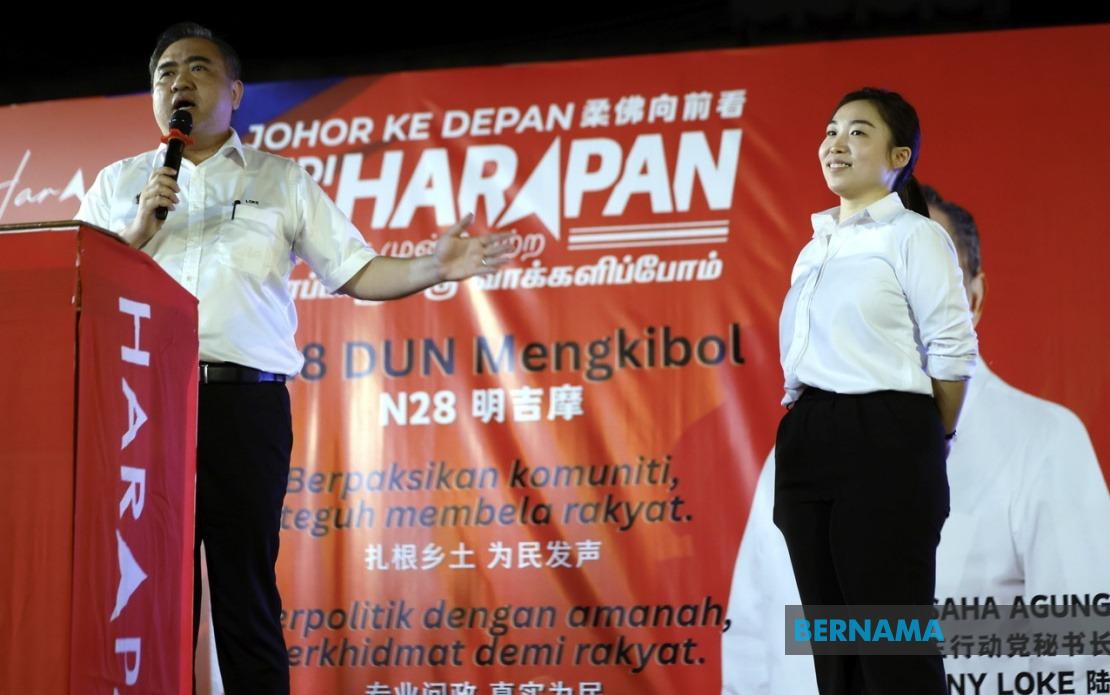
The Democratic Action Party made a significant leadership transition in Johor on June 18, announcing that 33-year-old lawyer Chu Poh Yee will contest the Mengkibol state assembly seat in the forthcoming state election. The candidacy represents a generational shift in the constituency, which has been held by the same assemblyman for two consecutive terms. Party secretary-general Anthony Loke unveiled Chu at a ceremony in Kluang, signalling DAP's commitment to injecting fresh perspectives into its state electoral lineup.
The selection paves the way for incumbent assemblyman Chew Chong Sin to step aside from the state seat and pursue a higher position within the party's broader political strategy. Loke outlined that Chew, having successfully represented Mengkibol for two terms, possesses the credentials and experience necessary to transition into federal politics. The party has identified him as a suitable candidate for the Labis parliamentary constituency, which will become vacant after sitting MP Pang Hok Liong indicated his intention not to contest in the next General Election. This succession plan demonstrates how DAP is attempting to leverage its existing talent pool across different electoral tiers.
Chu's appointment marks a deliberate effort by DAP to advance female representation within its political establishment. Her background as a legal professional brings specialised expertise to the assembly, particularly in areas where her previous work with elected representatives on legal aid matters has proven valuable. According to Loke, the party's leadership unanimously endorsed her candidacy, reflecting broad internal consensus rather than a contested or controversial choice. This unanimity suggests strong confidence in her suitability for the role despite her relative newness to electoral politics.
The young lawyer brings several attributes that party officials believe will resonate with voters in Mengkibol. Loke emphasised her educational achievements and linguistic capabilities, factors that increasingly matter to Malaysian constituencies seeking representatives who can navigate both local concerns and broader policy discussions. Her existing connections to the Mengkibol area, built through her professional interactions with the constituency's representatives, provide her with pre-existing relationships that could facilitate her campaign. These personal ties contrast with parachuted candidates who often face initial scepticism from local voters unfamiliar with their track records or commitment to the area.
Chu's candidacy reflects broader patterns within Pakatan Harapan, the ruling coalition to which DAP belongs, regarding gender representation in state elections. While Malaysian politics has traditionally been male-dominated, opposition and some ruling coalition parties have increasingly recognised that female candidates can expand their electoral reach and appeal to younger, more progressive voters. By explicitly framing Chu's selection as aligned with the party's aspiration to create greater opportunities for women in politics, DAP is attempting to communicate progressive values to its base while addressing criticisms about underrepresentation in candidate slates.
DAP's slate for the Johor election reflects a careful allocation of seats across different strategic categories. The party has finalised its list for 17 state constituencies it intends to contest, comprising three distinct groups. Ten of these seats are currently held by DAP, meaning the party is seeking to defend existing ground, a crucial task in any state election where incumbent parties face anti-incumbent sentiment. Four additional seats represent territory previously lost by DAP that the party believes it can recapture, suggesting confidence in improved electoral conditions or candidate quality in those areas. The remaining three seats represent expansion into new ground, where DAP sees opportunities to grow its footprint within the state.
The staggered announcement schedule for DAP candidates will unfold over several days, creating ongoing media attention for the party during the critical pre-election period. Four more candidates will be named on Saturday for the seats of Tiram, Johor Jaya, Senai and Bukit Permai, each representing different strategic priorities within DAP's electoral calculus. The final tranche of DAP candidates will be revealed alongside the broader Pakatan Harapan slate, announced by the Prime Minister on Monday. This coordinated rollout suggests careful synchronisation between DAP's state-level campaign preparation and the coalition's national leadership, ensuring that all component parties remain aligned in messaging and strategy.
For Malaysian observers monitoring opposition party dynamics, Chu's nomination signals DAP's intention to present itself as a modernising force capable of attracting professional talent into electoral politics. The transition from Chew to Chu also demonstrates how established politicians can be repositioned to pursue different electoral opportunities rather than simply retiring from public life. This flexibility in deployment allows parties to maximise the utility of experienced figures while simultaneously creating openings for new candidates. In the context of Johor politics, where DAP has significant presence and influence within the urban and semi-urban areas, maintaining and growing this representation remains strategically vital.
The Mengkibol seat holds particular importance within Johor's broader political geography. As a state constituency, it represents the foundation upon which the Labis parliamentary seat depends, making effective state-level representation crucial for maintaining Pakatan Harapan's broader political infrastructure in the region. Chu's success or failure in Mengkibol will provide important signals about voter appetite for DAP's political direction and candidate strategy. Her performance will also influence how the party calibrates future selections of young professionals as electoral candidates, potentially encouraging or discouraging similar moves in other constituencies.
The announcement also reflects changing demographics and generational politics within Malaysian electorates. Voters in Mengkibol, particularly younger age groups and more educated segments of the population, may view Chu's professional credentials and modern background as appealing alternatives to more traditional political figures. Her multilingual abilities and legal expertise position her to engage with the constituency's increasingly diverse and cosmopolitan population. Whether voters ultimately reward these attributes will depend on how effectively Chu and the broader DAP machinery convert her candidacy into sustained engagement with constituents around bread-and-butter issues affecting their daily lives.

%22%2F%3E%3C%2Fpattern%3E%3C%2Fdefs%3E%3Crect%20width%3D%22100%25%22%20height%3D%22100%25%22%20fill%3D%22url(%23ph523ndg)%22%2F%3E%3Crect%20width%3D%22100%25%22%20height%3D%22100%25%22%20fill%3D%22url(%23ph523ndp)%22%2F%3E%3Ctext%20x%3D%2250%25%22%20y%3D%2250%25%22%20text-anchor%3D%22middle%22%20dominant-baseline%3D%22central%22%20fill%3D%22rgba(255%2C255%2C255%2C0.95)%22%20font-family%3D%22Georgia%2C%20'Times%20New%20Roman'%2C%20serif%22%20font-weight%3D%22700%22%20font-size%3D%22272%22%20letter-spacing%3D%22-0.02em%22%3EAnwar%3C%2Ftext%3E%3C%2Fsvg%3E)