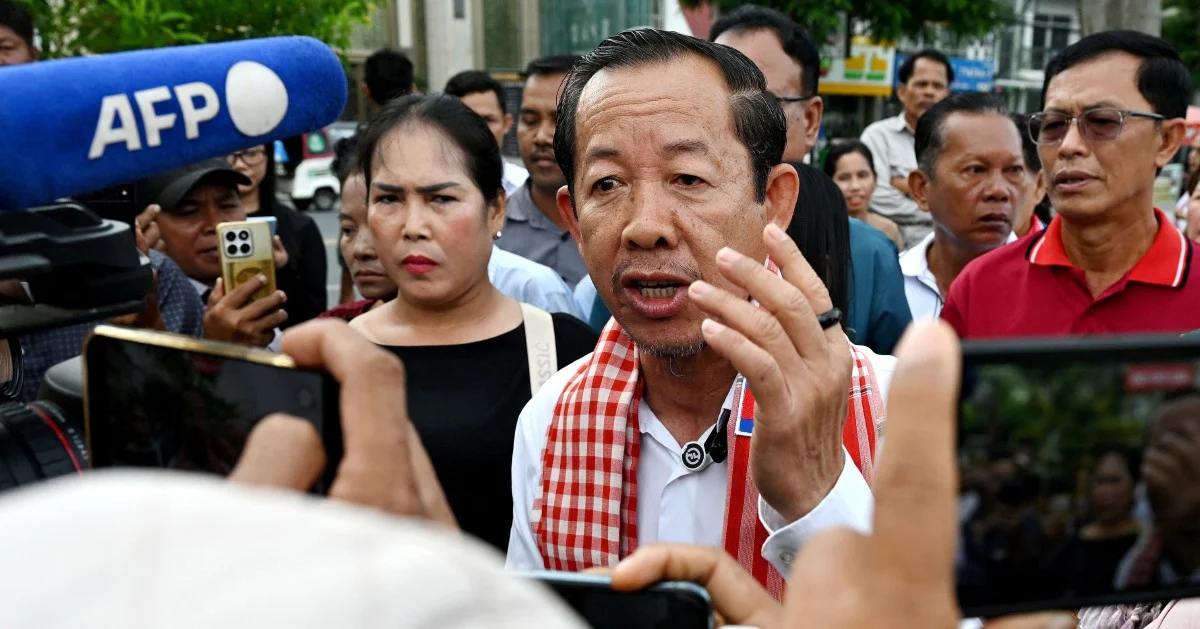
Cambodia's Supreme Court delivered a mixed ruling on Friday regarding opposition leader Rong Chhun, suspending an imposed prison sentence while simultaneously maintaining a prohibition on his participation in electoral processes. The decision, confirmed through his legal representative, reflects the country's ongoing complex relationship with political opposition and judicial procedures.
Rong Chhun, a prominent figure within Cambodia's fractured opposition landscape, has faced multiple legal challenges in recent years that have significantly constrained his political activities. The suspension of his prison sentence represents a partial concession from the judiciary, yet the preservation of the election ban underscores the substantive limitations remaining on his capacity to engage in formal democratic processes. This bifurcated outcome reveals the intricate balance Cambodia's courts attempt to strike between appearing to moderate enforcement and maintaining institutional controls over political competition.
The election ban carries particularly significant implications for Rong Chhun's future political viability. Regardless of whether he avoids incarceration, the prohibition on running for office effectively removes him from direct electoral competition, a restriction that effectively sidelelines opposition voices during crucial political moments. For regional observers and democracy advocates, such rulings demonstrate how judicial mechanisms can achieve political outcomes without resorting to explicit imprisonment, using electoral disqualifications as alternative instruments of political constraint.
Cambodia's opposition landscape has contracted substantially over the past decade, with several parties dissolved, leaders imprisoned, or stripped of political rights. Rong Chhun's situation exemplifies this broader pattern of legal measures directed against opposition figures, regardless of the specific charges levied against them. The combination of criminal prosecutions, disqualifications, and party dissolutions has fundamentally altered the country's electoral dynamics, reducing meaningful political competition and creating a political environment where the ruling Cambodian People's Party operates with limited institutional challenge.
The decision reflects deeper tensions within Cambodia's judicial system regarding the separation of powers and judicial independence. International observers have repeatedly raised concerns about whether courts function as autonomous institutions or as instruments aligned with executive preferences. The selective application of sentence suspension alongside election ban maintenance raises questions about the consistency and principle-based reasoning underpinning judicial decisions, particularly when opposition figures remain subject to restrictions while other political actors enjoy comparative freedom.
For Malaysia and the broader Southeast Asian region, Cambodia's treatment of opposition figures offers cautionary context regarding democratic deterioration. The systematic use of legal and electoral mechanisms to marginalise opposition voices represents a sophisticated approach to political control that circumvents the crude repression more associated with earlier authoritarian periods. Instead, legal procedures and judicial rulings provide veneer of procedural legitimacy while achieving substantive political exclusion, a distinction important for understanding contemporary Southeast Asian political dynamics.
Rong Chhun's legal circumstances also illuminate the vulnerability of individual opposition leaders in environments where institutional protections remain weak. Without robust separation of powers, independent media, or strong civil society oversight, opposition figures depend largely on international attention and advocacy networks for protection. The Supreme Court's decision, while reducing immediate imprisonment risk, solidifies longer-term political incapacity that international pressure may struggle to reverse, given the technical legality of election bans and the difficulty of definitively proving political motivation behind such restrictions.
The ruling arrives amid broader international scrutiny of Cambodia's political trajectory. The country's 2023 elections, though contested by various observers regarding competitiveness, occurred under conditions where multiple opposition parties faced institutional obstacles and key figures remained under legal restrictions. Subsequent developments, including the current Supreme Court decision, continue this pattern of constraining opposition participation through judicial mechanisms rather than through explicit party dissolution or leadership imprisonment.
For Cambodia's international standing, such decisions contribute to perceptions of democratic backsliding that influence diplomatic relationships, investment decisions, and development assistance. Countries and multilateral organisations that prioritise democratic governance standards have incrementally adjusted their engagement with Cambodia based partly on judicial and electoral developments. The Supreme Court's handling of Rong Chhun's case, whether framed as measured judicial independence or politically-influenced constraint, will influence external assessments of Cambodia's institutional health and democratic trajectory.
Looking forward, the fate of Cambodia's opposition under the current institutional framework remains precarious. As opposition leaders face successive legal challenges, electoral disqualifications, and party restrictions, the cumulative effect narrows the space for legal political participation outside the ruling party structure. For democracy advocates within Cambodia and international observers, such developments underscore the necessity of institutional reforms addressing judicial independence, electoral fairness, and opposition party protection—reforms that remain distant prospects under current political conditions.
The Supreme Court's decision ultimately exemplifies how contemporary Southeast Asian politics operate increasingly through ostensibly neutral legal and technical mechanisms rather than through explicit authoritarian prohibition. This shift presents particular challenges for democracy advocates and international monitors seeking to identify and address democratic erosion, as the institutional appearance of legitimacy complicates straightforward categorisation of political suppression.

%22%2F%3E%3C%2Fpattern%3E%3C%2Fdefs%3E%3Crect%20width%3D%22100%25%22%20height%3D%22100%25%22%20fill%3D%22url(%23ph523ndg)%22%2F%3E%3Crect%20width%3D%22100%25%22%20height%3D%22100%25%22%20fill%3D%22url(%23ph523ndp)%22%2F%3E%3Ctext%20x%3D%2250%25%22%20y%3D%2250%25%22%20text-anchor%3D%22middle%22%20dominant-baseline%3D%22central%22%20fill%3D%22rgba(255%2C255%2C255%2C0.95)%22%20font-family%3D%22Georgia%2C%20'Times%20New%20Roman'%2C%20serif%22%20font-weight%3D%22700%22%20font-size%3D%22272%22%20letter-spacing%3D%22-0.02em%22%3EAnwar%3C%2Ftext%3E%3C%2Fsvg%3E)