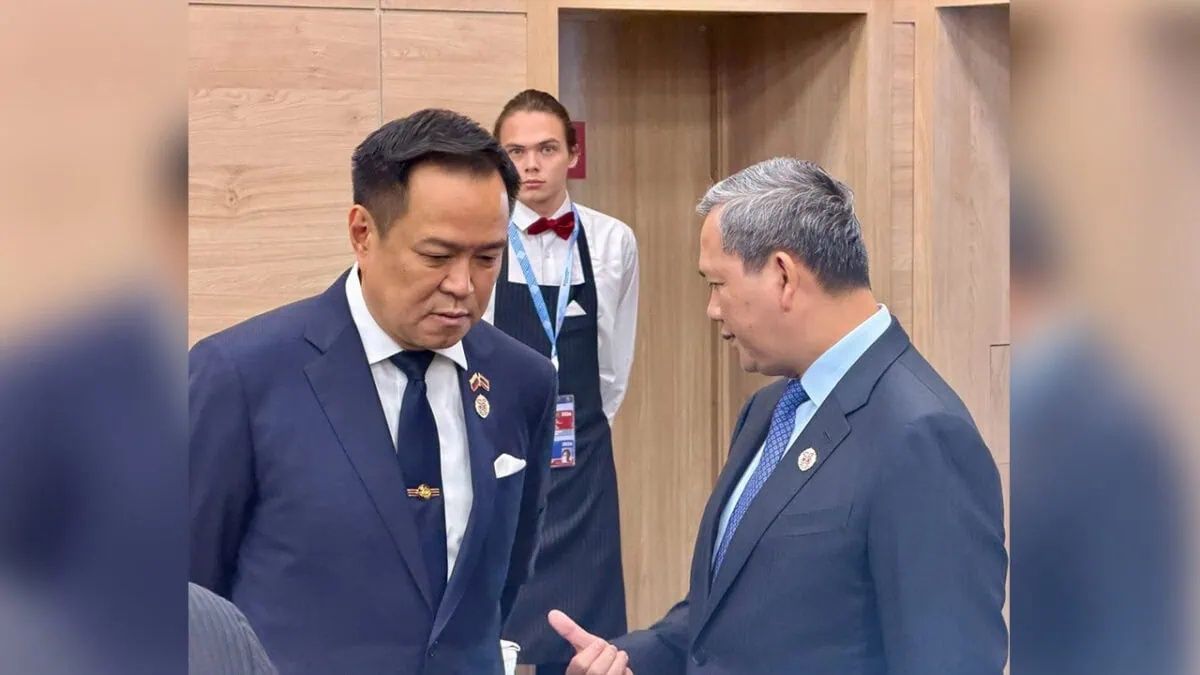
Cambodian Prime Minister Hun Manet has urged Thailand to appoint a chief for its Joint Boundary Commission and accelerate long-overdue boundary survey and demarcation work, reaffirming Phnom Penh's preference for resolving territorial differences through peaceful means and international law. The call came during an informal encounter between Manet and Thai Prime Minister Anutin Charnvirakul at an Asean-Russia engagement in Kazan, Russia, with both leaders subsequently confirming the substance of their brief exchange to domestic audiences.
Manet's public statement, released through social media on Friday, emphasised Cambodia's unwavering commitment to addressing border tensions with Thailand via established legal frameworks. Rather than adopting confrontational rhetoric, the Cambodian leader framed the discussion as a continuation of ongoing efforts to operationalise existing agreements and mechanisms that both countries have already endorsed. This measured approach reflects a strategic effort to maintain momentum on border issues without allowing disputes to escalate into broader diplomatic friction during a period of regional sensitivity.
The Cambodian premier specifically referenced the compulsory conciliation process under the UN Convention on the Law of the Sea, which both nations are already engaged in regarding maritime boundary questions. For terrestrial disputes, Manet indicated a clear preference for bilateral negotiations conducted through the Joint Boundary Commission, citing existing bilateral agreements as the appropriate framework. However, his call for Thailand to appoint its JBC chief revealed an underlying frustration with the pace of progress, suggesting that procedural gaps on the Thai side may be impeding substantive negotiations.
Manet's statement explicitly cited Point Three of a joint statement signed on 27 December 2025, indicating that both governments had previously agreed on the necessity for survey and demarcation work to proceed. By publicly invoking this earlier accord, Cambodia was essentially holding Thailand accountable to its own commitments, a diplomatic technique that creates pressure while maintaining a veneer of cooperation. The reference to specific dates and documents underscores that these are not abstract disputes but rather concrete matters governed by documented agreements that remain unimplemented.
Thailand's account of the Kazan encounter, provided by Anutin to Thai media, aligned substantially with Cambodia's version while offering its own interpretative emphasis. Anutin characterised the meeting as an extremely brief, opportunistic conversation—described colourfully as "pulling each other aside by the elbow"—rather than a formal, scheduled discussion. This framing served multiple purposes for Bangkok: it suggested that border issues were not dominating Thai foreign policy priorities at the highest levels, while simultaneously confirming that both sides remained engaged on the matter.
Anutin's reaffirmation that Thailand remains committed to international and bilateral frameworks, including UNCLOS, the JBC, and the General Border Committee, provided reassurance to regional observers that Bangkok is not abandoning diplomatic channels. His statement that "neither side wants conflict" functioned as an explicit commitment to avoid military or coercive approaches, a message particularly important given regional anxieties about border stability. Thailand's emphasis on closely monitoring the border situation suggested that Bangkok views its role as one of cautious observation rather than aggressive action.
A notable element of Anutin's remarks was his dismissive response when asked about discussions regarding reopening border checkpoints. His comment that he deliberately avoided raising this issue because "Thai people would be furious" revealed important domestic political considerations shaping Thailand's border policy. This candid acknowledgment suggests that reopening land crossings remains politically contentious within Thailand, with significant public constituencies opposing such measures. The implication is that border management in the region cannot be divorced from domestic political pressures within each country.
The contrasting emphases in the two leaders' public statements, despite the fundamental convergence on facts, illustrated how border diplomacy operates in Southeast Asia. Both Cambodia and Thailand publicly claimed commitment to peaceful resolution, yet each framed the narrative slightly differently to serve domestic audiences and regional partners. Cambodia stressed Thai responsibility for implementing agreed mechanisms, while Thailand emphasised the informality of the exchange and the absence of major new developments—a rhetorical strategy that prevents the encounter from being misinterpreted as a significant escalation or breakthrough.
Cambodia's dual-track approach to border disputes reveals sophisticated diplomatic positioning. By pursuing compulsory conciliation under UNCLOS for maritime disagreements while simultaneously pushing for bilateral JBC negotiations on terrestrial boundaries, Phnom Penh has diversified its dispute resolution strategy. This hedging approach ensures that progress can potentially occur on multiple fronts, reducing dependence on any single mechanism while maintaining options should bilateral talks stall.
The Kazan exchange carries broader significance for regional stability. Border tensions between Cambodia and Thailand periodically flare into public disputes that can distract both governments from other priorities and create opportunities for third parties to exploit rifts within Asean. By maintaining visible commitment to diplomatic processes, despite slow tangible progress, both nations are signalling to the region that they prefer managed disagreement to confrontation. For Malaysia and other Southeast Asian countries, the Cambodia-Thailand border situation represents a test case for how the region handles territorial disputes in an era when military solutions are increasingly delegitimised.
The persistent lack of a Thai JBC chief appointment, highlighted by Manet's intervention, suggests that bureaucratic delays or domestic political considerations may be preventing progress that both governments theoretically support. Cambodia's public pressure on this specific procedural matter may function as a diplomatic nudge intended to unblock implementation, tacitly acknowledging that the core disagreement may be less about principles than about practical constraints or shifting priorities within the Thai government. Whether this intervention proves effective remains to be seen, but the emphasis on concrete implementation steps rather than grand diplomatic gestures indicates that both leaders recognise the need for tangible progress.
For Malaysian observers, the Cambodia-Thailand dynamic offers instructive lessons about managing border disputes in a multipolar Southeast Asia. The sustained commitment to legal frameworks, even when progress appears glacial, provides a model for peaceful dispute resolution that contrasts with more confrontational approaches seen elsewhere globally. The willingness of both Cambodian and Thai leaders to publicly acknowledge their preference for dialogue, despite legitimate territorial disagreements, reflects a regional norm—however imperfectly observed—that interstate conflicts should be managed through established mechanisms rather than through force or aggressive posturing.

%22%2F%3E%3C%2Fpattern%3E%3C%2Fdefs%3E%3Crect%20width%3D%22100%25%22%20height%3D%22100%25%22%20fill%3D%22url(%23ph523ndg)%22%2F%3E%3Crect%20width%3D%22100%25%22%20height%3D%22100%25%22%20fill%3D%22url(%23ph523ndp)%22%2F%3E%3Ctext%20x%3D%2250%25%22%20y%3D%2250%25%22%20text-anchor%3D%22middle%22%20dominant-baseline%3D%22central%22%20fill%3D%22rgba(255%2C255%2C255%2C0.95)%22%20font-family%3D%22Georgia%2C%20'Times%20New%20Roman'%2C%20serif%22%20font-weight%3D%22700%22%20font-size%3D%22272%22%20letter-spacing%3D%22-0.02em%22%3EAnwar%3C%2Ftext%3E%3C%2Fsvg%3E)